Table of Contents
How to Start a Real Money Gaming Business in 2026: Complete Guide
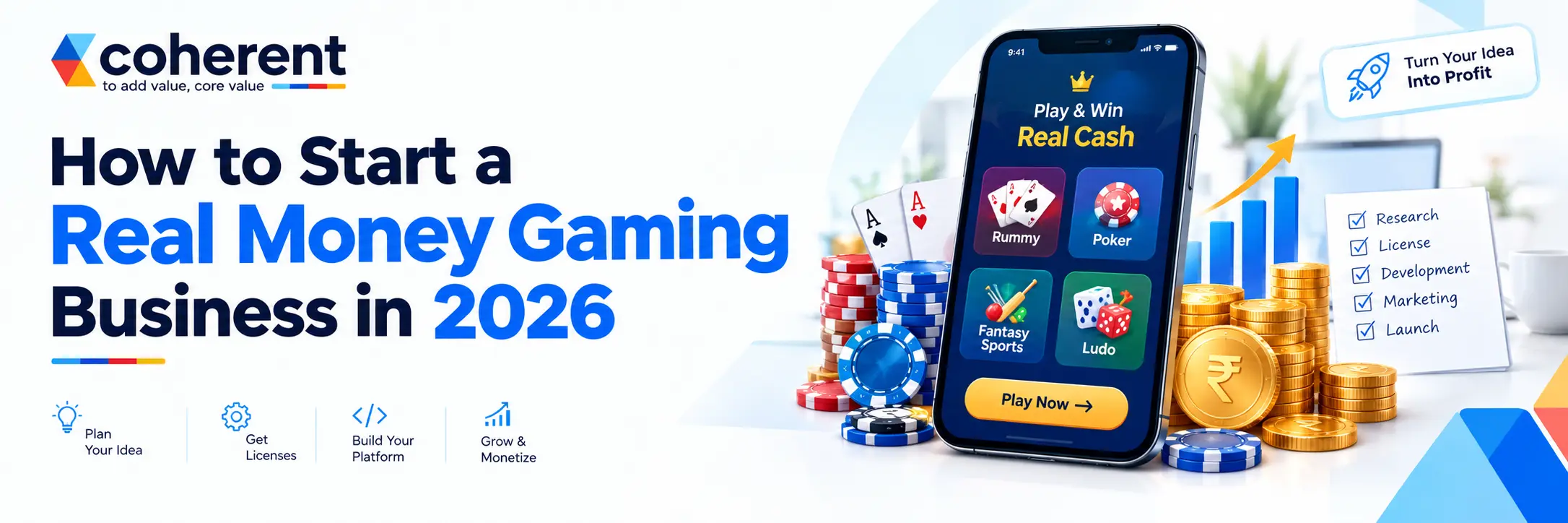
Starting a real money gaming business in 2026 requires much more than building a gaming app and adding a payment gateway. The industry sits at the intersection of gaming technology, payments, cybersecurity, identity verification, responsible gaming, taxation, advertising, and complex regulation.Most importantly, the legal position depends heavily on the country and jurisdiction in which you operate.
For India specifically, the regulatory environment changed significantly with the Promotion and Regulation of Online Gaming Act, 2025 (PROG Act). The Act prohibits online money games and related offering, operation, facilitation, advertising, promotion, and participation. MeitY also published implementing rules and related notifications in 2026. So, before investing in a real money gaming platform, founders need to determine whether their proposed business model is legally permissible in their target market.
What Is a Real Money Gaming Business?
A real money gaming business operates digital games or platforms where users may participe using money or receive monetary rewards, subject to the laws of the target jurisdiction. These businesses can include fantasy sports, poker, rummy, casino-style games, tournaments, or other regulated gaming formats. A successful RMG platform typically combines gaming technology, secure transactions, identity verification, fraud prevention, user protection, and regulatory compliance. Businesses exploring fantasy gaming concepts can also refer to Fantasy Sports App Like Dream11.
- Fantasy sports platforms
- Poker platforms
- Rummy platforms
- Online casino-style games
Is Real Money Gaming Legal in 2026?
Real money gaming regulations vary significantly by country, state, and business model. Before developing an RMG platform, founders should verify whether the proposed game, payment model, advertising strategy, and user participation are legally permitted. In India, the Promotion and Regulation of Online Gaming Act, 2025 prohibits online money games and related activities. Therefore, legal validation should happen before investment in development. Businesses can also explore Top Play-to-Earn Mobile Games in the US to understand virtual-coin-based gaming concepts.
Step 1: Choose Your Gaming Business Model
Choosing the right business model is the foundation of a gaming startup. The model should align with the target audience, monetization strategy, game mechanics, technology requirements, and applicable regulations. Founders should determine whether they are building a free-to-play platform, social gaming product, esports service, B2B gaming solution, or legally permitted real-money gaming platform.
- Subscription gaming
- Advertising-supported gaming
- B2B gaming technology
- Game licensing
Step 2: Research Your Target Market
Market research helps determine whether your gaming product has a viable audience and sustainable business opportunity. Instead of targeting users globally from day one, analyze specific countries and user segments. Study competitors, gaming preferences, payment behavior, acquisition costs, regulations, taxation, and consumer expectations to create a market-specific product strategy.
- Customer acquisition costs
- Tax and licensing requirements
- Data-protection rules
- Responsible gaming requirements
Step 3: Get Legal and Regulatory Advice
Legal and regulatory planning should begin before product development. Gaming businesses can face complex requirements involving licensing, user verification, payments, advertising, taxation, data protection, and responsible gaming. Professional legal advice helps founders understand whether their proposed gaming model is permitted and what compliance controls must be incorporated into the platform.
- Understand advertising rules
- Plan KYC procedures
- Review taxation requirements
- Document compliance responsibilities
Step 4: Design the User Journey
A well-designed user journey can make a gaming application easier to understand and use. Map every stage from registration to gameplay, account management, transactions, support, and account closure. For regulated platforms, verification, responsible gaming controls, transparent rules, and transaction information should be integrated naturally into the overall experience.
- Results
- Account management
- Transaction history
- Customer support
Step 5: Build Strong KYC and Identity Verification
KYC, or Know Your Customer, can be an important component of gaming platforms operating in regulated markets. Identity and age verification can help businesses establish user eligibility, reduce fraudulent registrations, and support compliance processes. The exact information and verification procedures depend on the jurisdiction, gaming model, financial requirements, and applicable privacy regulations.
- Address verification
- Phone verification
- Email verification
- Age verification
Step 6: Build a Secure Gaming Wallet
For legally permitted real-money gaming platforms, wallet infrastructure requires careful design because it may handle sensitive financial transactions. The wallet should provide accurate balance management, transaction records, payment verification, withdrawals, refunds, and applicable limits. Security, reconciliation, monitoring, and reliable transaction processing should be considered from the beginning of development.
- Transaction history
- Refund management
- Payment verification
- Transaction limits
Step 7: Add Responsible Gaming Features
Responsible gaming should be incorporated into product design rather than treated as a post-launch feature. Depending on the applicable jurisdiction, platforms may need controls that help users manage spending, playing time, account access, and self-exclusion. These measures can also improve transparency and demonstrate that user protection is part of the platform's operational framework.
- Reality checks
- Age controls
- Account closure
- Support information
Step 8: Choose the Right Technology Stack
The technology stack should reflect the gaming experience, expected traffic, security requirements, development budget, and target platforms. Mobile applications may use Flutter, React Native, Kotlin, or Swift, while backend systems can use Node.js, Python, Java, Go, or .NET. Databases and cloud infrastructure should be selected according to scalability, reliability, security, and operational requirements.
- Flutter or React Native
- Kotlin or Swift
- Node.js or Python
- Java, Go, or .NET
Step 9: Develop the Gaming Engine
The gaming engine manages the core mechanics that make the platform function. Depending on the game, it can handle game logic, matchmaking, contests, scoring, player states, results, leaderboards, notifications, and event processing. The architecture should prioritize reliability, transparency, security, and consistent results, particularly when gameplay involves regulated activities.
- Matchmaking
- Contest creation
- Player management
- Scoring
Step 10: Build an Admin Dashboard
An admin dashboard gives gaming operators centralized control over important business and operational functions. Depending on the platform, administrators may need tools for user management, KYC review, games, transactions, fraud monitoring, customer support, analytics, and reporting. Role-based permissions can help restrict sensitive operations to authorized employees.
- Fraud alerts
- Customer support
- Analytics
- Reports
Step 11: Implement Fraud Detection
Fraud prevention is an important consideration for platforms that manage user accounts, rewards, or financial transactions. Gaming businesses can encounter duplicate accounts, payment fraud, bonus abuse, account takeover, collusion, bots, and suspicious withdrawals. Combining automated monitoring with appropriate human review can help identify unusual activity and protect the platform.
- IP intelligence
- Behavioral analytics
- Velocity checks
- Risk scoring
Step 12: Plan Your Revenue Model
A gaming business needs a sustainable monetization strategy that fits its legal and product framework. Depending on the jurisdiction and gaming model, revenue may come from subscriptions, advertising, sponsorships, platform fees, B2B licensing, premium features, or legally permitted participation fees. The revenue model should be evaluated alongside acquisition costs, infrastructure expenses, compliance costs, and customer support.
- Tournament fees where permitted
- B2B licensing
- Technology licensing
- Premium features
Step 13: Understand Taxes and Financial Compliance
Taxes and financial compliance can significantly affect the economics of a gaming business. Founders should understand corporate taxes, applicable gaming-related taxes, GST or VAT, withholding requirements, payment-processing fees, accounting requirements, and potential taxation associated with user winnings. Because rules differ by jurisdiction and can change, businesses should obtain current professional tax advice.
- GST or VAT
- Payment-processing fees
- Licensing expenses
- Compliance costs
Step 14: Create a Strong Security Architecture
Security is critical for gaming platforms that manage identities, accounts, transactions, and valuable digital assets. A strong security architecture should protect data throughout its lifecycle and reduce unauthorized access. Security should be incorporated during system design rather than added immediately before launch.
- API authentication
- Role-based access control
- WAF and DDoS protection
- Vulnerability scanning
Step 15: Develop a Mobile Gaming App
Mobile devices are central to digital gaming, making Android and iOS applications important channels for many gaming businesses. A mobile gaming app should prioritize fast loading, intuitive navigation, reliable gameplay, secure authentication, and responsive account management. The experience should remain consistent across supported devices while providing appropriate security and performance.
- Leaderboards
- Account settings
- Support center
- Responsible gaming controls
Step 16: Build a Scalable Backend
Gaming applications can experience unpredictable traffic, especially during tournaments, campaigns, or major events. A scalable backend should support increasing users and transactions without sacrificing performance. Depending on the product, the architecture may use caching, queues, load balancing, real-time communication, database optimization, monitoring, and automated deployment.
- Real-time communication
- Monitoring
- Automated deployment
- Fault tolerance
Step 17: Test the Platform Before Launch
Testing a gaming platform involves more than checking whether games work correctly. Teams should evaluate performance, security, payments, account verification, APIs, devices, networks, and unusual transaction scenarios. Thorough testing helps identify technical weaknesses and user-experience problems before the application reaches a wider audience.
- Performance testing
- Device testing
- Fraud testing
- Recovery testing
Step 18: Launch in a Controlled Market
A controlled launch allows a gaming company to evaluate its technology, operations, support systems, and user experience before expanding into additional markets. Instead of immediately targeting multiple jurisdictions, businesses can validate their processes in markets where their product is legally permitted and compliance requirements are understood.
- Application stability
- User engagement
- Operational costs
- Compliance performance
Real Money Gaming Business Cost in 2026
The real money gaming business cost in 2026 depends on the game type, platform complexity, target market, security requirements, integrations, and regulatory obligations. A basic gaming MVP may cost around $20,000–$50,000+, while an advanced platform can require $120,000–$250,000+ in technology development. Licensing, legal consultation, KYC, payment infrastructure, security audits, hosting, marketing, and operational expenses are additional. Businesses can also explore game app development companies in India for development expertise.
| Platform Type | Approximate Development Range |
|---|---|
| Basic Gaming MVP | $20,000–$50,000+ |
| Mid-Level Gaming Platform | $50,000–$120,000+ |
| Advanced Gaming Platform | $120,000–$250,000+ |
| Highly Complex Regulated Platform | $250,000+ |
Team Required to Build a Gaming Business
Building a gaming business requires a multidisciplinary team covering product development, design, engineering, security, compliance, finance, and customer support. The exact team size depends on the gaming model, platform complexity, target market, and regulatory requirements. For regulated gaming businesses, legal and compliance professionals should be involved from the planning stage to ensure product decisions align with applicable requirements. Businesses can also explore Fantasy Cricket App Development Company for specialized fantasy gaming development solutions.
Core Technology Team
A strong technology team is responsible for designing, developing, securing, testing, and maintaining the gaming platform. Each specialist contributes to a specific part of the product lifecycle, from initial planning and user experience to backend infrastructure and application security.
- Product manager
- Business analyst
- UI/UX designer
- Mobile developer
Business and Compliance Team
The business side requires professionals who can manage legal requirements, financial operations, user support, risk, and growth. In regulated markets, these roles work alongside developers to ensure compliance requirements are reflected in the platform, policies, workflows, and operational processes.
- Gaming or legal counsel
- Compliance specialist
- Finance and accounting team
- Customer support team
Common Mistakes to Avoid When Starting a Gaming Business
Gaming startups can face technical, financial, operational, and regulatory challenges if important requirements are overlooked. Building the application before confirming the legal model, underestimating fraud, copying competitors, or treating security as an afterthought can create significant problems. A structured approach that combines legal research, product planning, security, compliance, testing, and customer support can reduce avoidable risks. Coherent Lab LLP helps businesses plan and develop scalable gaming applications with modern technologies and secure development practices.
1. Building Before Checking the Law
Developing a gaming platform before confirming its legal status can create unnecessary costs and operational risks. Gaming regulations vary by jurisdiction, so founders should verify the proposed business model, target users, payments, advertising, and licensing requirements before development begins.
- Verify applicable gaming laws
- Check licensing requirements
- Confirm permitted business models
- Review target jurisdictions
2. Copying Another Gaming App
Competitors may operate under different licenses, jurisdictions, technologies, or business models. Simply copying another gaming application's features does not guarantee that the same model will be suitable or legally permitted for your business.
- Study competitors carefully
- Identify market gaps
- Develop original features
- Review competitors' operating markets
3. Ignoring Fraud
Gaming platforms can attract account abuse, payment fraud, bonus abuse, bots, duplicate accounts, and other suspicious activities. Fraud prevention should be included in the architecture from the beginning rather than introduced after problems occur.
- Use transaction monitoring
- Detect duplicate accounts
- Monitor unusual behavior
- Implement risk scoring
- Review suspicious activity
4. Treating Security as an Add-On
Gaming platforms may process sensitive identity, account, and financial information. Security should therefore be incorporated into application architecture, APIs, databases, authentication, infrastructure, and development processes from the beginning.
- Encrypt sensitive information
- Use multi-factor authentication
- Apply role-based access
- Secure APIs
5. Underestimating Customer Support
Users may need assistance with registration, verification, payments, account access, transactions, or platform rules. Poor support can negatively affect the overall user experience and increase operational pressure as the platform grows.
- Provide multiple support channels
- Create a knowledge base
- Establish response procedures
- Track customer complaints
6. Using Outdated Regulatory Information
Gaming regulations can change, making older articles, competitor practices, or previously used business models unreliable sources for current decisions. Founders should verify applicable requirements using current official sources and qualified legal professionals before launching or expanding.
- Check current regulations
- Monitor regulatory updates
- Review official notifications
- Obtain professional legal advice
7. Assuming One Country's License Covers Everything
Gaming authorization is often jurisdiction-specific. Permission to operate in one market does not automatically mean a platform can accept users from another country or region. Businesses should evaluate the legal requirements of every jurisdiction they intend to target.
- Identify every target market
- Review local regulations
- Check licensing requirements
- Restrict unsupported jurisdictions
Final Thoughts
Starting a real money gaming business in 2026 is primarily a regulatory, technology, security and business-planning challenge—not simply an app development project.The most important first step is to determine whether your proposed model is legally permitted in the market you want to serve. For India, the current national framework is especially important because the PROG Act prohibits online money games and related activities.
For jurisdictions where a particular gaming model is permitted, founders should build the platform around compliance, secure payments, KYC, responsible gaming, fraud prevention, scalable infrastructure, and transparent user experiences from day one. A sustainable gaming company is built by combining a strong product with a clearly documented legal and operational framework. Talk to our experts to discuss your gaming application development requirements.
Frequently asked queshion
Q1. How much does it cost to start a real money gaming business in 2026?
Ans. The cost of starting a real money gaming business in 2026 depends on the platform’s complexity, features, technology, security, and target market. A basic MVP may cost tens of thousands of dollars, while an advanced platform can exceed $250,000. Legal, licensing, compliance, payment integration, security audits, marketing, hosting, and operational expenses are additional.
Q2. Is real money gaming legal in India in 2026?
Ans. India’s regulatory framework changed significantly with the Promotion and Regulation of Online Gaming Act, 2025. The Act prohibits online money games and activities connected with offering, operating, facilitating, advertising, promoting, or participating in such games. Businesses targeting Indian users should therefore obtain current legal advice and verify applicable regulations before developing or launching an RMG platform.
Q3. What technology is required for a real money gaming platform?
Ans. A real money gaming platform may require mobile or web applications, secure backend infrastructure, databases, APIs, identity verification, payment systems where legally permitted, analytics, fraud detection, cloud hosting, notifications, and an administration dashboard. Depending on the game, developers may also need real-time communication, matchmaking, leaderboards, gaming engines, transaction monitoring, and comprehensive security controls.
Q4. Do real money gaming apps need KYC?
Ans. KYC, or Know Your Customer verification, can be an important requirement for gaming platforms operating in regulated markets. Depending on the jurisdiction and business model, KYC may verify a user's identity, age, address, and payment information. Proper KYC infrastructure can also help prevent identity fraud, duplicate accounts, underage participation, money laundering, and other forms of platform abuse.
Q5. Can AI be used in real money gaming apps?
Ans. Yes, AI can support several functions within gaming platforms where its use is legally and operationally appropriate. Common applications include fraud detection, player behavior analysis, customer support, personalization, anomaly detection, moderation, bot detection, and business analytics. AI should complement established compliance, security, privacy, fairness, and responsible-gaming processes rather than replace them.
Q6. What is the first step in starting a real money gaming business?
Ans. The first step should be legal and market feasibility research. Founders should identify their target jurisdictions, understand the applicable gaming laws, determine whether their proposed game and monetization model are permitted, and identify licensing or compliance obligations. Completing this assessment before development helps prevent businesses from investing significant resources in a model that cannot legally operate.
Q7. How long does it take to build a real money gaming app?
Ans. Development time depends on the gaming model, number of platforms, features, integrations, security requirements, and regulatory obligations. A relatively simple MVP may take several months, while an advanced gaming platform can require considerably more time. Planning, UI/UX design, backend development, payment integrations, KYC, testing, security audits, and compliance preparation all influence the final timeline.
Q8. What features should a real money gaming app include?
Ans. Features depend on the jurisdiction and gaming model, but a sophisticated platform may include secure registration, identity and age verification, game lobbies, player profiles, transaction history, account controls, notifications, leaderboards, customer support, fraud monitoring, responsible-gaming tools, analytics, and an admin dashboard. Payment and withdrawal functionality should only be implemented where legally permitted and properly regulated.

 +91 774-202-1725
 +1 (945) 3387904
 business@coherentlab.com
 +49 15223341304
 UK
UK