
Table of Contents
Telegram Payment Gateway: Setup & Workflow in India
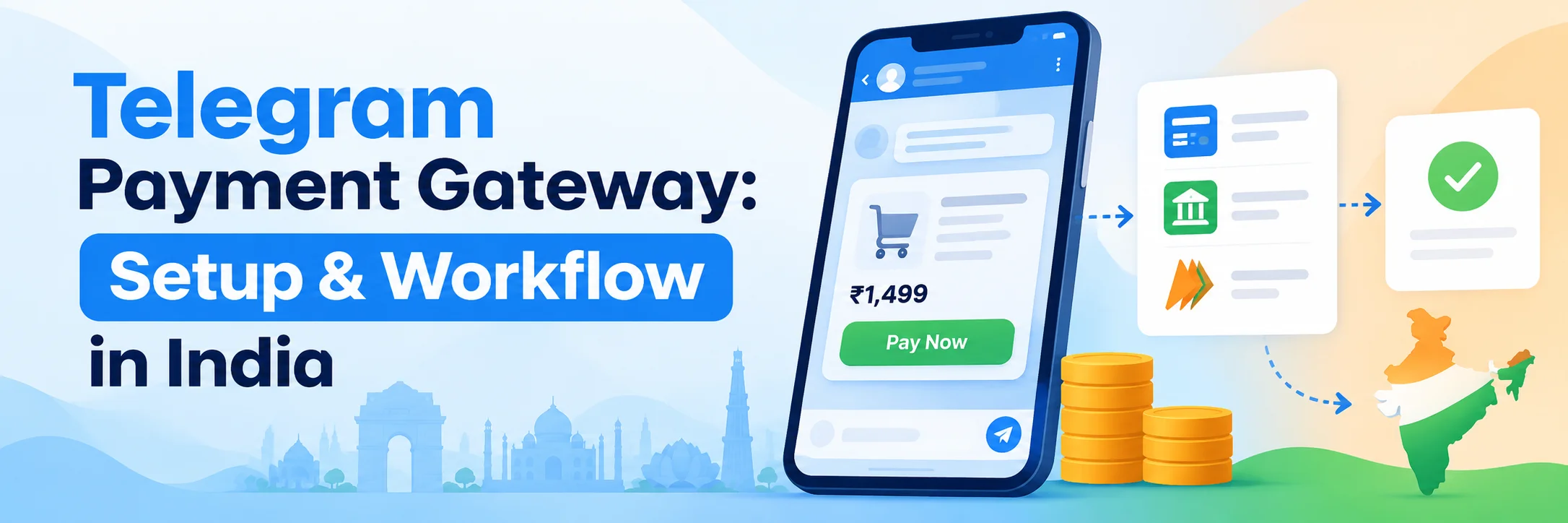
The Telegram payment process starts during a conversation, and the merchant is responsible for the checkout, status update, and fulfillment. Telegram accept – the chat is able to send a request, however, the merchant should halt if he is unable to confirm the result through his system with an order. Note, that Telegram payments can be performed with the link or QR, depending on the device of the customer. Either way, the payment gateway has collection and reporting abilities. Don't be surprised if Telegram does not support money transfers. Every order received, fulfilled and reconciled should be assigned a unique order number that the staff could use to resolve a delayed or mismatch order.
Payment link or merchant QR: which flow fits the sale?
You can use a Telegram payment gateway to finish the checkout procedure, however it will not be able to make a chat message proof of the checkout. When making a request through Telegram, make sure that users switch devices, and your order will be supported. Payment link enables a direct mobile handoff and enables the merchant to only continue processing when the status is confirmed. A merchant QR can be scanned from a different screen and assists the merchant to stop when he is unable to match a stale image with an open sale.
|
Decision Point |
Payment Link |
Merchant QR |
|---|---|---|
|
Device |
Use for a mobile chat when the customer can tap and open checkout. |
Use when Telegram is open on a desktop or the customer has another device available to scan. |
|
Conversation Context |
Fits a one-to-one order because the request can carry the merchant’s order reference. |
Fits a counter-assisted or desktop session when the displayed code can be tied to the current order. |
|
Handoff |
The customer leaves or overlays the chat to complete the payment flow. |
The customer scans the code and continues on the scanning device. |
|
Payment Options |
Check which payment options appear on the hosted checkout for the approved merchant account. |
Confirm that scanning the code opens the same approved choices and preserves the order reference. |
|
Reuse Risk |
A forwarded or stale link can create ambiguity. Create a payment request for one order and set clear expiry behavior. |
A screenshot can outlive the sale or appear in another chat. Use a reusable code only when the reconciliation rules explicitly support reuse. |
|
Reconciliation |
Match the gateway result, amount, and order reference before fulfillment. |
Match the scanned request to the same fields; the screenshot itself proves nothing. |
How payments in Telegram move through the merchant workflow
- Capture the order. Before developing anything, record the item/service, the quantity, the currency, the customer and a special reference for the merchant. Not enough to merely specify an amount to order, an order must contain a unique and searchable reference so that it can be used to identify the goods and services that are ordered. Include the number of the billing period or invoice number on a subscription or invoice.
- Create the request. The merchant system requests the payment gateway/payment provider to generate link or QR code. A payment gateway can process the request and return a status to the merchant, allowing the merchant to act on the request.
- Deliver it in chat. The bot places the request in the appropriate conversation. Here in the telegram payment process, it just provides instructions. Does not prove that money has been paid, even if the customer says that it has been paid.
- Send the customer to checkout. The customer visits the hosted page or scans the QR in order to make payments. According to Telegram's Bot Payments documentation, the payment processing for the telegram is done with the selected third party. Part of supported payment is processed by the payment processor, Telegram doesn't accept it. Only advertise a wallet if it is displayed for the merchant's configuration.
- Validate the reported result. When the payment comes from a bot, make sure to check the status in API/approved reporting channel and verify payment amount, currency, reference and state with the open order. Do not add pending, expired, failed, duplicate or mismatched results to the fulfillment queue.
- Release fulfillment. Only mark the order for when it is validated and received from the merchant system with a successful result. This is not a customer screen shot, or a bot message or chat reply. If the callback is delayed, then instead of making a new request, ask the supported status source for support.
- Reconcile and review launch gates. Ensure payments to Telegram for India is activated with payment method approved, merchant KYC, transaction limits, reporting fields, settlement terms and reconciliation file/dashboard. Test for exception and success using non-production controls as appropriate. No payments are processed if the payment provider is not able to provide a mapping between a request and a settlement or to show the reversals later on.
Telegram bot architecture: keep checkout and confirmation separate
If you have integrated a telegram bot into your system, make the following order in your system: Make the order and reference on the merchant order page. 2. Ask the provider API for a link or QR on the bot service. 3. Send it to the customer via Telegram. 4. Allow the customer to enter payment details supported while doing the hosted checkout. 5. Retrieve in the provider dashboard or the provider status endpoint. 6. Before you release an order, finally verify on the merchant order screen the details of the amount, currency, reference and order status.
Before the bot is integrated with the merchant order service, use BotFather to create and set it up. The Telegram app can send requests for payments and payment statuses, but payment systems outside of the chat will have to log the financial outcome. Don't make promises of easy checkout until testing time, because you don't want to assume that the order reference is being handed off in each handoff.
Bot payments are not kept on the ledger – they are sent through Telegram bot. Leave it in ‘request sent' and not ‘paid'. If one of the chat statuses is given as an indicator for payment, then a delayed callback or repeated request for payment may result in an expected fulfillment. The bot may have detected that the checkout was opened, but it's up to the merchant system to decide if the order can move forward.
Test access does not mean access to real transactions: provider's commercial record should be checked before enabling a live flow to see if there is a live flow with the following: type of business approval, how payments are made, limits, and settlement arrangement. The limits and conditions for settlement are subject to agreement and do not necessarily follow an API response or a demonstration account.
A chat message, bot response, a customer screen shot or a checkout return page are NOT payment confirmation. Alternative: If Telegram is unavailable, continue with reporting source to operate, and reporting merchant reference to investigate unmatched result.
When to use Telegram for payment requests—and when not to
Telegram is an application and software for messaging. Its role is only to pass the message and to pass a payment request in this workflow, the payment provider and the merchant system will take care of checkout and the status of the payment and reconciliation. If you already have a chat in the sale, then you can give the customer a QR code with another device or an external checkout page without losing the order reference, use Telegram. Payment is not a message reported by a provider of his/her success, it is a financial result reported by the provider. Check quantities, currency, reference and final state prior to releasing goods/services.
Good fit
- The operator can send a unique telegram payment request for a sales/support conversation, which has an order, sum and with whom it is taken.
- One-to-1 chat can be done using a link that can be tapped, and a person using Telegram on the desktop can scan a QR code of a merchant and start a conversation.
- Though a Telegram channel can be used to announce an offer, it should be used along with a bot/merchant system that creates an order specific request rather than a single request that would be sent to all customers. Consider Telegram a marketing function; don't assume that a request is from a particular buyer.
- The merchant's status source is different and the merchant can block fulfillment until a result matches.
Poor fit or failure signals
- Wherever possible, refrain from using Telegram where a unique identifier cannot be attached to the customer's identity, order, or amount.
- If staff need to use screenshots or the Bot's own recorded message to be able to tell if payment was made, STOP.
- Changing order quantities is a bad way to pay for an invalid order quantity or re-used QR (except for one that prevents it).
- There should be no missing flow when there is no owner documented on pending, reversed, duplicate or disputed results. If there is any difference between an order's ledger and the chat, the payment use cases don't work.
Also read:Single-Service vs Multi-Service On-Demand Apps: Which Should You Build?
How to evaluate a payment provider before launch
- Has the merchant been approved by the business? Prior to live transactions, make sure that the legal entity, use case, payment methods are approved, customer journey is expected; any restricted activity is done.
- What are the statuses that can be passed to the integration? Ask the telegram payment provider about the meanings of successful, pending, failed, expired, reversed and disputed. Figure out whether callbacks can be delayed/duplicated and how to do it safely and check API status.
- What limits apply? Resolving transaction limits, daily limits or account limits in the commercial papers and live configuration. Please note that the merchant limit when on a public network differs from the merchant limit.
- What are the components of settlement? There should be a documented schedule, currency, limitations, fees, pending and reversed transactions which will determine if the finance will close the ledger. Check them in the signed commercial terms and compare the first report with merchant orders.
- Are all of the results reconcilable? Have the payment gateway/payment processor return merchant order reference, amount, currency, payment reference and status of the entire payment. Check to see if those fields are reversed in exports and/or in the dashboard record.
- What is refunds? Identify who can initiate a refund, what records will be impacted and how it will be reported. Ask the provider to document all security measures that are used when authorising a refund, and then design the process to have acceptable refund requests reviewed by staff when they receive them in free text message.
- Are chargebacks relevant?The handling of a chargeback is not clearly defined and could be dependent on the supported method and the commercial arrangement. See if there are any chargebacks, what documentation is needed and what credit will look like in the future.
- What happens during an outage? Find out if the merchant is able to ask status without Telegram, and find out who will cancel order release, and how to prevent duplicate requests. If selling hours don't allow for chat, then email can be utilized to send formal operation notices and ensure the address you provided for escalation is monitored during those hours.
- So, is Crypto in scope? Don't assume that if it has a bot then it has crypto support. There could be another payment method, confirmation model and settlement treatment and a commercial and operational review may be required to approve cryptocurrency as a payment method. Be aware if they switch from crypto to fiat, how they fix the amount, and what the written product scope permits them to do.
- Is it possible to test exceptions? Perform valid checks of stale links, repeated QR images, wrong quantities, duplicate return calls and late reversals. The provider will communicate with the user prior to launch about what is expected for each test.
Failure controls for every bot-assisted checkout
If Telegram does not get the payment, there is a need for a source outside the Telegram chat for handling it. The merchant system can send structured status information to the API, which may change the outcome of the release of a bot message in response to the open order. An Internet bot may help the customer and merchant make a transaction, but it should not be allowed to win; always require a merchant's validated status to begin the fulfillment process. If the payment channel does not have a different order reference to send back the customer should never pay directly to a detail that is displayed in a chat.
- Successful: If the quantity, currency and "Confirmed" is equal to the quantity and currency on order reference, it is fulfilled.
- Pending: Order will not be automatically resend as it has not been placed.
- Not fulfilled or cancelled: do not try to fulfill and create a new request if the request that cannot be fulfilled is cancelled.
- Duplicate: Deduplicate by provider event and/or merchant reference, investigate prior to applying a refund for provider event and shipping for provider event.
- Amount mismatch: If the quantities are not equal, cancel out the order and send it for review.
- Delayed callback: Ensure that payment flow status is confirmed before making changes or requesting customer to repeat the payment process.
- Reversal/dispute: Document the reversal and follow up on the fulfilment/recovery.
Final Thoughts
This Telegram payment gateway in India would bring a paradigm shift in payments, making the transaction even more smoother and convenient and enabling the payments to be managed right from the Telegram bots. Reliable payment partners, secure payment process and making popular payment methods such as UPI easy can make the payment process simpler for the Indian customers.
For successful integration, however, the following is required: Appropriate testing, the right security measures and compliance of relevant laws of payment. For online retailers, subscription services, and digital platforms, the right Telegram payment gateway can help minimize manual tasks, simplify payment processes, and contribute to sustainable business development.

 +91 774-202-1725
 +1 (945) 3387904
 business@coherentlab.com
 +49 15223341304
 UK

