Table of Contents
How AI Video Analytics Platforms Are Turning Cameras Into Intelligent Business Systems in 2026
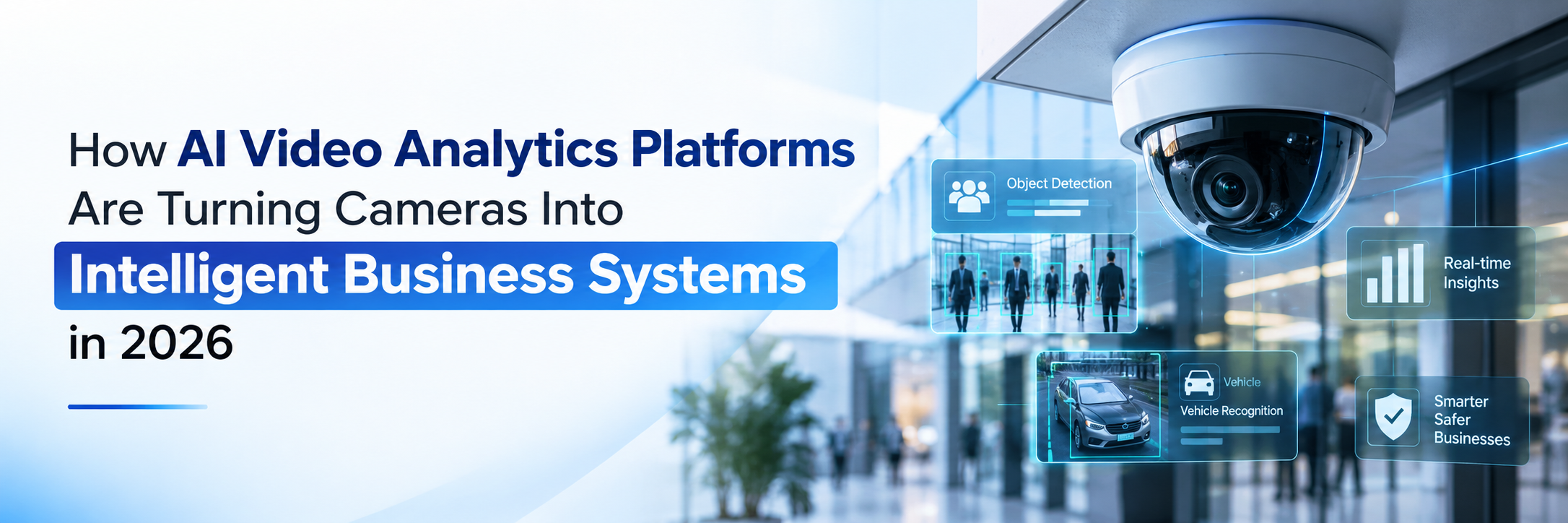
Cameras have traditionally served a simple purpose in business environments: record what happens and preserve footage in case someone needs to review it later. In 2026, that role is changing. Advances in artificial intelligence, computer vision, cloud computing, and edge processing are allowing organizations to extract useful information from video while events are still unfolding.
The scale of this transition is becoming visible in market data. The global video analytics market is estimated at approximately $18.8 billion in 2026 and is projected to reach $37.8 billion by 2030, representing a compound annual growth rate of 19.5%. At the same time, McKinsey reported that 88% of organizations were using AI in at least one business function by mid-2025, showing how quickly AI is moving from isolated experiments into everyday operations.
Traditional surveillance systems leave organizations with enormous amounts of footage but relatively little usable information. Employees still have to watch live feeds, investigate alerts, or manually search recordings after an incident.
AI is changing that equation. Instead of functioning only as recording devices, cameras can become sources of structured operational data that help businesses understand movement, investigate events, identify risks, improve workflows, and make faster decisions.
From Passive Recording to Continuous Visual Intelligence
The biggest transformation is the shift from cameras that simply capture events to systems that interpret what is happening inside a scene. Conventional motion detection generally reacts to changes in pixels. Modern AI models can distinguish between people, vehicles, objects, movement patterns, and specific types of activity.
That difference can dramatically change how video is used. Instead of receiving an alert every time something moves near a loading dock, for example, an organization can focus on specific conditions such as a vehicle entering a restricted zone, a person appearing in an employee-only area, or unusual activity occurring outside normal operating hours.
Computer vision also makes recorded footage much easier to use. Metadata can be attached to detected objects and events, allowing teams to search video according to characteristics rather than relying entirely on timestamps. Finding a particular vehicle, person, object, or activity can therefore become closer to searching a database than manually watching hours of footage.
For businesses, this changes the economics of surveillance. Cameras already installed for security can begin providing information useful to operations, safety, facilities, customer service, and management teams. The value of the system increasingly comes from what organizations can learn from video rather than simply how much footage they can store.
Video Is Becoming Part of Everyday Business Operations
The second major development is the expansion of video intelligence beyond conventional security monitoring. AI can turn visual activity into data about how physical spaces are actually being used, giving organizations another source of operational information.
Retailers, for example, can examine traffic patterns, entrances, queue formation, customer movement, and activity around important areas. Warehouses can observe congestion around loading zones, movement between aisles, and potentially dangerous interactions between workers and vehicles. Manufacturers can use visual information to identify recurring workflow interruptions or safety concerns.
This becomes particularly useful because many physical processes are difficult to understand from business software alone. Inventory software may show that an order was delayed, but video can help establish what happened on the warehouse floor. Access logs might record when a door opened, while video can provide the visual context around that event.
The result is a more complete picture of operations. Rather than treating cameras as equipment used exclusively by security departments, organizations can use visual information to investigate bottlenecks, validate incidents, understand space utilization, and identify recurring patterns that would otherwise remain difficult to measure.
Connecting Video Analytics With the Wider Technology Ecosystem
The intelligence generated by a camera becomes more valuable when it can be connected with other systems. An isolated detection might tell a team that someone entered an area, but combining video with access events, operational workflows, alerts, and other business information can reveal considerably more context.
This is one reason modern surveillance architecture is moving toward integrated systems. Video can support access control verification, incident management, emergency response, investigations, and multi-location operations. Instead of employees moving between separate applications to reconstruct an event, related information can increasingly be brought together around the same incident.
Modern video analytics platforms illustrate this transition. Coram, for example, describes an AI-native physical security platform that can connect with existing ONVIF-compliant IP cameras and provide capabilities such as natural-language video search, detection and real-time alerts, person or vehicle journey views, and synchronized video with access-control events. This approach demonstrates how camera infrastructure can become part of a wider information system rather than remaining an isolated archive of footage.
The broader principle matters more than any individual platform. Organizations gain greater value when visual information can move into the workflows where decisions already happen. Integration can reduce the time between detecting an event, understanding its context, assigning responsibility, and taking appropriate action.
Real-World Impact Across Retail, Warehousing, and Physical Operations
The practical value of AI video analytics becomes clearer when viewed against real operational problems. In retail, companies are increasingly looking beyond traditional theft measurements toward a wider understanding of total retail loss, including inventory inaccuracies, supply-chain problems, fraud, operational failures, and physical theft. At NRF PROTECT 2026, retail leaders discussed this broader approach to understanding where profit is lost across the enterprise.
Video intelligence can add another layer to this analysis. Instead of relying only on transaction records or inventory reports, retailers can investigate what actually occurred around receiving areas, shelves, service counters, entrances, and other high-activity locations. Cameras therefore become useful not simply for proving that an incident happened but for identifying recurring operational patterns.
Safety presents another important use case. U.S. Bureau of Labor Statistics data shows that transportation and warehousing recorded about 261,500 nonfatal workplace injuries and illnesses in 2024, with a rate of 4.4 cases per 100 full-time workers. Manufacturing recorded approximately 332,600 cases. These figures illustrate why businesses continue looking for better ways to identify risky environments and behaviors before they contribute to incidents.
AI-enabled video can support that goal by highlighting defined events or patterns for human review. It does not eliminate the need for training, procedures, physical safeguards, or experienced safety staff, but it can give those teams greater visibility into large facilities where continuous manual observation would be impractical.
Building Intelligent Video Systems Responsibly
More capable cameras do not automatically produce better business outcomes. Organizations first need to decide which problems they are trying to solve and whether video analytics is appropriate for those situations. Deploying every available detection feature simply because the technology exists can create unnecessary alerts, privacy concerns, and management complexity.
Data governance is particularly important. Businesses should establish clear policies for who can access footage, how long video and associated metadata are retained, how information can be searched, and how recorded material can be exported or shared. Strong authentication and role-based permissions become increasingly important as video systems become accessible to more departments.
Accuracy also requires attention. Lighting conditions, camera angles, crowded environments, obstructions, and unusual circumstances can all affect computer vision performance. Organizations should test analytics under the conditions in which they will actually operate rather than assuming that a successful demonstration will translate perfectly to every location.
Human oversight remains essential. An AI-generated detection should normally support decision-making rather than replace judgment in situations where consequences are significant. Successful implementations combine automation with clear escalation procedures, employee training, periodic review, and measurable objectives.
The Next Phase: Cameras That Can Be Queried Like Business Data
One of the most significant changes ahead is likely to be the way people interact with recorded video. Historically, finding an event required selecting a camera, estimating a time, and manually navigating through recordings. AI is increasingly allowing users to describe what they want to find in ordinary language.
Recent industry developments already show this direction. AI-optimized surveillance infrastructure introduced in 2025 included free-text search capabilities designed to help users locate relevant objects and events across complex scenes. The broader AI video analytics market is projected to expand rapidly through the next decade as organizations apply visual intelligence to security, planning, customer behavior, traffic patterns, and operational decision-making.
The next step will be connecting this searchable visual information with other enterprise data. A manager investigating a delivery delay, for example, could potentially combine timestamps, access records, video events, vehicle activity, and operational data instead of examining each source separately.
That development could move video analytics beyond surveillance altogether. Cameras would become another class of business sensor, continuously producing information about the physical world that software systems can organize, search, and use to support decisions.
Conclusion
In 2026, the most important change in video surveillance is not simply that cameras are becoming smarter. It is that visual information is becoming searchable, measurable, and increasingly connected with the systems businesses already use to manage their physical operations.
Organizations that approach AI video analytics as business infrastructure rather than another camera feature are likely to find more meaningful applications for it. The priority should be connecting useful visual intelligence with real operational problems while maintaining strong governance, human oversight, and clear objectives. As those capabilities mature, cameras will increasingly function as active sources of business intelligence rather than passive witnesses to events.
FAQs
What are video analytics platforms?
Video analytics platforms use computer vision and AI to analyze video footage and identify objects, people, vehicles, movements, or predefined events. Instead of requiring employees to review every camera manually, the software can organize visual information and surface relevant activity for investigation or response.
How is AI video analytics different from traditional motion detection?
Traditional motion detection primarily identifies changes within an image, which can result in alerts caused by shadows, weather, animals, or other irrelevant movement. AI analytics can classify objects and interpret more context around a scene, allowing organizations to create more meaningful searches and alerts.
Can businesses use video analytics for more than security?
Yes. Depending on the environment and system, video intelligence can support areas such as occupancy analysis, traffic flow, workplace safety, queue monitoring, facility management, incident investigation, and operational analysis. The appropriate applications depend on the organization's goals and privacy requirements.
Can AI analytics work with existing security cameras?
Some platforms can analyze footage from existing IP cameras, while others require specific proprietary hardware or additional processing equipment. Businesses considering an upgrade should therefore evaluate camera compatibility, network requirements, storage architecture, processing capacity, and integration requirements before selecting a system.
What should organizations consider before deploying AI video analytics?
Organizations should begin with a clearly defined operational or security problem rather than choosing technology first. Accuracy, privacy, cybersecurity, retention policies, employee training, camera positioning, system integration, and human oversight should all be considered when designing a responsible deployment.

 +91 774-202-1725
 +1 (945) 3387904
 business@coherentlab.com
 +49 15223341304
 UK
UK