Table of Contents
Full-Cycle Game Development Services: What’s Included?
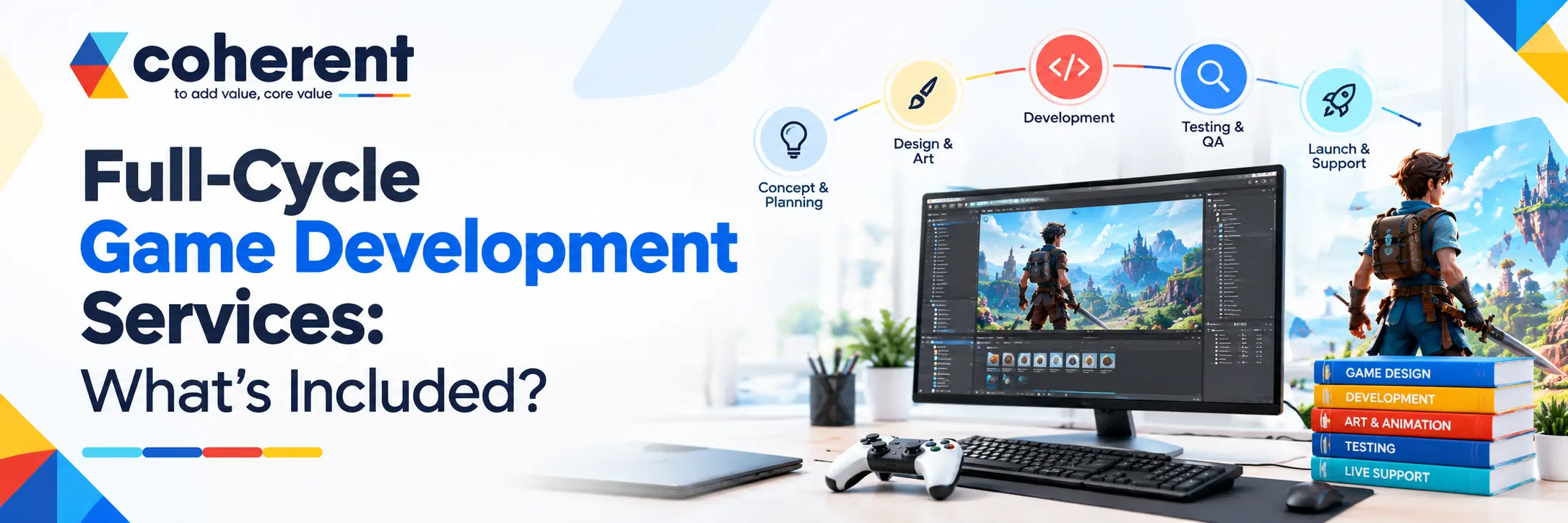
Game development is no longer just about creating attractive graphics and adding exciting gameplay. Modern players expect fast performance, immersive experiences, smooth controls, multiplayer capabilities, regular updates, and cross-platform accessibility.For businesses, startups, and game publishers, building a successful game often requires much more than hiring a developer to write code. It involves planning, game design, development, testing, deployment, monetization, and ongoing maintenance.
This is where full-cycle game development services come in.A full-cycle game development company can manage the entire process—from the initial game concept to development, testing, launch, and post-release support. This approach helps businesses reduce coordination challenges while maintaining greater control over quality, timelines, and development costs.In this guide, we'll explain what full-cycle game development includes, how the process works, the technologies involved, and what businesses should consider before choosing a game development partner.
What Are Full-Cycle Game Development Services?
Full-cycle game development services cover the complete lifecycle of creating, launching, and maintaining a video game. Instead of working with separate teams for game design, programming, art, testing, and deployment, businesses can partner with one development team that coordinates multiple stages efficiently. This integrated approach improves communication, streamlines project management, and maintains consistency throughout development. To understand the stages involved in building a mobile game, explore the Mobile Game Development Process by Coherent Lab LLP.
- Game concept development
- Game design and documentation
- UI/UX design
- 2D and 3D game art
Also Read :- How to Choose the Best Game App Development Company
What Is Included in Full-Cycle Game Development?
Full-cycle game development covers every major stage required to transform a game idea into a market-ready product. It brings together game design, UI/UX, 2D and 3D art, programming, backend development, multiplayer systems, quality assurance, optimization, monetization, deployment, and ongoing maintenance. This integrated approach helps businesses coordinate different development activities through one structured workflow while maintaining consistency in gameplay, technology, performance, and overall player experience. Coherent Lab LLP provides end-to-end game development solutions tailored to different business and technical requirements.
1. Game Concept and Pre-Production
Pre-production establishes the foundation for the entire game development project. During this stage, developers, designers, and stakeholders define the game's concept, audience, gameplay mechanics, visual direction, technical requirements, platforms, and monetization strategy. A clear plan helps the development team understand project scope, identify technical challenges early, and create a practical roadmap for production.
- Game genre
- Target audience
- Core gameplay mechanics
- Storyline and characters
2. Game UI/UX Design
Game UI/UX design determines how players interact with menus, controls, dashboards, inventories, settings, and other interfaces. A well-designed interface should look consistent while remaining simple and responsive. During full-cycle game development, designers focus on creating intuitive player journeys, clear visual feedback, accessibility, and device compatibility so players can understand and navigate the game naturally.
- Game dashboards
- Settings pages
- Leaderboards
- Achievement screens
3. 2D and 3D Game Art Development
Visual design helps establish a game's identity and influences how players experience its world. Full-cycle game development can include concept art, character design, environments, animations, textures, lighting, and visual effects. Depending on the project, teams may create optimized 2D assets or detailed 3D environments designed for specific platforms and performance requirements.
2D Game Art
2D game art is commonly used for mobile, casual, puzzle, strategy, and other game genres. Artists can create characters, sprites, backgrounds, interface elements, illustrations, and visual effects. The art style should remain consistent across different screens and gameplay environments while being optimized for the target device.
- Character illustrations
- Sprites
- Backgrounds
- Icons
3D Game Art
3D game development involves creating characters, environments, objects, textures, animations, lighting, and visual effects. Artists need to balance visual quality with technical performance. Properly optimized 3D assets can help games deliver immersive environments while controlling memory usage, rendering requirements, and loading times across supported platforms.
- 3D characters
- Game environments
- Buildings
- Vehicles
4. Game Development and Programming
Game programming converts design concepts and visual assets into functional gameplay systems. Developers implement player controls, physics, artificial intelligence, animations, audio, inventory systems, progression, and multiplayer functionality. The programming architecture depends on the selected game engine, target platforms, game complexity, and required performance, scalability, and security.
- Gameplay programming
- Character controls
- Physics systems
- Collision detection
5. Game Engine Development
The game engine provides the technical foundation for building and running the game. Engine selection can affect graphics capabilities, development workflow, platform support, performance, and available tools. Full-cycle game development teams generally select an engine based on project requirements rather than popularity alone, considering gameplay, target devices, graphics, multiplayer needs, budget, and team expertise.
- Target devices
- Development budget
- Multiplayer requirements
- Team expertise
6. Multiplayer Game Development
Multiplayer game development requires additional networking, server, security, and synchronization systems. A full-cycle team can build features that allow players to connect, compete, communicate, and interact within shared game environments. The architecture needs to account for latency, server capacity, synchronization, scalability, authentication, and security to provide a reliable online gameplay experience.
- Real-time multiplayer
- Matchmaking
- Player authentication
- Game lobbies
7. Backend and Server-Side Development
Modern online games often depend on backend systems for authentication, player profiles, game progress, transactions, analytics, content management, and multiplayer services. A scalable game backend helps manage increasing player activity while keeping data organized and accessible. The backend architecture should be designed around expected traffic, game features, security requirements, and future growth.
- In-app purchases
- Notifications
- Analytics
- Content management
8. Game Testing and Quality Assurance
Game QA testing helps identify technical problems, gameplay bugs, usability issues, compatibility problems, and performance limitations before and after launch. Testing should happen throughout development rather than only at the final stage. Continuous quality assurance helps teams validate individual features, complete builds, multiplayer functionality, device compatibility, and overall player experience.
- UI problems
- Device compatibility issues
- Memory consumption
- Performance bottlenecks
9. Game Optimization
Game optimization focuses on improving performance while preserving the intended gameplay and visual experience. Developers can optimize code, assets, rendering, memory usage, network communication, and server performance. Optimization is particularly important for mobile and cross-platform games because devices can have significantly different hardware capabilities and resource limitations.
- GPU performance
- Network performance
- Battery consumption
- Asset sizes
- Server response time
10. Game Monetization Development
Monetization planning determines how a commercial game can generate revenue while maintaining a suitable player experience. The model should align with the game's genre, audience, platform, and gameplay structure. Integrating monetization during development makes it easier to design virtual economies, purchase flows, subscriptions, advertisements, and premium content without disrupting the core gameplay.
- Battle passes
- Virtual currencies
- Cosmetic items
- Downloadable content
- Freemium models
11. Game Deployment and Launch
Game deployment is the process of preparing the completed product for production and distribution. A full-cycle game development company can assist with platform configuration, server deployment, analytics, crash monitoring, version management, and release preparation. Deployment requirements vary between mobile, PC, console, and cloud environments, so platform-specific requirements should be addressed before launch. Explore game development services from Coherent Lab LLP for end-to-end development and deployment support.
- Production configuration
- Analytics integration
- Crash monitoring
- Version management
12. Post-Launch Game Maintenance
Game development continues after release as players encounter new issues, platforms change, and businesses introduce additional content. Post-launch game maintenance helps keep the product secure, stable, compatible, and engaging. A development partner can monitor performance, fix bugs, release updates, add features, optimize servers, and support new devices throughout the game's lifecycle.
- Gameplay improvements
- Server maintenance
- Compatibility updates
- Analytics monitoring
Benefits of Choosing Full-Cycle Game Development Services
Choosing full-cycle game development services can simplify the process of building, launching, and maintaining a game. Instead of managing multiple specialized vendors, businesses can work with one coordinated development partner covering design, programming, art, backend, testing, deployment, and maintenance. This approach can improve communication, create a more consistent workflow, simplify project management, and make it easier to scale development resources as the game evolves.
One Development Partner
Working with one full-cycle game development company reduces the need to coordinate separate teams for game design, programming, artwork, QA testing, backend development, and deployment. A centralized team can understand the complete project vision and coordinate different technical activities around the same requirements, timeline, development roadmap, and quality expectations.
Better Communication
Clear communication is essential when multiple disciplines contribute to the same game. A unified development team can help designers, artists, programmers, QA engineers, and project managers communicate within the same workflow. This can reduce misunderstandings, improve requirement sharing, and make it easier to identify and address technical or design issues during development.
Consistent Development Workflow
A centralized team can maintain greater consistency across different stages of game production. Designers, developers, artists, and testers can work from shared documentation and project requirements. This helps ensure that the game's visual design, gameplay mechanics, technical architecture, testing standards, and deployment process remain aligned throughout the development lifecycle.
Easier Project Management
Managing a complex game project can become challenging when several external vendors are involved. Full-cycle game development provides businesses with a centralized point of contact for requirements, timelines, technical decisions, testing, deployment, and maintenance. This can make progress tracking easier and reduce the administrative effort required to coordinate different service providers.
Scalable Development
Game requirements can change as development progresses. A full-cycle development partner can adjust resources based on project needs, whether the business requires additional programmers, artists, QA engineers, backend specialists, or other technical expertise. This flexibility can support feature expansion, platform additions, multiplayer development, content updates, and post-launch improvements.
Technologies Used in Full-Cycle Game Development
Full-cycle game development uses a combination of game engines, programming languages, 3D design tools, backend technologies, databases, cloud platforms, networking solutions, and analytics tools. Popular technologies include Unity, Unreal Engine, Godot, C#, C++, Blender, Node.js, Python, AWS, Azure, Google Cloud, PostgreSQL, MongoDB, and Git. The technology stack is selected according to the game's genre, platforms, graphics, multiplayer requirements, performance goals, scalability, and development budget.
| Development Area | Common Technologies |
|---|---|
| Game Engines | Unity, Unreal Engine, Godot |
| Programming | C#, C++, GDScript |
| 3D Development | Blender, Maya, 3ds Max |
| Backend | Node.js, Python, Java, .NET |
| Databases | PostgreSQL, MySQL, MongoDB |
| Cloud | AWS, Microsoft Azure, Google Cloud |
| Multiplayer | Dedicated servers, networking frameworks |
| Analytics | Game analytics platforms |
| Version Control | Git-based workflows |
How Much Do Full-Cycle Game Development Services Cost?
The cost of game development varies significantly because every project has different requirements.The cost of full-cycle game development depends on the project's complexity, features, platforms, graphics, gameplay mechanics, multiplayer functionality, backend requirements, development team size, and testing needs. A simple 2D mobile game generally requires fewer resources than a feature-rich 3D multiplayer game. Businesses should define their requirements, technical scope, target platforms, and post-launch support needs before requesting an accurate development estimate.
- Game complexity
- Number of platforms
- 2D or 3D graphics
- Number of game levels
- Multiplayer functionality
How to Choose a Full-Cycle Game Development Company
Choosing the right full-cycle game development company can influence the quality, timeline, scalability, and long-term maintenance of your game. Instead of comparing providers only by hourly rates, evaluate their technical capabilities, previous projects, development methodology, communication process, and post-launch support. A suitable development partner should understand your game concept, target audience, platforms, gameplay requirements, technology stack, budget, and expected business outcomes.
Evaluate Game Development Portfolio
A company's portfolio provides practical insight into its game development capabilities. Review previous projects that are relevant to your requirements rather than focusing only on visual quality. Look for experience with similar genres, platforms, multiplayer systems, game engines, backend architecture, optimization, and 2D or 3D development to better understand whether the team matches your project.
- Similar game genres
- Target platforms
- Multiplayer games
- 2D and 3D development
Check Technical Expertise
Technical expertise is essential for building a stable and scalable game. Before selecting a development partner, confirm that the team has experience with the technologies required for your project. Their capabilities should align with your chosen game engine, programming language, backend architecture, cloud infrastructure, multiplayer requirements, and performance expectations.
- Game engines
- Programming languages
- Backend technologies
- Cloud infrastructure
Understand Their Development Process
A clearly defined development process helps keep complex game projects organized. Ask how the company handles requirements, prototyping, game design, programming, testing, deployment, and maintenance. Understanding their workflow can help you determine how milestones are planned, how feedback is incorporated, how technical issues are managed, and how progress is communicated throughout development.
- Requirements gathering
- Game prototyping
- UI/UX design
- Game development
Discuss Communication
Effective communication becomes increasingly important as game projects involve multiple specialists and development stages. Before starting the project, clarify how communication will work, who will manage the project, how frequently updates will be provided, and how issues will be escalated. A transparent communication process can make collaboration smoother throughout the development lifecycle.
- Dedicated project managers
- Reporting frequency
- Communication channels
- Development milestones
Also Read :- How Much Does Game Development Cost? Complete Pricing Guide
Full-Cycle Game Development vs Specialized Development
Businesses often choose between a full-cycle development company and multiple specialized vendors.Full-cycle game development and specialized development follow different approaches to building a game. A full-cycle game development company manages multiple stages, including design, programming, art, testing, deployment, and maintenance through one coordinated team. Specialized development focuses on a specific area, such as game art, multiplayer programming, or QA testing. The right approach depends on project scope, technical requirements, internal resources, budget, and management preferences.
| Factor | Full-Cycle Development | Multiple Specialized Teams |
|---|---|---|
| Project Coordination | Centralized | Distributed |
| Communication | One primary team | Multiple teams |
| Development Workflow | Integrated | Requires coordination |
| Accountability | More centralized | Shared between vendors |
| Scaling | Easier within one partner | Depends on vendors |
| Management | Simplified | More complex |
Why Full-Cycle Game Development Matters in 2026
In 2026, game development increasingly involves cross-platform experiences, multiplayer functionality, advanced 3D environments, AI-powered features, cloud infrastructure, and continuous content updates. Full-cycle game development helps businesses manage these requirements through an integrated workflow. By combining game design, development, testing, optimization, deployment, and maintenance, teams can maintain better coordination while adapting the game to changing technologies, player expectations, platforms, and business requirements.
- Strong gameplay
- Good UX
- Stable performance
- Engaging content
Final Thoughts
Full-cycle game development services provide businesses with an integrated approach to building, launching, and maintaining games. Instead of treating design, development, testing, deployment, and maintenance as completely separate activities, the full-cycle model connects them into one development workflow.From game concept and 2D/3D art to gameplay programming, multiplayer development, backend engineering, QA testing, optimization, deployment, and post-launch support, every stage contributes to the final player experience.
For startups, publishers, and established businesses, the key is to define the game vision clearly, select the right technologies, understand the development process, and work with a team that has relevant technical and domain expertise. A well-planned development process can turn an initial game idea into a scalable, engaging, and technically reliable product. Connect with Us to discuss your game development requirements with the experts at Coherent Lab LLP.
Frequently Asked Questions
Q1: What are full-cycle game development services?
Ans. Full-cycle game development services cover the complete process of creating and maintaining a game. This includes game concept planning, game design, UI/UX, 2D and 3D art, programming, backend development, multiplayer functionality, quality assurance, optimization, deployment, and post-launch support. A full-cycle approach allows businesses to manage multiple development stages through one coordinated game development team.
Q2: What does a full-cycle game development company do?
Ans. A full-cycle game development company manages different stages of game production, from initial research and prototyping to development, testing, launch, and maintenance. Its services may include game design, gameplay programming, character development, animation, backend engineering, multiplayer development, QA testing, performance optimization, deployment, and ongoing updates based on technical requirements and player feedback.
Q3: How long does it take to develop a game?
Ans. Game development time depends on several factors, including game complexity, genre, platform, features, graphics, multiplayer requirements, team size, and testing scope. A simple 2D mobile game may require considerably less development time than a feature-rich 3D multiplayer game. A detailed project scope and development roadmap can provide a more realistic timeline.
Q4: Can a full-cycle game development team develop multiplayer games?
Ans. Yes, full-cycle game development teams can build multiplayer games with the required networking and backend infrastructure. Services may include real-time multiplayer, matchmaking, player authentication, game servers, leaderboards, player profiles, chat, synchronization, and anti-cheat features. The architecture is generally planned around the expected number of players, gameplay requirements, target platforms, and scalability needs.
Q5: Can game development companies provide post-launch support?
Ans. Yes, post-launch game development support can help keep a game stable and compatible after release. Services may include bug fixing, security updates, performance optimization, server maintenance, new features, additional levels, seasonal content, platform updates, and technical improvements. Ongoing monitoring can also help development teams identify crashes, performance issues, and other problems affecting players.
Q6: Which game engine should I choose?
Ans. Unity, Unreal Engine, and Godot are widely used game engines, but the right choice depends on the project's requirements. Factors include game genre, graphics quality, target platforms, multiplayer needs, performance expectations, development skills, and budget. Unity may suit cross-platform and mobile projects, while Unreal Engine is commonly considered for advanced 3D experiences and high-end visuals.
Q7: How much do full-cycle game development services cost?
Ans. The cost of full-cycle game development varies according to project scope and technical complexity. Important factors include game genre, platforms, 2D or 3D graphics, number of features, multiplayer functionality, backend infrastructure, AI requirements, team size, testing, and post-launch support. A detailed feature list and technical specification are usually required to prepare a more accurate development estimate.
Q8: How do I choose a full-cycle game development company?
Ans. When choosing a full-cycle game development company, review its portfolio, technical expertise, development process, communication approach, and experience with similar game projects. Check whether the team supports game design, programming, 2D/3D art, multiplayer development, QA testing, deployment, and maintenance. Clear project milestones, documentation, communication channels, and post-launch support should also be discussed before development begins.

 +91 774-202-1725
 +1 (945) 3387904
 business@coherentlab.com
 +49 15223341304
 UK
UK