
Table of Contents
Most Reliable Platforms for Managing Apparel Production Workflows in 2026
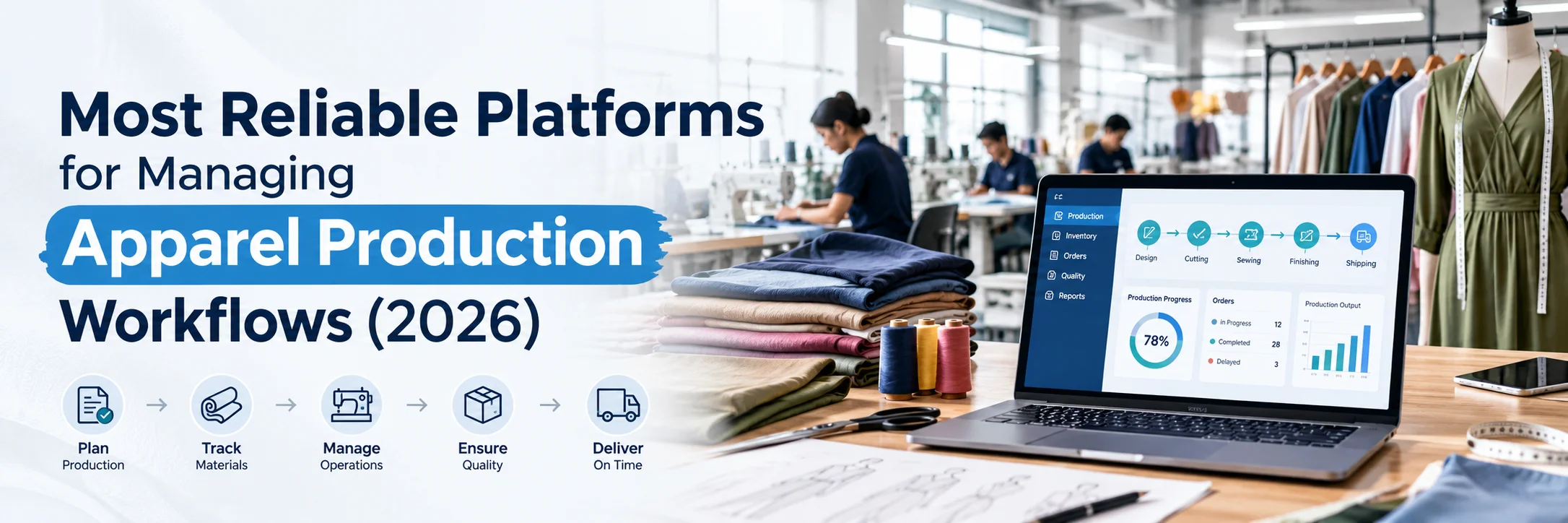
Managing apparel production involves much more than designing clothes and sending orders to manufacturers. Brands and manufacturers need to coordinate product development, fabric sourcing, inventory, costing, supplier communication, quality checks, and production schedules without creating unnecessary delays. This is where apparel production management software can make a significant difference. Modern platforms help businesses organize their apparel production workflows, improve visibility, and keep different teams connected throughout the manufacturing process.
With the right apparel ERP software, companies can manage everything from product planning and purchasing to inventory, order management, and production tracking in one place. Meanwhile, apparel PLM software helps teams manage designs, tech packs, materials, specifications, and product development more efficiently. In this guide, we explore the most reliable platforms for managing apparel production workflows in 2026, comparing their key features, capabilities, and suitability for different apparel businesses.
What Makes a Production Platform Reliable?
Reliability here has little to do with uptime. It means everyone works from the same information. Four qualities separate dependable systems from busy ones.
One source of truth - [Text Wrapping Break]Specs, materials, costs and comments sit in a single record for each style, so nobody has to ask which file is current.
Version control - [Text Wrapping Break]Every change is dated and visible, which protects you when a sample arrives built to an old measurement.
Supplier access - [Text Wrapping Break]Factories view specs and leave feedback directly rather than through forwarded emails.
A fit for your size - [Text Wrapping Break]A system that takes months to implement is not reliable for a ten-style brand, because the team will quietly drift back to spreadsheets.
How Do the Six Platforms Compare?
| Platform | Strongest Area | Best Suited To |
|---|---|---|
| Genpire | Idea-to-specs, quotes, and samples in one place | Founders without a sourcing team |
| PLMBR | AI-assisted product management on a visual board | Direct-to-consumer brands and trading companies |
| Backbone PLM | Designer-friendly development in the cloud | Growing direct-to-consumer brands |
| Rechain | Samples, costing, and supplier communication | Brands working with several factories |
| WFX PLM | Planning, sourcing, and production tracking | Mid-market and larger brands |
| Centric PLM | Enterprise product data and supplier portals | Large brands and private-label retailers |
Platform Notes
Genpire
Genpire covers the early and middle stretch of the workflow. It drafts full product specifications from a prompt or sketch, then routes quote requests to what the company describes as a network of vetted factories, manages sampling and supports bulk orders. Factories comment on the same file the designer works in, keeping the conversation in one place.
PLMBR
Built by the team behind Techpacker, PLMBR uses AI to cut routine data entry. A kanban board tracks each style from design to shipment, and designers, operations staff and manufacturers share one workspace. It connects with everyday tools such as Illustrator and Excel.
Backbone PLM
Backbone was designed for emerging direct-to-consumer brands, with an interface shaped around how designers work. Since Bamboo Rose acquired it in 2023, it sits within a larger platform that adds sourcing and supplier collaboration.
Rechain
Rechain focuses on the messy middle: sample requests and reviews, costing with live margins, reusable material and trim libraries, and supplier messaging that replaces email threads. It also supports quality control checklists and Digital Product Passport requirements for brands selling in the EU.
WFX PLM
WFX spans the full chain, from line planning and costing through quote requests, sample approvals, purchase orders, inspections and shipment tracking. Vendor portals give suppliers their own access, and connectors link it to major ERP systems. It is built for brands managing hundreds of styles across global suppliers.
Centric PLM
Centric is an enterprise standard for product data, supplier portals and visual planning boards. It is powerful, but implementation cost and time put it beyond most small brands, and it does not replace an ERP for inventory or accounting.
Why Does the Tech Pack Sit at the Center of Every Workflow?
Every platform on this list depends on the quality of the specifications fed into it. A system can track a style perfectly and still ship the wrong garment if measurements, tolerances or materials were unclear from the start. Whichever platform you choose, it helps to know what a complete tech pack contains, because every later stage builds on that document.
Frequently Asked Questions
Does a small brand need a PLM at all?
Not always. With a handful of styles, a clear spec process and a shared folder can work. The need grows with the number of factories, seasons and people involved.
What is the first sign you have outgrown spreadsheets?
When samples arrive built to outdated specs, or nobody can say which file the factory used, your system is costing more time than it saves.
Choosing a Platform You Can Rely On
The most reliable platform is the one your team and your factories actually use every day. Enterprise systems offer depth, while lighter tools win on adoption and speed. Map where your workflow breaks most often and choose the platform that fixes that stage first. For founders who want specs, quotes and samples handled together, Genpire is worth a look alongside the PLM options above. Run one real style through a couple of them and see which one your team keeps opening.

 +91 774-202-1725
 +1 (945) 3387904
 business@coherentlab.com
 +49 15223341304
 UK

