
Table of Contents
Game Design vs Game Development: Key Differences Explained
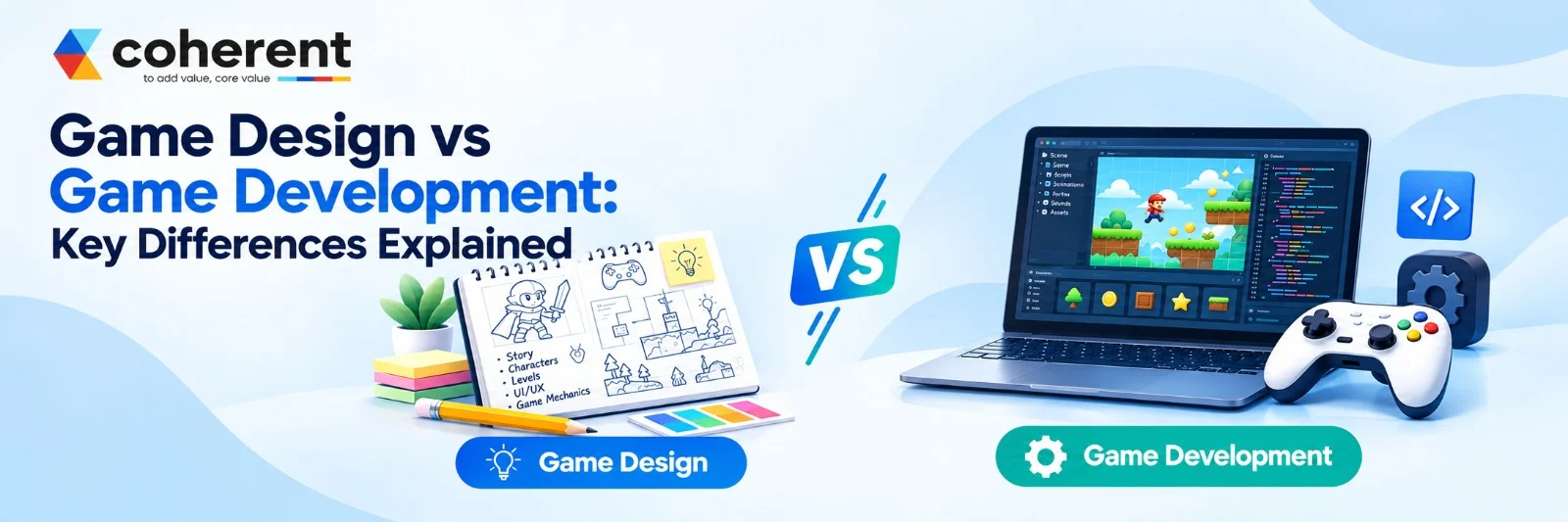
Game design and game development are two essential parts of creating a successful video game, but they serve different purposes. Game design defines the concept, rules, mechanics, characters, levels, and player experience, while game development transforms those ideas into a playable product using programming, graphics, audio, and technology.
Understanding game design vs game development helps aspiring professionals choose a career path and enables businesses to plan projects more effectively. Whether you want to build a mobile game, PC title, multiplayer experience, or immersive VR game, both disciplines must work together to deliver engaging gameplay and reliable performance.
Quick Answer
Game design focuses on a game's concept, rules, mechanics, levels, story, and player experience. Game development turns these ideas into a playable product using programming, graphics, physics, audio, and testing. Coherent Lab supports game development by helping businesses transform creative concepts into engaging digital experiences with reliable functionality, smooth performance, and cross-platform compatibility.
Key Takeaways
- Game design defines mechanics, rules, levels, and player experience.
- Game development implements the design through programming and technology.
- Designers and developers collaborate throughout production.
- Both disciplines require testing, feedback, and iteration.
- Costs depend on scope, platforms, features, and team requirements.
- Early prototyping can reveal problems before full production.
- AI, procedural content, and cross-platform experiences are trends to evaluate for 2026–2027.
Statistics and Market Insights: The Gaming Industry in 2026
The gaming industry continues to evolve across mobile, PC, console, and cloud platforms, with top trending gaming websites helping users discover popular games, gaming news, reviews, and emerging trends. Market opportunities vary by region, genre, monetization model, and audience. For businesses, understanding player preferences, website traffic, and platform adoption helps guide product decisions. Current industry research should inform investment choices rather than relying on broad growth claims alone.
Major Gaming Market Opportunities
Mobile gaming offers access to broad audiences, while PC and console games support diverse genres and premium experiences. Cloud gaming can reduce hardware barriers where connectivity and service availability permit. Market research should examine player spending, engagement, regional demand, platform preferences, and competition before selecting a development strategy.
AI, VR, and Emerging Technologies
AI-assisted tools can help teams explore ideas, generate prototypes, and support selected content workflows. Virtual reality and augmented reality create different interaction possibilities, but require careful attention to usability and hardware limitations. Adoption should be based on player value, technical feasibility, licensing, and responsible use of generated content.
What Is Game Design?
Game design is the creative process of planning a game's concept, rules, mechanics, and overall player experience. It involves defining objectives, challenges, characters, storylines, rewards, and progression systems that make gameplay engaging and meaningful. When designing real money gaming apps, designers must also consider user engagement, fair gameplay, responsible gaming features, and applicable regulations. Game designers focus on player motivation, difficulty balance, and interaction to create enjoyable experiences that align with the target audience's expectations and preferences.
Key Responsibilities of a Game Designer
A game designer develops the concept and establishes the gameplay experience before and during production. Responsibilities include:
- Creating game mechanics, rules, and objectives.
- Designing levels, characters, missions, and storylines.
- Planning player progression and reward systems.
- Improving usability through playtesting and feedback.
Essential Game Design Skills and Tools
Game designers need creativity, analytical thinking, communication, storytelling, and knowledge of player psychology. They may use Figma for interface planning, Miro for brainstorming, and Unity or Unreal Engine for prototypes. A game design document (GDD) communicates mechanics, features, requirements, and design decisions to the development team.
What Is Game Development?
Game development is the process of transforming a game concept and design into a functional, playable product. A professional game development company handles coding, gameplay systems, graphics and audio integration, physics, and performance optimization. Developers collaborate with designers, artists, and testers to ensure the game runs smoothly, delivers the intended experience, and meets technical requirements across supported platforms and devices.
Key Responsibilities of a Game Developer
Game developers implement the systems that make a game function. Their responsibilities vary by specialization but commonly include:
- Programming gameplay mechanics and controls.
- Integrating graphics, animations, and sound.
- Developing multiplayer, server, and backend systems.
- Fixing bugs and optimizing performance.
Essential Game Development Skills and Technologies
Developers use programming languages such as C# and C++, depending on the engine and project requirements. Popular engines include Unity, Unreal Engine, and Godot. Additional skills include debugging, version control, software architecture, platform integration, and performance testing to deliver stable and maintainable games.
Game Design vs Game Development: Key Differences
Game design focuses on planning gameplay, rules, characters, challenges, and player experiences, while game development turns these ideas into a functional product through programming and technical implementation. These disciplines are essential for Cross-Platform Game App Development, enabling teams to create games that work smoothly across multiple platforms and devices. Designers shape the creative direction, while developers build and optimize game systems to ensure the final game is engaging, stable, and enjoyable.
Game Design vs Game Development Comparison
| Factor | Game Design | Game Development |
|---|---|---|
| Main Focus | Gameplay and player experience | Technical implementation |
| Core Tasks | Rules, levels, mechanics, and story | Coding, systems, and integrations |
| Key Skills | Creativity and game balancing | Programming and debugging |
| Common Tools | Figma, Miro, and design documents | Unity, Unreal Engine, and IDEs |
| Main Deliverables | Game concepts, mechanics, and prototypes | Playable builds and functional systems |
Creative Planning vs Technical Implementation
Game designers decide how a character moves, how challenges progress, and what makes gameplay rewarding. Developers implement movement, collision detection, controls, and scoring systems. Both teams collaborate to refine the experience, because even a creative concept needs reliable implementation, while technically impressive features must serve the game's intended purpose.
Game Designer vs Game Developer: Roles and Career Paths
Game designers and game developers have distinct but complementary roles in the gaming industry. Designers focus on gameplay mechanics, level design, storytelling, and player experience, while developers specialize in programming, graphics, artificial intelligence, and multiplayer functionality. Game Console Development Companies bring these skills together to create engaging console gaming experiences with optimized performance and responsive gameplay. Both career paths require creativity, problem-solving, and teamwork, while practical projects and industry experience help professionals develop skills and advance their careers.
Common Game Design and Development Roles
- Game designer: defines gameplay systems and rules.
- Level designer: creates environments, challenges, and progression.
- Narrative designer: develops story structure and player choices.
- Gameplay programmer: implements controls and interactive systems.
- Engine developer: works on rendering, tools, and core technology.
- UI/UX designer: improves navigation, accessibility, and usability.
Education, Skills, and Portfolio Requirements
A relevant degree can help, but practical ability is equally important. Designers should demonstrate mechanics, prototypes, level layouts, and design documents. Developers should showcase playable projects, clean code, and technical problem-solving. Internships, game jams, online courses, and collaborative projects can help beginners develop experience and build stronger portfolios.
Benefits of Game Design and Game Development
Game design and game development work together to create engaging, enjoyable, and technically reliable gaming experiences. Game design focuses on creative concepts, gameplay mechanics, storytelling, and player engagement, while game development brings these ideas to life through programming, testing, and optimization. Game developers using NFTs can also explore blockchain-based ownership, digital collectibles, and player-driven economies. Combining both disciplines improves game quality, enhances user satisfaction, supports maintainability, and helps developers adapt to player feedback and evolving market expectations.
Key Benefits
- Improves player engagement and retention.
- Enhances gameplay quality and performance.
- Delivers better user experiences.
- Supports easier maintenance and updates.
- Increases player satisfaction and game success.
Game Design and Development Process: Step-by-Step Guide
The game design and development process involves several stages, from initial research and concept planning to prototyping, production, testing, and launch. Each stage helps teams transform creative ideas into engaging gaming experiences and build a Successful Mobile Game. Designers define gameplay mechanics, characters, and storylines, while developers build and integrate technical features. Continuous testing, performance optimization, and user feedback help fix issues and deliver a polished game that meets player expectations.
Game Development Process: Step-by-Step Table
| Step | Stage | Description | Key Activities |
|---|---|---|---|
| 1 | Research the Market and Define the Target Audience | Research player preferences, popular genres, competitors, and market trends to establish the game's direction. | - Identify target age groups and player demographics. - Analyze competitors and gaming trends. - Understand player expectations and interests. - Select platforms and monetization models. |
| 2 | Create a Concept, Core Mechanics, and Game Design Document | Develop the initial idea into a structured plan covering the game's story, objectives, rules, and gameplay mechanics. | - Define the theme, story, and objectives. - Establish core gameplay mechanics. - Create a Game Design Document (GDD). - Plan levels, characters, progression, and rewards. |
| 3 | Build a Prototype to Test the Main Gameplay Loop | Create a basic playable version to validate gameplay, identify weaknesses, and gather early feedback before full-scale production. | - Build a basic playable prototype. - Test the gameplay loop and controls. - Gather player and team feedback. - Refine mechanics before development. |
| 4 | Develop the Game Using a Suitable Engine | Implement gameplay systems, physics, controls, artificial intelligence, and technical features using an appropriate game engine. | - Choose Unity, Unreal Engine, or another suitable engine. - Implement gameplay logic, physics, and controls. - Develop AI systems, levels, and functionality. - Optimize performance for target platforms. |
| 5 | Integrate Artwork, Animation, Audio, and Interfaces | Combine visual assets, animations, sound effects, music, and user interfaces to create an immersive and consistent player experience. | - Create characters, environments, and visual assets. - Add animations, sound effects, and music. - Design menus, buttons, and interfaces. - Integrate assets and maintain visual consistency. |
| 6 | Conduct Quality Assurance, Debugging, and Optimization | Test the game for bugs, compatibility, stability, and performance to ensure a reliable experience before release. | - Test gameplay, controls, and progression. - Fix bugs, crashes, and glitches. - Check device and platform compatibility. - Optimize performance, stability, and loading speed. |
| 7 | Launch the Game, Monitor Feedback, and Release Updates | Publish the game, promote its release, monitor player feedback, and improve the experience through regular updates. | - Publish on relevant platforms or app stores. - Promote the game through marketing campaigns. - Monitor reviews and performance metrics. - Release patches, improvements, and new content. |
Step 1: Research the Market and Define the Target Audience
Market research helps game developers understand player preferences, popular genres, competitor offerings, and emerging gaming trends. Identifying the target audience early allows teams to plan suitable gameplay, visual styles, platforms, and monetization strategies. This step establishes a clear direction and reduces uncertainty before investing significant time and resources in production.
- Identify the target age group and player demographics.
- Analyze competitors, popular genres, and market trends.
- Understand player expectations, interests, and challenges.
- Select suitable platforms and monetization models.
Step 2: Create a Concept, Core Mechanics, and Game Design Document
The concept development stage transforms an initial idea into a structured game plan. Designers define the storyline, characters, objectives, rules, and core mechanics. A game design document records these decisions and communicates the vision to the entire team. Clear documentation helps maintain consistency throughout production and supports better collaboration.
- Define the game's theme, story, and objectives.
- Establish core gameplay mechanics and rules.
- Create a game design document (GDD).
- Plan levels, characters, progression, and rewards.
Step 3: Build a Prototype to Test the Main Gameplay Loop
Prototyping allows teams to test the central gameplay experience before developing the complete game. Developers create a basic playable version using simple graphics and essential mechanics. This helps identify design weaknesses, evaluate player engagement, and validate important assumptions. Early feedback enables teams to refine gameplay while keeping development costs and risks manageable.
- Build a basic playable version of the game.
- Test the main gameplay loop and controls.
- Gather feedback from players and team members.
- Improve mechanics before full-scale development begins.
Step 4: Develop the Game Using a Suitable Engine
During production, developers use a suitable game engine to implement gameplay systems, physics, controls, artificial intelligence, and other technical features. The engine choice depends on the game's genre, platform, visual requirements, and budget. A well-planned development approach helps maintain performance, simplify integration, and support future improvements throughout the production cycle.
- Choose an appropriate engine, such as Unity or Unreal Engine.
- Implement gameplay logic, physics, and player controls.
- Develop AI systems, levels, and game functionality.
- Optimize performance for the intended platforms.
Step 5: Integrate Artwork, Animation, Audio, and Interfaces
This stage brings the game world to life by combining visual assets, character animations, sound effects, music, and user interfaces. Artists, animators, sound designers, and developers collaborate to create a consistent player experience. Effective integration improves immersion, communicates important gameplay information, and makes interactions more intuitive across different devices and screen sizes.
- Create characters, environments, and visual assets.
- Add animations, sound effects, and background music.
- Design menus, buttons, and user interfaces.
- Integrate assets and maintain a consistent visual style.
Step 6: Conduct Quality Assurance, Debugging, and Optimization
Quality assurance ensures the game functions correctly and delivers a reliable player experience. Testers evaluate gameplay, identify bugs, check compatibility, and assess performance across supported devices. Developers resolve technical issues, improve loading times, and optimize resource usage. Repeated testing helps teams address problems before release and maintain quality throughout the production process.
- Test gameplay mechanics, controls, and progression.
- Identify and fix bugs, crashes, and glitches.
- Check compatibility across devices and platforms.
- Optimize performance, stability, and loading speed.
Step 7: Launch the Game, Monitor Feedback, and Release Updates
The launch stage makes the completed game available to its intended audience through selected platforms or app stores. Teams coordinate marketing, distribution, and release preparation while monitoring player feedback after launch. Performance data and user reviews help identify improvement opportunities. Regular updates, bug fixes, and additional content can maintain engagement and support long-term growth.
- Publish the game on relevant platforms or stores.
- Promote the release through marketing campaigns.
- Monitor reviews, player behavior, and performance metrics.
- Release patches, improvements, and new content.
Conclusion
Game design and game development are different but interconnected disciplines. Design establishes the experience players will have, while development makes that experience functional, responsive, and technically reliable. Neither can replace the other. The right balance depends on the game's goals, complexity, audience, and platform.
For aspiring professionals, the choice depends on whether they prefer creative problem-solving, technical implementation, or a combination of both. For businesses, collaborating with a capable team across both disciplines can improve planning, production quality, and long-term maintainability. Talk to Our Experts
Frequently Asked Questions
Q1. What is the main difference between game design and game development?
Ans. Game design focuses on gameplay mechanics, storylines, levels, objectives, and player experience. Game development involves programming, graphics, audio, and technical implementation. Designers plan how a game should work, while developers build its functionality. Both collaborate throughout the project to create engaging, functional, and enjoyable gaming experiences that meet player expectations.
Q2. Is game design easier than game development?
Ans. Neither game design nor game development is universally easier. Game design requires creativity, storytelling, player psychology, and gameplay balancing. Game development involves programming, debugging, and technical problem-solving. The difficulty depends on individual strengths, experience, and project complexity. Both careers require continuous learning, practical experience, collaboration, and dedication to creating successful games.
Q3. Do game designers need to know programming?
Ans. Game designers do not always need advanced programming skills, but basic coding knowledge is beneficial. Understanding scripting and game engines helps designers test ideas, communicate with developers, and recognize technical limitations. Technical game designers may require stronger programming abilities. The necessary skills depend on the role, studio, and complexity of the gaming project.
Q4. What skills are required to become a game developer?
Ans. Game developers need programming knowledge, logical thinking, debugging abilities, and familiarity with game engines. C# is commonly used with Unity, while C++ is widely used with Unreal Engine. Additional skills may include graphics, artificial intelligence, physics, and networking. Building playable projects, participating in game jams, and maintaining a portfolio can improve career opportunities.
Q5. Which pays more: a game designer or a game developer?
Ans. Game designer and game developer salaries vary according to experience, location, specialization, and employer. Developers specializing in graphics programming, multiplayer systems, or engine architecture may earn higher salaries in some markets. Experienced designers and design leads can also receive competitive compensation. Comparing current job listings and salary reports helps evaluate opportunities before choosing a career.
Q6. How much does game design and development cost?
Ans. Game design and development costs depend on complexity, platform, features, graphics, and team size. A simple mobile game generally costs less than a large multiplayer game. Budgets should include design, programming, art, audio, testing, licensing, and maintenance. Request a detailed estimate based on features, technical requirements, project milestones, and expected delivery timelines.
Q7. Can one person handle both game design and game development?
Ans. Yes, one person can manage both game design and development, especially for small projects. Independent creators can design gameplay, write code, create levels, and publish games using accessible engines. Larger projects often require specialists. Starting with a small prototype helps validate ideas, control costs, identify technical challenges, and improve gameplay before expanding the project.
Q8. How do I choose a game design and development company for my project?
Ans. Choose a game design and development company by reviewing its portfolio, relevant experience, technical expertise, and client feedback. Define your game concept, target audience, platforms, features, and budget before contacting providers. Discuss timelines, testing, communication, intellectual property ownership, and post-launch support. Compare proposals carefully and select a team that understands your goals and requirements.

 +91 774-202-1725
 +1 (945) 3387904
 business@coherentlab.com
 +49 15223341304
 UK

