Table of Contents
Why Enterprises Are Moving From Single AI Agents to Multi-Agent Systems
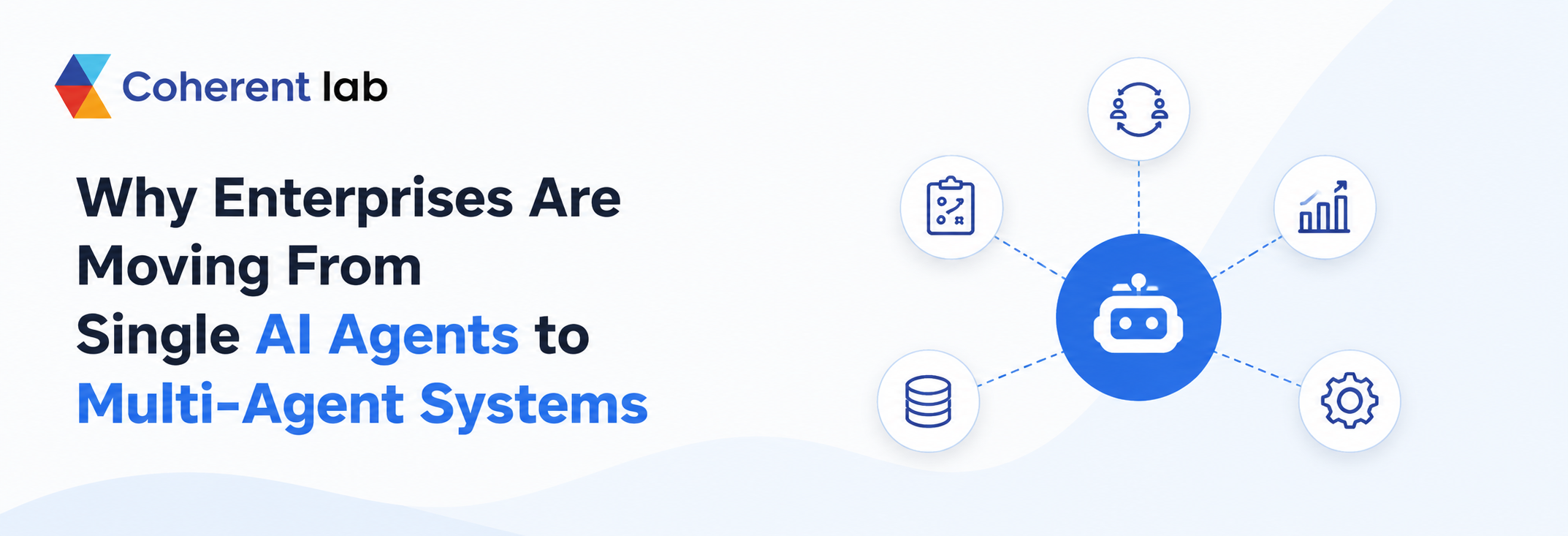
Artificial intelligence in the enterprise is entering a new phase. Businesses are no longer looking at AI only as a chatbot that answers questions or a copilot that helps employees complete individual tasks. They increasingly want AI systems that can plan work, interact with business software, retrieve information, make decisions within defined limits, and coordinate complex processes.
Instead of asking one AI agent to understand, plan, research, execute, verify, and report on an entire workflow, a multi-agent architecture distributes those responsibilities across specialized agents. Each agent can focus on a particular role while working with other agents toward a shared business objective.
For enterprises dealing with complex workflows, multiple data sources, security requirements, and different departments, this approach can offer advantages that a single-agent architecture may struggle to provide.But multi-agent AI isn't automatically better. It introduces its own cost, governance, orchestration, and reliability challenges. The real question is where the additional complexity creates meaningful business value.
What Is a Multi-Agent AI System?
A multi-agent AI system is an architecture where multiple AI agents interact, coordinate, and perform different tasks to achieve a broader objective. Instead of asking one employee to research a market, analyze customer data, prepare a campaign, approve a budget, launch the campaign, and measure its performance, a company normally assigns those responsibilities to people with different expertise.
One agent might retrieve data. Another analyzes it. A planning agent determines what should happen next. An execution agent interacts with business applications, while another agent verifies the result before an action is finalized.
The exact architecture depends on the business problem. Some systems may use only two or three agents, while complex enterprise AI automation environments could involve many specialized agents.
How Multi-Agent Systems Work
| Component | How It Works | Role in Multi-Agent Systems |
|---|---|---|
| User or System Request | A task or business goal enters the system. | Starts the AI workflow |
| Coordinator Agent | Analyzes the request and assigns tasks to suitable agents. | Manages workflow and delegation |
| Specialized AI Agents | Individual agents perform specific tasks based on their capabilities. | Provides domain-specific expertise |
| Agent Communication | Agents exchange data, results, and context with each other. | Enables effective collaboration |
| Tools & APIs | Agents connect with databases, software, APIs, and enterprise systems. | Allows agents to take real-world actions |
| Shared Memory | Important context and previous results are stored and made accessible. | Maintains workflow continuity |
| Validation Agent | Review outputs for accuracy, consistency, or predefined requirements. | Improves reliability and quality |
| Final Output | Results from multiple agents are combined into a completed response or action. | Delivers the final business outcome |
Also Read: Top AI Agentic Development Companies in India | Best Firms
Why Enterprises Are Moving Toward Multi-Agent Systems
Enterprise processes rarely happen inside one application or involve only one decision.A sales process, for example, can involve CRM records, emails, customer history, product information, pricing rules, calendars, contracts, approvals, and follow-ups. Trying to manage all of that through one AI agent can quickly become difficult.
| Reason | How Multi-Agent Systems Help | Enterprise Benefit |
|---|---|---|
| Complex Workflows | Different agents handle specialized parts of a larger task. | Better management of complex processes |
| Greater Scalability | New agents can be introduced as business requirements grow. | Easier expansion of AI capabilities |
| Specialized Expertise | Each agent can focus on a specific function or domain. | More relevant and focused outputs |
| Workflow Automation | Multiple agents coordinate sequential and parallel tasks. | Reduces repetitive manual work |
| Faster Execution | Independent tasks can be handled simultaneously. | Shorter processing and response times |
| System Integration | Agents can interact with APIs, databases, CRM, ERP, and other tools. | Connects AI with existing enterprise systems |
| Improved Reliability | Agents can review, validate, or cross-check each other's work. | Helps reduce errors and improve consistency |
| Flexible Architecture | Individual agents can be modified without rebuilding the entire system. | Easier maintenance and optimization |
How Multi-Agent Systems Work in an Enterprise Environment
In an enterprise environment, multi-agent systems connect specialized AI agents that collaborate across departments, data sources, and business tools. Companies may first build an AI agent for a specific task, then expand into a coordinated system where multiple agents share information, automate workflows, validate results, and handle complex operations efficiently.
Planning Agent
The planning agent interprets a business objective and breaks it into smaller tasks.For example, if the goal is to prepare a quarterly sales analysis, it may determine that customer data, revenue figures, pipeline information, regional performance, and historical comparisons are required.
Specialist Agents
Specialist agents perform focused tasks.A company could have agents dedicated to finance, customer support, sales research, compliance, analytics, or software development.Each can be configured with different models, instructions, tools, and access permissions.
Data Agent
The data agent retrieves relevant information from authorized sources such as databases, document repositories, APIs, CRM platforms, or enterprise knowledge bases.Its purpose is to give other agents the context required to complete their work.
Execution Agent
An execution agent performs actions in external systems. Depending on its permissions, it might create a CRM record, send an approved communication, update a ticket, trigger a workflow, or call an enterprise API. Because execution can affect real business systems, enterprises should place strict controls around this layer.
Monitoring Agent
A monitoring agent can evaluate workflow performance, detect failures, flag unusual activity, or check whether expected outcomes were achieved.This becomes increasingly important as organizations deploy more autonomous AI agents.
AI Agent Orchestration and Communication
AI agent orchestration enables multiple specialized agents to communicate, share context, delegate tasks, and coordinate actions across complex workflows. For enterprises looking to build AI-native software, effective orchestration creates a connected environment where agents can work together, access business systems, make informed decisions, and complete processes with greater efficiency.
| Component | How It Works | Enterprise Benefit |
|---|---|---|
| Task Orchestration | Assigns tasks to the most suitable AI agent. | Improves workflow efficiency |
| Agent-to-Agent Communication | Agents exchange information and results in real time. | Enables better collaboration |
| Shared Context | Agents access relevant workflow data and previous interactions. | Maintains consistency across tasks |
| Task Delegation | Complex processes are divided among specialized agents. | Reduces workload on individual agents |
| Tool & API Integration | Agents connect with enterprise applications, databases, and APIs. | Automates cross-platform operations |
| Workflow Coordination | Controls the sequence and dependencies between agent activities. | Keeps complex processes organized |
| Validation & Feedback | Agents review outputs and provide feedback to other agents. | Improves accuracy and reliability |
| Final Response | Outputs from different agents are combined into one result or action. | Delivers a complete business outcome |
Also Read :- Why Enterprises Are Rebuilding Apps Instead of Maintaining Them
Enterprise Use Cases for Multi-Agent AI Systems
Multi-agent AI systems are helping enterprises automate complex workflows across customer service, finance, healthcare, supply chain, software development, and business operations. By combining specialized enterprise AI agents, organizations can coordinate tasks, analyze data, automate decisions, and connect multiple business systems. This collaborative approach makes AI automation more scalable, flexible, and practical for handling real-world enterprise processes.
Customer Service and Support
A support system could use one agent to classify an issue, another to search the knowledge base, another to inspect account information, and a final agent to prepare or execute an appropriate resolution. Complex or sensitive cases can still be escalated to human support teams.
Sales and CRM Automation
Multi-agent AI can help coordinate prospect research, account enrichment, CRM updates, meeting preparation, proposal generation, and follow-up activities.Instead of isolated AI tools, enterprises can create connected workflows around the entire sales process.
Software Development and IT Operations
Specialized agents can assist with requirements analysis, coding, testing, documentation, security review, incident investigation, and deployment workflows.For example, a coding agent might prepare a change while separate testing and security agents review it before human approval.
Finance and Business Operations
Multi-agent systems can support invoice processing, financial analysis, reconciliation, reporting, and exception handling.Businesses can introduce approval checkpoints whenever a workflow reaches a predefined financial or operational threshold.
Supply Chain and Logistics
An enterprise could coordinate agents responsible for inventory analysis, demand forecasting, supplier information, shipment tracking, and exception management. When disruption occurs, different agents can analyze the problem before proposing the next action.
Also Read: Latest AI News and Updates: What Businesses Need to Know in 2026
Multi-Agent Systems vs Traditional Business Automation
Traditional automation remains highly effective when processes are predictable and rules are clearly defined.Multi-agent AI becomes more relevant when workflows involve unstructured information, changing context, reasoning, or decisions that cannot easily be represented through fixed rules.
| Factor | Multi-Agent Systems | Traditional Business Automation |
|---|---|---|
| Approach | Uses multiple specialized AI agents working together | Uses predefined rules and workflows |
| Decision-Making | Can dynamically reason and select actions based on context | Follows fixed logic and conditions |
| Task Management | Agents can delegate and coordinate complex tasks | Tasks follow predefined sequences |
| Adaptability | Can adjust workflows based on changing information | Usually requires manual workflow updates |
| Scalability | New agents and capabilities can be added as needed | Scaling may require additional workflow development |
| System Integration | Agents can interact with APIs, databases, and enterprise tools | Relies on configured integrations and connectors |
| Complex Workflows | Suitable for multi-step, cross-functional processes | Best suited to predictable, repetitive processes |
| Human Involvement | Can reduce manual intervention while keeping human oversight | Often requires humans for exceptions and complex decisions |
| Best Use Cases | Enterprise AI automation, research, support, operations, and data analysis | Data entry, approvals, notifications, and routine process automation |
Benefits of Multi-Agent Systems for Enterprises
Multi-agent systems help enterprises improve automation, scalability, decision-making, and operational efficiency by allowing specialized AI agents to work together. As AI is transforming app development, businesses can use coordinated agents to build smarter applications, streamline complex workflows, integrate enterprise systems, and deliver more responsive digital experiences.
End-to-end workflow automation: Multiple agents can coordinate different stages of a business process instead of automating only one task.
Specialization: Each agent can be optimized for a particular responsibility, data source, tool, or business function.
Modular scalability: Enterprises can introduce new agents as requirements evolve rather than continually expanding a single agent.
Controlled permissions: Different agents can receive only the system access required for their responsibilities.
Validation opportunities: Separate agents can review, verify, or challenge outputs before important actions occur.
Cross-system coordination: Agents can help connect workflows spanning CRMs, ERPs, databases, communication platforms, and internal applications.
Conclusion:
The transition from single AI agents to multi-agent systems represents a broader change in enterprise AI—from isolated intelligence toward coordinated, goal-driven workflows. For complex business processes, specialized agents can divide responsibilities, interact with enterprise applications, validate one another's work, and automate processes that would be difficult for a single agent to manage effectively.
However, a successful enterprise agentic AI requires much more than connecting several language models. Architecture, security, data integration, orchestration, observability, human oversight, and continuous testing all play critical roles. Businesses should therefore begin with a real operational problem, determine whether multi-agent architecture is genuinely necessary, and build around measurable outcomes.
If your organization is exploring multi-agent system development, enterprise AI automation, or custom AI agent development, talk to our experts to turn your AI use case into a secure, scalable solution designed around your existing workflows and business systems.
Frequently Asked Questions
Q1. What is a multi-agent AI system?
Ans. A multi-agent AI system consists of multiple specialized AI agents that communicate and collaborate to complete complex tasks. Instead of relying on one agent for everything, each agent can handle a specific role, such as research, data analysis, customer support, validation, or workflow execution.
Q2. Why are enterprises moving from single AI agents to multi-agent systems?
Ans. Enterprises are adopting multi-agent systems because many business workflows are too complex for a single AI agent to manage efficiently. Multiple agents can divide responsibilities, work in parallel, share information, and coordinate actions, helping businesses create more scalable and flexible enterprise AI automation.
Q3. What is the difference between a single AI agent and a multi-agent system?
Ans. A single AI agent generally handles tasks independently, while a multi-agent AI system brings together several specialized agents. These agents can collaborate, delegate tasks, use different tools, and validate results, making multi-agent architectures better suited to complex, cross-functional enterprise workflows.
Q4. What are the main enterprise use cases for multi-agent AI systems?
Ans. Common enterprise AI agent use cases include customer service, software development, financial analysis, supply chain management, cybersecurity operations, sales automation, research, and internal business processes. Multi-agent systems are particularly useful when a workflow involves several steps, tools, data sources, or areas of expertise.
Q5. How do AI agents communicate in a multi-agent system?
Ans. AI agents can communicate through an orchestration layer that manages tasks, context, messages, tools, and workflow dependencies. Effective AI agent orchestration helps each agent understand its responsibilities, exchange relevant information, and coordinate with other agents to complete an end-to-end business process.
Q6. Are multi-agent systems more scalable than single AI agents?
Ans. They can be. A well-designed multi-agent architecture allows enterprises to introduce specialized agents as requirements grow rather than expanding one agent to handle every responsibility. This modular approach can make AI automation easier to scale, maintain, test, and adapt across different business functions.
Q7. How can an enterprise get started with multi-agent AI?
Ans. Businesses should begin with a clearly defined workflow, identify tasks that benefit from specialized agents, and establish requirements for data access, security, integrations, orchestration, and human oversight. Starting with a focused enterprise AI solution can help validate value before expanding multi-agent systems across broader operations.

 +91 774-202-1725
 +1 (945) 3387904
 business@coherentlab.com
 +49 15223341304
 UK
UK