Table of Contents
How to Develop a Telemedicine App from Scratch (Step-by-Step)
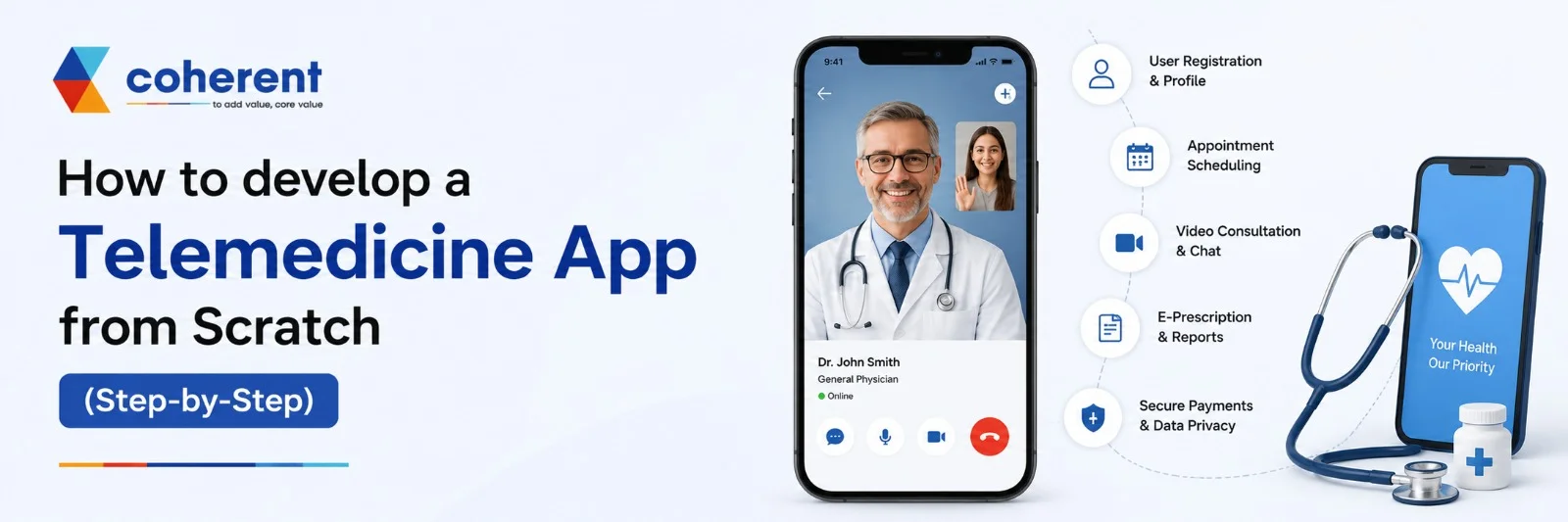
Telemedicine has transformed how patients connect with doctors, access medical advice, and manage healthcare remotely. From virtual consultations and online appointments to digital prescriptions and electronic health records, telemedicine apps make healthcare more accessible and convenient. If you are planning to build a telemedicine app, understanding the development process, essential features, technology stack, security requirements, and development costs is important before starting.
A successful telemedicine application must provide an easy experience for patients and healthcare professionals while protecting sensitive medical information. It should also support secure communication, reliable video consultations, online payments, appointment scheduling, and healthcare data integration. This guide explains how to develop a telemedicine app from scratch, covering every major step from business planning and UI/UX design to development, testing, deployment, monetization, and maintenance.
What Is a Telemedicine App and How Does It Work?
Telemedicine App Development enables businesses to create digital healthcare platforms that connect patients with doctors through smartphones, tablets, or web applications. Depending on the business model, these apps can support appointment scheduling, video consultations, secure messaging, e-prescriptions, online payments, medical records, and follow-up care. The platform typically provides dedicated interfaces for patients, healthcare providers, and administrators, ensuring convenient and connected remote healthcare delivery.
How Does a Telemedicine App Work?
- Patient registration: Patients create accounts, complete profiles, add health information, and search for suitable healthcare professionals based on specialty, availability, location, ratings, or consultation fees.
- Appointment booking: Patients select an available doctor, choose a consultation date and time, make a payment when required, and receive confirmation through push notifications, email, or SMS.
- Virtual consultation: At the scheduled time, patients enter a secure video or audio consultation room. Doctors can communicate with patients, review relevant information, and provide medical guidance.
- Digital healthcare services: After consultation, doctors can provide digital prescriptions, consultation notes, recommendations, or follow-up instructions while patients can access their records securely.
Why Should You Develop a Telemedicine App in 2026?
The growing adoption of remote healthcare has created opportunities for startups, hospitals, clinics, healthcare networks, and technology companies. A well-designed telemedicine platform can reduce geographical barriers and make healthcare services available beyond traditional clinic hours. Businesses can also create specialized platforms for mental healthcare, chronic disease management, specialist consultations, or corporate healthcare services.
Key Benefits of Telemedicine App Development
- Improved healthcare accessibility: Patients can connect with healthcare professionals without travelling long distances, which is especially useful for people with limited mobility or those living far from specialized healthcare facilities.
- Better patient convenience: Online appointments, virtual consultations, digital prescriptions, and reminders allow patients to manage healthcare activities from a single application.
- Scalable business opportunities: Telemedicine platforms can expand by adding new doctors, specialties, locations, healthcare services, subscription plans, and digital health features.
- Enhanced patient engagement: Notifications, follow-ups, medication reminders, health records, and secure messaging can encourage patients to remain connected with healthcare providers.
How to Develop a Telemedicine App Step by Step?
Developing a telemedicine application requires more than creating a mobile interface. The process involves market research, business planning, feature selection, UI/UX design, mobile app development, technology selection, backend development, healthcare integrations, security, testing, deployment, and ongoing maintenance. Defining the MVP early can reduce development complexity, control costs, and help validate the concept before introducing advanced healthcare features and capabilities.
Step-by-Step Telemedicine App Development Process
- Step 1 – Define the business model: Decide whether the application will operate as a doctor marketplace, hospital platform, clinic solution, B2C healthcare application, B2B healthcare platform, or subscription-based service. Clearly identify your target patients and healthcare professionals.
- Step 2 – Plan the MVP: Select the essential features required for the first version, such as registration, doctor profiles, appointment scheduling, video consultation, chat, payments, prescriptions, notifications, and an administration panel.
- Step 3 – Design and develop: Create patient and doctor workflows before starting development. Build the frontend, backend, APIs, database, authentication system, appointment engine, communication functionality, and payment infrastructure.
- Step 4 – Test, launch, and improve: Perform functional, security, performance, usability, API, and video-call testing. After deployment, monitor application performance, collect user feedback, fix issues, and continuously introduce valuable improvements.
Also Read :- Medicine Delivery App Development 2026 | Features, Cost
Which Technology Stack Is Best for Telemedicine App Development?
Choosing the right technology stack affects application performance, scalability, security, maintenance, and integration capabilities. The technology selection should be based on your platform requirements, development budget, expected user volume, healthcare integrations, and long-term product roadmap. Cross-platform technologies can reduce development effort when the same application needs to support multiple mobile platforms.
| Technology Area | Recommended Technologies | Purpose |
|---|---|---|
| Mobile Development | Flutter, React Native, Swift, Kotlin | Patient and doctor applications |
| Frontend | React, Next.js | Web dashboards and portals |
| Backend | Node.js, Python, Java | APIs and business logic |
| Database | PostgreSQL, MySQL, MongoDB | Application and user data |
| Cloud | AWS, Google Cloud, Microsoft Azure | Hosting and scalability |
| Video | WebRTC, Video APIs | Virtual consultations |
| Healthcare Data | HL7 FHIR | Healthcare interoperability |
| Payments | Stripe, Razorpay, PayPal | Online transactions |
| Notifications | Firebase Cloud Messaging | Push notifications |
| Security | OAuth, MFA, Encryption | Authentication and data protection |
How Much Does It Cost to Develop a Telemedicine App?
The cost to develop a telemedicine app depends on its complexity, platform, features, UI/UX, development team location, integrations, security, interoperability, and maintenance. A basic MVP with appointments and video consultations requires less investment than an enterprise solution with AI-powered features, remote monitoring, EHR integration, multilingual support, and analytics. Choosing experienced AI App Development expertise can also help build smarter, secure, and scalable healthcare solutions.
Factors Affecting Telemedicine App Development Cost
- Application complexity: A basic telemedicine MVP costs less than a multi-sided platform with patient, doctor, pharmacy, laboratory, insurance, and administrative functionality.
- Number of platforms: Developing separate native iOS and Android applications can increase costs compared with a carefully planned cross-platform solution.
- Third-party integrations: Video APIs, payment gateways, SMS services, maps, identity verification, healthcare APIs, analytics, and notification services can influence both initial and recurring expenses.
- Security and advanced technology: Strong security controls, compliance requirements, AI capabilities, remote patient monitoring, wearable integrations, and healthcare interoperability can significantly increase development effort.
How Long Does It Take to Build a Telemedicine App?
The development timeline depends on the number of features, platforms, integrations, design complexity, team size, testing requirements, and compliance scope. A focused MVP can be launched faster than an enterprise-grade healthcare ecosystem. Dividing development into phases allows businesses to validate core functionality before investing heavily in advanced capabilities.
Telemedicine App Development Timeline
- Planning and research: Define the target market, business model, user journeys, regulatory requirements, competitors, technical requirements, and MVP scope.
- UI/UX design: Create wireframes, prototypes, design systems, patient workflows, doctor workflows, and administrative interfaces before implementation.
- Development and integration: Build frontend and backend systems, APIs, databases, authentication, appointment scheduling, payments, video consultations, notifications, and healthcare integrations.
- Testing and deployment: Complete functional, security, performance, usability, device compatibility, and integration testing before publishing the application and beginning post-launch monitoring.
How Can a Telemedicine App Make Money?
A telemedicine platform can use multiple monetization models depending on its target audience and healthcare services. The most suitable model should create sustainable revenue without making essential healthcare access unnecessarily difficult. Businesses should also consider doctor participation, patient demand, service costs, payment processing, and local regulations before selecting a monetization strategy.
Best Telemedicine App Monetization Models
- Commission per consultation: The platform can charge a percentage or service fee for successful consultations booked through the application.
- Subscription plans: Patients or healthcare providers can pay monthly or annual subscription fees for premium functionality, priority services, or additional platform benefits.
- Doctor membership: Doctors can purchase professional plans offering enhanced profiles, analytics, appointment-management tools, visibility features, or additional business capabilities.
- Healthcare partnerships: Platforms can generate revenue through corporate healthcare programs, clinic partnerships, specialized services, or other B2B healthcare arrangements where legally and commercially appropriate.
How to Launch and Maintain a Telemedicine App?
Launching a telemedicine app is not the final stage of development. Healthcare applications require continuous monitoring because technology, security threats, user expectations, integrations, and regulatory requirements can change. A strong post-launch strategy helps maintain performance and improve the product based on real-world user behavior.
Telemedicine App Launch and Maintenance Strategy
- App deployment: Prepare production infrastructure, configure application-store requirements, establish monitoring, complete final security checks, and release the patient and healthcare-provider applications.
- Performance monitoring: Monitor crashes, API performance, server health, video quality, login failures, appointment issues, payment errors, and other important operational metrics.
- Security maintenance: Regularly review access controls, dependencies, APIs, authentication systems, cloud configurations, backups, and security procedures to reduce potential vulnerabilities.
- Continuous improvement: Analyze feedback and product data to improve onboarding, consultation workflows, appointment booking, search, accessibility, retention, and advanced healthcare functionality.
Also Read :- Smart Choice for Healthcare App Development
Conclusion
Developing a telemedicine app from scratch requires careful planning across business strategy, user experience, technology, healthcare integrations, security, compliance, and ongoing maintenance. Start with a focused MVP covering essential patient, doctor, appointment, consultation, payment, and administration features. After validating the core platform, you can add AI, remote patient monitoring, wearable integration, EHR connectivity, and advanced analytics.
Patient privacy, data security, reliability, and regulatory compliance should remain fundamental throughout development. With the right technology stack and healthcare expertise, your telemedicine app can become a scalable digital healthcare solution. To discuss your requirements and development goals, Connect With Us today.
Frequently Asked Questions
Q1. How much does it cost to develop a telemedicine app?
Ans. The cost varies according to features, platforms, integrations, design complexity, development location, security requirements, and application scale. A basic MVP with registration, doctor profiles, appointment scheduling, video consultation, payments, and an admin panel requires less investment than an advanced healthcare platform with AI, remote patient monitoring, EHR integration, multilingual functionality, and enterprise analytics. A detailed feature list is required for an accurate estimate.
Q2. How long does it take to develop a telemedicine app?
Ans. A telemedicine application can take several months to develop, depending on its scope and complexity. Planning, UI/UX design, frontend and backend development, video consultation, payment integration, healthcare APIs, security implementation, testing, and deployment all affect the timeline. A focused MVP can generally be completed faster than a large-scale healthcare platform. Using an agile development process can also help businesses release core functionality in stages.
Q3. What are the must-have features of a telemedicine app?
Ans. Core telemedicine features typically include patient registration, doctor profiles, doctor search, appointment scheduling, video or audio consultation, secure messaging, digital prescriptions, online payments, notifications, medical history, and an administrative dashboard. Doctors should have tools for managing availability, appointments, consultations, patient information, and prescriptions. The exact feature set should be based on the healthcare business model, target users, geography, and applicable regulatory requirements.
Q4. How do I make a telemedicine app HIPAA compliant?
Ans. HIPAA compliance cannot be achieved simply by adding a single security feature. The application should implement appropriate administrative, technical, and physical safeguards where HIPAA applies. Important areas can include access controls, authentication, encryption, audit controls, secure data handling, risk management, and appropriate vendor agreements. Businesses targeting the U.S. healthcare market should evaluate their specific obligations with qualified compliance and legal professionals before launch.
Q5. What technology is used to build a telemedicine app?
Ans. Telemedicine applications can use Flutter or React Native for cross-platform mobile development and Swift or Kotlin for native applications. Node.js, Python, or Java can support backend services, while PostgreSQL, MySQL, or MongoDB can manage application data. WebRTC or specialized video APIs can enable virtual consultations. Cloud platforms such as AWS, Microsoft Azure, or Google Cloud can provide scalable infrastructure, while healthcare integrations may use standards such as HL7 FHIR.
Q6. Can AI be integrated into a telemedicine app?
Ans. Yes, AI can support several telemedicine workflows when implemented responsibly. Potential applications include symptom intake, patient triage assistance, appointment recommendations, conversational support, medical documentation assistance, personalized health insights, and administrative automation. AI should not automatically replace qualified medical professionals or provide unsafe diagnoses. Healthcare businesses should establish appropriate clinical oversight, data protection, transparency, validation, and regulatory processes before deploying AI-powered functionality.
Q7. How does a telemedicine app make money?
Ans. Telemedicine applications can generate revenue through consultation commissions, patient subscriptions, doctor memberships, appointment fees, premium healthcare services, and B2B healthcare partnerships. Some platforms may combine multiple revenue streams to reduce dependence on a single source. The monetization model should align with the target market, healthcare regulations, operating expenses, payment processing costs, and user expectations. Transparent pricing can also help improve trust and long-term patient retention.
Q8. How can I choose a telemedicine app development company?
Ans. Choose a development partner with demonstrated experience in healthcare applications, secure mobile development, video consultation, API integration, cloud infrastructure, and healthcare interoperability. Evaluate previous projects, development methodology, security practices, communication process, testing capabilities, maintenance support, and technical expertise. Ask how the team approaches privacy, compliance, scalability, and sensitive healthcare data. A strong development partner should also provide a clear roadmap, realistic timeline, transparent pricing, and post-launch support.

 +91 774-202-1725
 +1 (945) 3387904
 business@coherentlab.com
 +49 15223341304
 UK
UK