Table of Contents
How to Build an AI Shopping Agent for WooCommerce: Development Guide
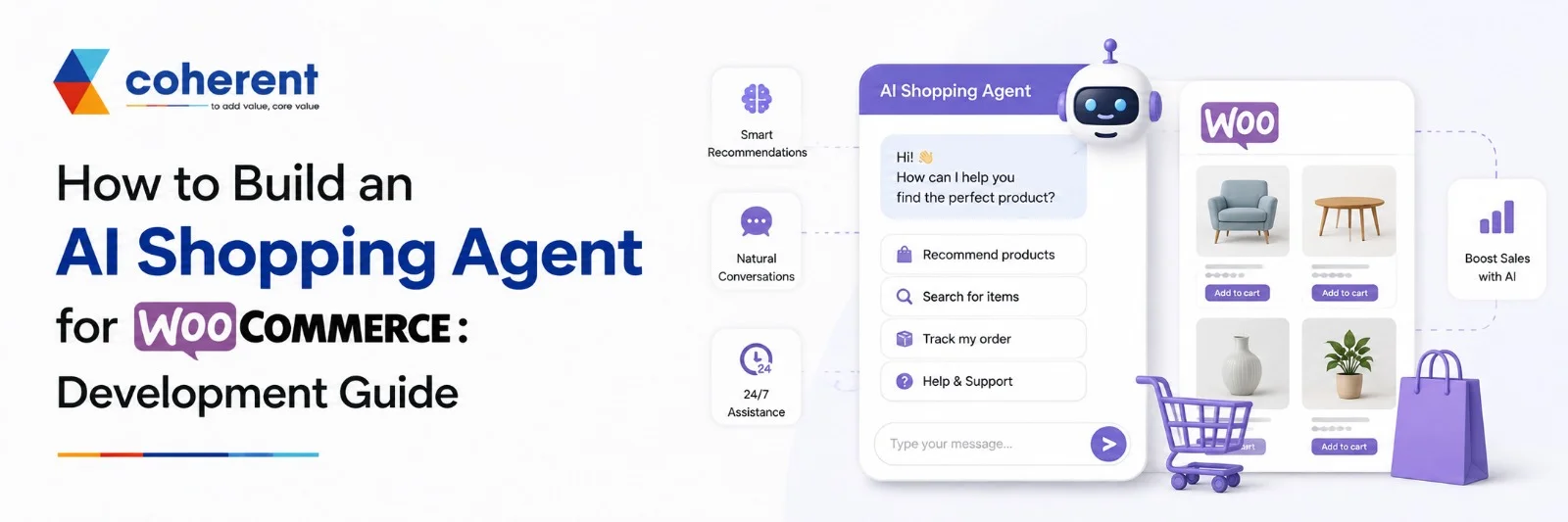
Ecommerce is moving beyond basic search bars and rule-based chatbots toward intelligent shopping experiences that understand customer intent, preferences, and context. An AI shopping agent for WooCommerce can help customers discover products, compare options, receive personalized recommendations, manage carts, track orders, and get instant answers through natural conversations. Unlike traditional chatbots, AI agents can connect with product catalogs, WooCommerce APIs, customer data, and external tools to perform useful shopping actions.
Businesses can combine large language models (LLMs), retrieval-augmented generation (RAG), semantic search, and automation to create a more responsive digital storefront. This guide explains how to build an AI shopping agent for WooCommerce, including essential features, technology stack, development steps, AI integration, costs, security considerations, challenges, and future opportunities. It also provides a practical framework for businesses planning an AI-powered ecommerce solution.
What Is an AI Shopping Agent for WooCommerce?
An AI shopping agent for WooCommerce is an intelligent assistant that helps customers discover products, compare options, answer questions, and complete purchases. It can understand customer preferences and provide personalized recommendations in real time. Businesses looking to expand these capabilities can explore How to Build an AI Agent for Your Business to create smarter, automated shopping experiences that improve customer engagement, conversions, and overall satisfaction.
How an AI Shopping Agent Works
- Understands customer intent: The agent interprets requests such as “show me affordable running shoes” and identifies product requirements, budget, preferences, and context.
- Searches product information: It connects with WooCommerce product catalogs, databases, APIs, and vector search systems to retrieve relevant products.
- Provides personalized responses: The AI can compare products, explain specifications, recommend alternatives, and suggest complementary products.
- Performs shopping actions: With appropriate permissions, the agent can add products to carts, check order information, and guide customers toward checkout.
Key Features of a WooCommerce AI Shopping Agent
A WooCommerce AI shopping agent helps customers discover products faster through personalized recommendations, intelligent search, and real-time assistance. It can understand natural-language queries, compare products, suggest suitable alternatives, answer product-related questions, and guide shoppers throughout their buying journey. By analyzing customer preferences, browsing behavior, and purchase history, the agent creates personalized experiences while helping WooCommerce stores improve engagement, conversions, and customer satisfaction.
Essential AI Shopping Agent Features
- Conversational product search: Customers can search using natural language instead of relying only on keywords and filters.
- AI product recommendations: The system can recommend products based on preferences, requirements, behavior, and shopping context.
- Product comparison: Customers can ask the AI to compare specifications, pricing, features, reviews, and use cases.
- Smart cart and order assistance: The agent can help manage carts, answer order questions, and guide customers through purchasing workflows.
What Technology Stack Is Needed to Build an AI Shopping Agent?
A modern AI shopping agent requires a robust technology stack combining artificial intelligence, natural language processing, machine learning, databases, APIs, and cloud infrastructure. Technologies such as Python, LLM APIs, vector databases, React, Node.js, and cloud platforms enable intelligent product discovery, recommendations, conversational search, personalization, and real-time pricing. A reliable mobile app development company can help build scalable, secure, and engaging shopping experiences across devices.
Recommended Technology Stack
- Frontend: React, Next.js, JavaScript, or WooCommerce-compatible interfaces can power conversational shopping experiences and interactive product cards.
- Backend: Node.js, Python, PHP, or Java can handle business logic, authentication, API communication, AI orchestration, and application workflows.
- AI and data layer: LLM APIs, embeddings, RAG frameworks, and vector databases such as Pinecone, Qdrant, or Weaviate can support intelligent product discovery.
- WooCommerce infrastructure: WooCommerce REST API, webhooks, WordPress, MySQL, cloud hosting, and monitoring tools can connect the agent with store operations.
| Technology Area | Recommended Options | Purpose |
|---|---|---|
| Frontend | React, Next.js, JavaScript | Chat and shopping interface |
| Backend | Node.js, Python, PHP | APIs and business logic |
| AI Models | OpenAI, Gemini, Claude | Natural-language reasoning |
| Search | Elasticsearch, OpenSearch | Product search |
| Vector Database | Pinecone, Qdrant, Weaviate | Semantic retrieval |
| Database | MySQL, PostgreSQL, MongoDB | Application and customer data |
| WooCommerce | REST API, Webhooks | Store integration |
| Cloud | AWS, Azure, Google Cloud | Hosting and scalabilit |
How to Integrate AI With WooCommerce?
Learn how AI can transform your WooCommerce store through personalized product recommendations, intelligent search, automated customer support, dynamic pricing, inventory forecasting, and marketing automation. This guide explains the key AI integration methods, tools, technologies, benefits, and implementation steps to help businesses create smarter shopping experiences, improve customer engagement, streamline operations, and increase conversions while reducing manual effort and operational cos
WooCommerce AI Integration Process
- Connect WooCommerce APIs: Configure secure API credentials and establish communication between the AI backend and WooCommerce store.
- Synchronize catalog data: Import product names, descriptions, categories, attributes, variations, pricing, availability, and other relevant information.
- Implement webhooks: Use event-driven updates to keep product and inventory information synchronized with the AI search layer.
- Control AI permissions: Allow the agent to access only the WooCommerce actions it genuinely needs, especially when handling carts, customers, or orders.
How to Build an AI Shopping Agent for WooCommerce Step by Step?
Building an AI shopping agent for WooCommerce requires careful planning, from understanding customer needs to integrating AI-powered product search, recommendations, and automated assistance. Businesses can streamline this process by working with an experienced AI app development company that understands eCommerce workflows, WooCommerce APIs, and intelligent automation. A well-designed solution can improve product discovery, personalize shopping experiences, and help increase customer engagement and conversions.
Step 1: Define Shopping Use Cases
- Identify the main customer problems the AI agent should solve, such as product discovery, recommendations, comparisons, and support.
- Define which actions the agent can perform automatically and which actions require customer confirmation.
- Determine target customers, product categories, supported languages, and shopping channels.
- Establish measurable goals such as conversion rate, engagement, response quality, support automation, and average order value.
Step 2: Prepare and Structure WooCommerce Data
- Clean product titles, descriptions, specifications, categories, attributes, pricing, inventory, and variation data.
- Standardize product information so the AI can retrieve and compare products consistently.
- Include useful supporting content such as FAQs, shipping policies, return policies, and product documentation.
- Create structured metadata and embeddings if semantic or RAG-based search will be used.
Step 3: Choose an AI Model
- Evaluate LLMs according to reasoning quality, response speed, context window, tool-calling capabilities, and supported languages.
- Consider API pricing and expected conversation volume before selecting the model.
- Choose models capable of following structured instructions and safely interacting with defined tools.
- Test multiple models using real ecommerce queries instead of relying only on benchmark results.
Step 4: Implement RAG for Product Search
- Convert relevant product information into embeddings and store them in a suitable vector database.
- Retrieve the most relevant products based on the meaning and intent behind customer queries.
- Combine retrieved product information with the customer's current conversation context.
- Generate responses using current retrieved data to reduce inaccurate or outdated AI-generated information.
Step 5: Add AI Agent Tools and Actions
- Create controlled tools for product search, product comparison, inventory checking, and product-detail retrieval.
- Add cart functions such as adding, removing, or updating products where appropriate.
- Build order-status tools for authenticated customers when business requirements allow.
- Use confirmation steps before important actions to prevent unintended changes.
Step 6: Connect the Agent With WooCommerce APIs
- Configure authentication and secure API communication between the application and WooCommerce.
- Map AI tool calls to the appropriate WooCommerce REST API endpoints.
- Validate every requested action before sending it to the store backend.
- Use webhooks and event processing to maintain synchronization between WooCommerce and AI services.
Step 7: Build the Conversational Shopping Interface
- Create an intuitive AI chat widget that is accessible throughout the shopping journey.
- Display product cards containing useful information such as images, prices, ratings, availability, and purchase actions.
- Add quick actions for comparing products, viewing details, filtering recommendations, and adding products to a cart.
- Consider voice and multimodal capabilities if they match the target audience and ecommerce use case.
Step 8: Test, Secure, and Deploy
- Test the AI using real customer scenarios, ambiguous questions, product comparisons, and edge cases.
- Validate API permissions, authentication, customer-data handling, and tool execution.
- Monitor latency, API usage, hallucinations, failed actions, and customer satisfaction.
- Deploy gradually, measure performance, and continuously improve the agent using real interaction data.
Also Read :- Top AI Agentic Development Companies in India
How Can AI Personalize WooCommerce Product Recommendations?
AI can personalize WooCommerce product recommendations by analyzing customer behavior, browsing history, purchase patterns, search activity, and preferences. Machine learning algorithms use this data to suggest relevant products, complementary items, and personalized offers for each shopper. AI-powered recommendations can improve product discovery, increase customer engagement, boost conversions, and enhance the overall shopping experience while helping store owners maximize sales and customer retention.
AI Personalization Strategies
- Browsing behavior: Analyze relevant browsing and interaction signals to understand current shopping interests.
- Purchase history: Where permitted, previous purchases can help identify preferences and complementary product opportunities.
- Shopping preferences: The agent can learn conversational preferences such as budget, size, color, brand, features, or intended use.
- Real-time intent: The customer's current conversation can be used to refine recommendations dynamically rather than relying only on historical data.
How to Add AI-Powered Product Search to WooCommerce?
AI-powered product search can make WooCommerce stores faster, smarter, and more user-friendly by understanding natural-language queries, customer intent, product attributes, and preferences. This guide explains how to integrate AI search into WooCommerce, covering suitable AI technologies, search features, implementation steps, product data processing, personalization, and performance optimization. It also highlights how intelligent search can improve product discovery, customer experience, conversions, and overall eCommerce growth.
AI Product Search Capabilities
- Natural-language queries: Understand questions and descriptive shopping requests.
- Semantic search: Find products based on meaning and context rather than exact keyword matches.
- Attribute filtering: Combine AI understanding with structured WooCommerce filters such as price, size, brand, category, and availability.
- Multimodal discovery: Advanced systems can support voice or image-based shopping experiences alongside text.
Also Read :- How AI is transforming app development in 2026
How Much Does It Cost to Build an AI Shopping Agent for WooCommerce?
The cost of building an AI shopping agent depends on its functionality, AI architecture, integrations, design, development team, and expected usage. A simple MVP with conversational search and recommendations requires less investment, while advanced solutions may include RAG, personalized recommendations, cart automation, voice interaction, multilingual support, analytics, and integrations. Businesses like Coherent Lab LLP can help build scalable AI shopping solutions tailored to specific requirements.
Factors Affecting AI Shopping Agent Development Cost
- AI model and API usage: Token consumption, model selection, embeddings, and request volume can influence recurring costs.
- Integration complexity: Basic product retrieval is simpler than implementing secure cart, customer, payment, and order workflows.
- AI features: RAG, personalization, recommendations, voice, multimodal capabilities, and autonomous workflows increase development requirements.
- Maintenance: Product synchronization, model updates, infrastructure, monitoring, security, and optimization create ongoing costs after launch.
AI Shopping Agent vs Traditional WooCommerce Chatbot
Traditional chatbots typically depend on predefined rules, menus, and scripted responses. AI shopping agents can understand more flexible language, retrieve information dynamically, reason over context, and use tools to perform authorized actions. However, businesses should still define clear boundaries because autonomous functionality requires strong validation and security.
Key Differences
- Conversational intelligence: AI agents can understand more varied natural-language requests.
- Product discovery: Semantic retrieval can identify products beyond exact keyword matches.
- Personalization: Agents can adapt recommendations to context and preferences.
- Autonomous actions: With controlled tools, agents can perform selected ecommerce operations instead of only providing information.
Also Read :- AI-Powered Mobile App Development Guide for Businesses
Conclusion
Building an AI shopping agent for WooCommerce can transform a traditional online store into a conversational, personalized, and intelligent shopping experience. By combining LLMs, RAG, semantic search, WooCommerce APIs, product data, and controlled AI tools, businesses can improve product discovery, recommendations, customer support, and shopping automation.
The best approach is to start with a focused MVP, secure integrations, reliable real-time data, and continuous AI performance monitoring. As agentic commerce evolves, businesses can create more relevant customer journeys and improve operational efficiency. If you’re planning to build an AI shopping agent, Get in Touch to discuss your requirements.
Frequently Asked Questions
Q.1 What is an AI shopping agent in WooCommerce?
Ans. An AI shopping agent is an intelligent assistant integrated with a WooCommerce store that understands customer requests and helps with product discovery, recommendations, comparisons, and support. Depending on its permissions, it can also interact with carts, retrieve order information, and perform selected store actions. It typically combines an LLM with WooCommerce APIs, product databases, search technology, and sometimes RAG to provide context-aware ecommerce assistance.
Q.2 Can I integrate ChatGPT with WooCommerce?
Ans. Yes, ChatGPT-style AI capabilities can be integrated with WooCommerce through an application backend, APIs, and an AI model provider. The integration can allow the AI to retrieve product information, answer customer questions, recommend products, and support shopping workflows. Developers should avoid giving the model unrestricted access to the store. Instead, controlled tools and API permissions should determine which WooCommerce operations the AI is allowed to perform.
Q.3 How does an AI shopping agent recommend products?
Ans. An AI shopping agent can combine customer intent, product attributes, semantic search, conversation context, and personalization signals to generate recommendations. For example, a shopper can provide a budget and preferred features, and the agent can retrieve matching products from the WooCommerce catalog. A RAG-based architecture can help ground recommendations in current product information, while recommendation algorithms can further improve personalization based on permitted behavioral signals.
Q.4 Can an AI agent add products to the WooCommerce cart?
Ans. Yes, an AI agent can support cart operations when the application provides a secure cart-management tool connected to WooCommerce. The agent can identify the requested product and variation, confirm availability, and then initiate an approved cart action. Developers should validate product IDs, quantities, prices, variations, and customer permissions before executing changes. Confirmation can also be required for important actions to reduce unintended purchases or cart modifications.
Q.5 How much does it cost to build a WooCommerce AI shopping agent?
Ans. There is no single development price because the cost depends on the project's scope. A basic conversational assistant with product search requires less development than an advanced platform using RAG, personalized recommendations, voice, multilingual support, cart automation, analytics, and complex integrations. Costs can also include AI API usage, cloud infrastructure, vector databases, maintenance, monitoring, security, and ongoing optimization after the initial launch.
Q.6 How long does it take to develop an AI shopping agent?
Ans. The development timeline depends on the required features, integration complexity, data quality, design requirements, and testing process. A focused MVP with conversational product search and recommendations can be delivered faster than an advanced AI agent with RAG, personalization, cart management, order support, voice capabilities, and multilingual functionality. A staged approach is generally more practical because businesses can launch core capabilities, measure results, and expand the agent gradually.
Q.7 Is RAG necessary for a WooCommerce AI shopping assistant?
Ans. RAG is not mandatory for every WooCommerce AI assistant, but it can be highly useful when the agent needs accurate store-specific information. Product descriptions, prices, specifications, inventory, policies, and FAQs can change frequently. RAG allows the application to retrieve relevant information before generating responses. For simple scripted assistance, traditional databases and APIs may be sufficient, while larger product catalogs can benefit significantly from semantic retrieval.
Q.8 Can a WooCommerce AI shopping agent handle customer orders?
Ans. A WooCommerce AI shopping agent can assist with order-related tasks when secure APIs and authentication are implemented. It may retrieve order status, provide shipping information, explain order details, or guide customers through support processes. Access to customer-specific information should require appropriate verification, and sensitive actions should be tightly controlled. The AI should never receive unrestricted backend access; every order-related capability should be explicitly defined and validated.

 +91 774-202-1725
 +1 (945) 3387904
 business@coherentlab.com
 +49 15223341304
 UK
UK