
Table of Contents
How Live Scores and Leaderboards Work in Fantasy Sports Apps
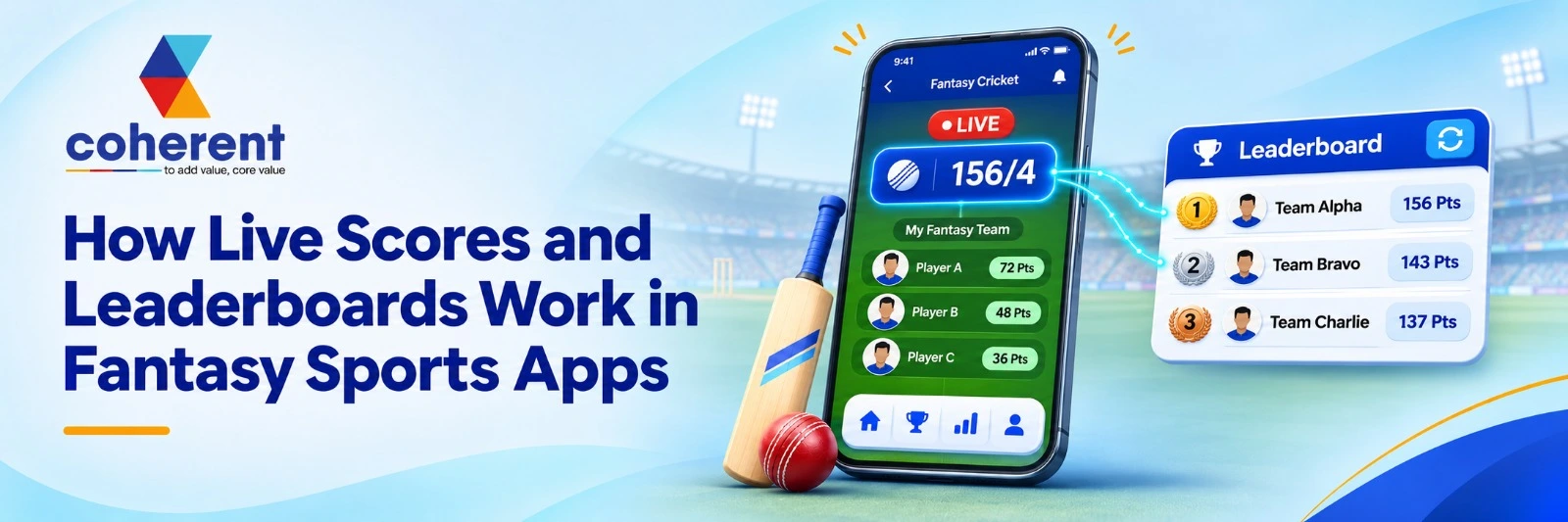
Fantasy sports apps have transformed how fans experience live sporting events. Instead of simply watching a cricket match, football game, or basketball tournament, users can create virtual teams, select real-life players, earn points based on their performances, and compete against other participants.Behind this apparently simple experience is a sophisticated technology system that combines sports data APIs, event processing, databases, caching, and real-time communication.
Live scores and leaderboards in fantasy sports apps work through real-time sports data integration, scoring algorithms, backend processing, and ranking systems. These components collect match events, convert player performances into fantasy points, calculate team scores, and update leaderboard positions so users can follow their progress throughout a live match.Let's explore how these systems work, what technologies power them, and what businesses should consider when developing a fantasy sports application.
How Do Live Scores Work in Fantasy Sports Apps?
Live scores in fantasy sports apps work by collecting real-time match data, processing player performances, applying predefined fantasy scoring rules, and updating team points automatically. The process connects sports data APIs with backend scoring engines and mobile application interfaces. Whenever a player scores a run, takes a wicket, or scores a goal, the system evaluates the event and updates fantasy points. This allows users to monitor team performance and contest rankings during live matches. Businesses planning to build similar platforms can partner with a trusted Mobile App Development Company to develop scalable applications with real-time scoring, leaderboard management, and engaging user experiences.
1. Sports Data Collection Through APIs
Fantasy sports applications rely on third-party sports data APIs to collect accurate match information. These APIs provide structured data about ongoing matches, individual player performances, and important sporting events. Developers integrate these services into the application backend to receive regular updates. Providers such as Sportradar offer sports data feeds that support live score functionality across different sports.
- Live match scores and match status.
- Player statistics, including runs, wickets, goals, and assists.
- Player substitutions and performance updates.
- Match events, including boundaries, penalties, and dismissals.
2. Processing Real-Time Match Events
After collecting sports data, the application backend processes incoming match events to identify player performances and their impact on fantasy contests. Each event passes through validation and processing stages before the scoring engine calculates its value. This ensures that relevant actions are recorded correctly and duplicate or incorrect updates do not unnecessarily affect fantasy scores.
- A batsman hitting a four or six.
- A bowler taking a wicket.
- A footballer scoring a goal.
- A basketball player making a three-point shot.
3. Applying Fantasy Scoring Rules
Once match events are processed, the fantasy scoring engine converts actual player performances into fantasy points. Each platform follows predefined scoring rules based on the selected sport and contest format. The engine evaluates eligible actions and assigns points or deductions accordingly. This calculation ensures that users receive scores based on their selected players' actual match performances rather than simply relying on overall team results.
- Points for runs, boundaries, and wickets.
- Bonus points for catches and assists.
- Deductions for penalties or poor performances.
- Special bonuses for captain and vice-captain selections.
4. Calculating the Fantasy Team Score
After individual player points are calculated, the backend combines them to determine the user's total fantasy team score. The system considers selected players, captain and vice-captain multipliers, substitutions, and applicable contest rules. Whenever new match information becomes available, the scoring engine recalculates the affected totals. This allows users to track their fantasy performance throughout the competition.
- Adding eligible points earned by selected players.
- Applying captain and vice-captain multipliers.
- Including applicable bonus and deduction points.
- Updating the overall fantasy team score.
5. Updating Scores on the User's Screen
Once the backend calculates updated fantasy points, the application sends the latest information to connected devices. Technologies such as WebSockets, server-sent events, and real-time database synchronization help deliver updates without requiring users to refresh the application manually. The interface displays changes as match events occur, creating a more engaging experience during live competitions.
- Updated fantasy points for individual players.
- Total fantasy team scores.
- Live match progress and player statistics.
- Contest leaderboards and ranking changes.
Also read: Free-to-Play Fantasy Sports Apps: How They Work, Features, and How to Build One
How Do Leaderboards Work in Fantasy Sports Applications?
Leaderboards in fantasy sports applications work by comparing participants' fantasy team scores and ranking them according to their accumulated points. The backend collects updated scores from the scoring engine, processes ranking rules, and adjusts participant positions whenever match events affect player performance. Depending on the contest structure, users can view global rankings, private group standings, or individual contest positions. Real-time leaderboard updates help participants track their progress and understand how their fantasy teams perform against competitors. Businesses looking to develop feature-rich fantasy sports applications can partner with an experienced iOS App Development Company in India to build high-performance iOS applications with real-time leaderboards, seamless navigation, and engaging user experiences.
1. Collecting Fantasy Team Scores
The leaderboard system receives updated fantasy scores from the scoring engine and associates each score with its corresponding user, team, and contest. This information helps the backend maintain accurate rankings across multiple competitions. Every score update must be validated before being included in the ranking calculation to prevent incorrect results or duplicate entries.
2. Comparing Scores Between Participants
Once fantasy scores are collected, the ranking engine compares participant performance and arranges teams according to their accumulated points. Participants with higher scores generally receive better positions. The system also applies predefined tie-breaking rules when multiple users have identical scores. This process ensures that leaderboard positions reflect the scoring structure of each contest.
3. Updating Rankings in Real Time
Whenever a new sporting event changes player performance, the scoring engine recalculates affected fantasy team scores. The leaderboard service then processes the updated information and adjusts participant positions accordingly. Real-time communication technologies help deliver these changes to connected users without requiring manual page refreshes. This creates an interactive experience where rankings can change throughout a live match.
- Changes in individual participant scores.
- Movement between leaderboard positions.
- Updates to the highest-scoring fantasy teams.
- Changes in contest standings during live matches.
Also read :Fantasy Sports Apps Crash During Live Match
What Technologies Power Real-Time Scores and Leaderboards?
Real-time scores and leaderboards in fantasy sports applications depend on a combination of frontend frameworks, backend services, sports data APIs, databases, and communication technologies. Each component performs a specific role, from collecting match information to calculating fantasy points and displaying ranking changes. Developers must select technologies that support low-latency communication, accurate score processing, database consistency, and high availability, particularly when thousands of users access the platform simultaneously during popular sporting events. Businesses planning to build such applications can partner with a reliable Cross Platform App Development Company to create scalable fantasy sports solutions that deliver consistent performance across Android, iOS, and other supported platforms.
1. Sports Data APIs
Sports data APIs provide the match information required to calculate fantasy points and maintain updated leaderboards. These integrations allow applications to receive structured information from external sports data providers. Developers should evaluate data accuracy, supported competitions, update frequency, licensing conditions, and API reliability before selecting a provider.
- Live scores and match events.
- Player performance statistics.
- Team information and match schedules.
- Player profiles and historical results.
2. WebSockets for Real-Time Communication
WebSockets establish persistent, two-way communication between application clients and backend servers. They allow the server to push score and leaderboard updates whenever new match information becomes available. Unlike traditional polling, WebSockets can reduce unnecessary repeated requests and support responsive live interfaces. They are particularly useful for applications where multiple users need frequent updates during ongoing sporting events.
- Receiving a match event from the sports data provider.
- Validating and processing the event through backend services.
- Calculating updated fantasy points.
- Publishing the latest scores through WebSocket connections.
3. Firebase Realtime Database
Firebase Realtime Database is a cloud-hosted NoSQL database that synchronizes JSON data across connected clients in real time. It can support live score displays, contest information, user activity updates, and temporary application data synchronization. Its offline capabilities can also help maintain application usability during connectivity interruptions. However, authoritative fantasy scoring and leaderboard calculations should remain controlled by trusted backend services.
- Live score synchronization.
- Contest and team information updates.
- Player point displays.
- Offline data synchronization.
4. Redis for Fast Leaderboard Operations
Redis is an in-memory data store that helps applications retrieve and update frequently accessed information quickly. Fantasy sports platforms can use Redis sorted sets to organize participants according to their fantasy scores. This makes leaderboard queries and ranking operations efficient, especially during high-traffic matches. Developers should also implement appropriate persistence and synchronization strategies to ensure leaderboard data remains consistent with authoritative scoring records.
- Caching frequently accessed fantasy scores.
- Maintaining temporary contest data.
- Supporting sorted ranking structures.
- Reducing repeated database queries.
5. Backend Development Technologies
Backend technologies manage the core business logic behind fantasy sports applications, including player score calculations, contest management, leaderboard processing, and user authentication. Developers select backend frameworks and databases according to application complexity, expected traffic, and scalability requirements. A well-designed backend architecture also separates match data processing from ranking operations to maintain performance during major sporting events.
- Node.js: Supports event-driven backend services and real-time communication.
- Python: Useful for scoring logic, automation, and data processing.
- Java: Suitable for large-scale enterprise application development.
- Go: Supports performance-oriented backend services.
Read More: Innovative Game Ideas for Fantasy Sports App Development
How Can Businesses Build an Accurate Fantasy Sports Scoring System?
Businesses can build an accurate fantasy sports scoring system by defining clear scoring rules, integrating reliable sports data APIs, developing a scalable backend, and implementing automated score calculations. The system should process match events, assign fantasy points, and update participant rankings consistently. A structured development approach also helps prevent duplicate events, incorrect calculations, and leaderboard delays. Before launching, businesses should thoroughly test scoring accuracy, system performance, and data synchronization to deliver a reliable experience during live sporting events.
Step 1: Define Sports and Scoring Rules
Start by identifying the sports your application will support and documenting how individual player performances translate into fantasy points. Each sport requires different scoring conditions, bonuses, and deductions. Clearly defined rules help developers build a consistent scoring engine and avoid misunderstandings during implementation. Consider future rule changes and provide administrators with options to configure scoring settings without modifying the entire application.
- Player performance categories and point values.
- Bonus and deduction rules.
- Captain and vice-captain multipliers.
- Substitute player and tie-breaking conditions.
Step 2: Select a Sports Data Provider
Choose a reliable sports data provider that offers accurate match information, player statistics, and real-time event updates. The API should support your target sports and competitions while meeting your application's technical and commercial requirements. Compare multiple providers before making a decision, particularly regarding data licensing, update frequency, historical coverage, and service reliability. Proper provider selection helps reduce data inconsistencies and supports accurate fantasy scoring.
- Supported sports, leagues, and tournaments.
- Data accuracy and update frequency.
- API documentation and integration support.
- Licensing terms and service-level commitments.
Step 3: Design the Backend Architecture
Design a backend architecture that separates sports data collection, event processing, fantasy scoring, contest management, and leaderboard calculations. This structure allows individual services to operate independently and handle increasing workloads more efficiently. Developers should also plan database relationships, caching strategies, error handling, and communication between services. A well-designed architecture makes future feature additions easier and reduces the complexity of maintaining the application.
- Sports data ingestion services.
- Real-time event processing services.
- Fantasy scoring and contest management modules.
- Database, caching, and leaderboard services.
Step 4: Develop the Scoring Engine
Develop a configurable scoring engine that converts real-world sporting events into fantasy points according to predefined rules. Instead of hardcoding every scoring condition, use configurable rule structures that allow administrators to manage different sports and competition formats. The engine should also support event validation, duplicate detection, score corrections, and recalculation when official match statistics change.
- Configurable sport-specific scoring rules.
- Automated player point calculations.
- Event validation and duplicate prevention.
- Score corrections and calculation history.
Step 5: Implement Real-Time Leaderboards
Build a ranking system that automatically updates participant positions whenever fantasy team scores change. The leaderboard should support different contest formats, including public competitions, private groups, and multi-match tournaments. Technologies such as Redis and WebSockets can help improve ranking retrieval and deliver updates to connected users. Ensure the ranking logic also handles tied scores, contest completion, and final result verification.
- Automatic participant ranking updates.
- Public and private contest leaderboards.
- Efficient score retrieval and sorting.
- Tie-breaking and final ranking management.
Step 6: Test Accuracy and Performance
Thoroughly test the scoring system before releasing the application. Simulate different match situations to verify that player performances generate the correct fantasy points. Testing should also cover unexpected API responses, duplicate notifications, corrected match statistics, and simultaneous user activity. Performance testing is particularly important because fantasy sports applications can experience significant traffic increases during popular tournaments.
- Fantasy point calculation accuracy.
- Duplicate and delayed event handling.
- Network interruptions and API failures.
- High concurrent traffic and leaderboard performance.
Step 7: Monitor the Application After Launch
Continuous monitoring helps businesses identify scoring issues, infrastructure problems, and performance bottlenecks after deployment. Set up monitoring systems that track API health, event processing delays, database performance, and real-time communication. Developers should also maintain application logs and alerts to investigate unexpected score changes quickly. Regular performance reviews and infrastructure optimization help maintain a reliable fantasy sports experience as the user base grows.
- Sports API availability and response times.
- Event processing delays and scoring errors.
- Database response times and WebSocket health.
- Leaderboard performance and backend server utilization.
Also Read: Mastering Fantasy Sports App Development: Best Practices for Success
Conclusion
Live scores and leaderboards are at the heart of the fantasy sports experience. They connect real-world player performances with virtual team competitions, allowing users to follow their scores and rankings as matches unfold.From sports data API integration and event-driven processing to fantasy scoring algorithms, Redis caching, and real-time communication, every component contributes to a smooth and trustworthy application experience.
For businesses planning to launch a fantasy sports platform, investing in accurate data processing, scalable infrastructure, transparent scoring rules, and reliable leaderboard management is essential.Coherent Lab LLP can help businesses plan and develop feature-rich mobile and web applications with modern backend architecture, real-time functionality, and scalable technology solutions.Connect with Coherent Lab's development experts to discuss your fantasy sports app development requirements.
Frequently Asked Questions (FAQs)
Q1. How Do Live Scores Work in Fantasy Sports Apps?
Ans.Live scores in fantasy sports apps work by collecting real-time match data through sports APIs. The backend processes player performances, applies predefined fantasy scoring rules, and updates individual player points. Technologies such as WebSockets help deliver score updates to connected users without manual refreshing. This allows participants to monitor their fantasy team performance and match progress throughout an ongoing sporting event.
Q2. How Do Leaderboards Work in Fantasy Sports Applications?
Ans.Leaderboards compare fantasy team scores and rank participants according to their accumulated points. The backend collects updated scores from the scoring engine and recalculates rankings whenever match events affect player performance. Users can view their positions in public contests, private groups, and tournaments. Real-time leaderboard updates help participants track their progress and compare their performance with other competitors.
Q3. Which APIs Are Used for Live Scores in Fantasy Sports Apps?
Ans.Fantasy sports applications use third-party sports data APIs to collect live match information and player statistics. Providers such as Sportradar offer sports data solutions for different sporting competitions. These APIs deliver information about scores, wickets, goals, assists, and other match events. Developers should evaluate data accuracy, API latency, sports coverage, licensing conditions, and update frequency before selecting a provider.
Q4. How Are Fantasy Sports Points Calculated?
Ans.Fantasy sports points are calculated by converting actual player performances into points according to predefined scoring rules. For example, a cricket application may award points for runs, boundaries, wickets, and catches. The scoring engine processes match events, identifies the relevant players, and calculates their points. Captain bonuses, vice-captain multipliers, deductions, and competition-specific rules are also considered when determining total team scores.
Q5. Which Technologies Are Used to Build Real-Time Fantasy Sports Leaderboards?
Ans.Developers use several technologies to build real-time fantasy sports leaderboards. Node.js, Python, and Java can manage backend operations, while WebSockets support instant score updates. Redis helps retrieve and organize participant rankings efficiently. PostgreSQL and MySQL store structured contest information, while Firebase can support real-time data synchronization. The technology combination depends on application complexity, expected traffic, and scalability requirements.
Q6. Why Are WebSockets Important for Fantasy Sports Applications?
Ans.WebSockets are important because they establish persistent, two-way communication between application clients and backend servers. This allows fantasy sports platforms to send score updates, player statistics, and leaderboard changes without repeated manual requests. For example, when a cricket player takes a wicket, the backend can process the event and immediately publish updated fantasy points to connected users.
Q7. How Can Businesses Ensure Accurate Fantasy Sports Scores?
Ans.Businesses can improve scoring accuracy by defining clear fantasy rules, integrating reliable sports data APIs, and implementing backend event validation. The scoring engine should prevent duplicate events, handle corrected statistics, and maintain calculation records. Developers should also test different match situations, API failures, and simultaneous updates before launch. Continuous monitoring helps identify scoring errors and maintain reliable leaderboard results.
Q8. How Much Does It Cost to Develop a Fantasy Sports App With Live Scores and Leaderboards?
Ans.The cost of developing a fantasy sports application with live scores and leaderboards depends on features, supported sports, API licensing, integrations, and infrastructure requirements. A basic application may cost 15,000–30,000, while a medium-complexity platform may require 30,000–80,000. Advanced applications with multiple sports, real-time scoring, payment integrations, and scalable infrastructure can cost 80,000–150,000 or more.

 +91 774-202-1725
 +1 (945) 3387904
 business@coherentlab.com
 +49 15223341304
 UK

