
Table of Contents
Fantasy Sports App MVP: What to Build First and What Can Wait
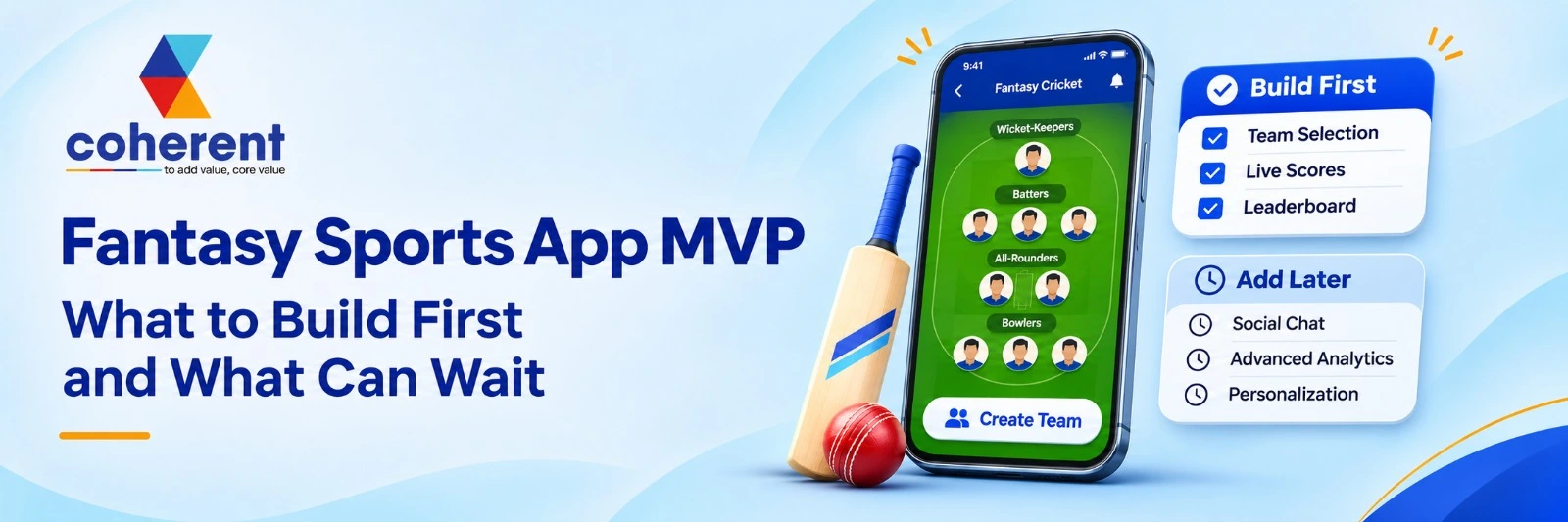
Building a fantasy sports app is an exciting opportunity for startups, entrepreneurs, and sports technology businesses. However, launching a successful product does not mean developing every feature from day one. The smarter approach is to start with a focused fantasy sports app MVP (Minimum Viable Product) that delivers the essential experience, attracts early users, and helps validate your business idea.
A fantasy sports app MVP should initially include user registration, player selection, team creation, contest participation, live score updates, leaderboards, and basic notifications. Advanced features such as AI-powered recommendations, social communities, multiple sports, and complex analytics can be introduced after understanding user behavior and market demand.The goal is simple: build a functional product, test it with real users, collect feedback, and invest in additional features when they create measurable value.
What Is a Fantasy Sports App MVP?
A fantasy sports app MVP is the first functional version of a fantasy sports platform that includes only the essential features required for users to participate in fantasy games. It allows businesses to test their concept without spending unnecessary time and money developing a fully featured application.For example, imagine a startup wants to launch a fantasy cricket app. Instead of immediately supporting cricket, football, basketball, and multiple tournament formats, it can begin with cricket, a limited number of contests, team creation, and leaderboard functionality.
- Validate the business idea: Understand whether the target audience is interested in the fantasy sports experience.
- Control development costs: Prioritize essential features instead of investing in unnecessary functionality.
- Launch faster: Release a smaller product and begin collecting actual user feedback.
- Identify usability issues: Discover problems with registration, team creation, navigation, and contest participation.
Also read : MVP App Development Cost in 2027
Which Features Should You Build First in a Fantasy Sports App MVP?
When developing a fantasy sports app MVP, prioritize features that allow users to complete the primary journey, from account registration and match discovery to team creation, contest participation, and score tracking. The objective is to launch a functional product without spending the initial budget on unnecessary complexity. Start with a reliable user experience, accurate player information, clear contest rules, and a dependable scoring system. These essential features help validate market demand, collect user feedback, and identify improvements before investing in advanced functionality. Businesses looking to build a seamless and high-performing iOS fantasy sports application can partner with an experienced iOS App Development Company in India to create a user-friendly solution that supports future growth.
1. User Registration and Profile Management
User registration is one of the first interactions people have with a fantasy sports application. Make onboarding simple, secure, and convenient so users can access the platform without unnecessary steps. The initial version should collect only the information required to create and manage an account. Avoid complicated registration workflows and excessive profile fields. A straightforward onboarding experience reduces friction and helps new users understand how to start participating in fantasy sports contests.
- Email and mobile number registration.
- OTP or email verification.
- Secure login and logout.
- Password recovery.
2. Sports and Match Listing
A match listing screen helps users discover upcoming, live, and completed matches available on your fantasy sports platform. Organize match information clearly so participants can identify their preferred tournaments and select games without confusion. For the first release, consider supporting one sport and a limited number of competitions. This approach reduces development complexity while helping businesses understand which matches attract the most user interest.
- Available sports and tournaments.
- Upcoming and live matches.
- Team names and match schedules.
- Match countdown timers.
3. Player Selection and Fantasy Team Creation
Team creation is the central functionality of a fantasy sports application. Users should be able to select real-world players and build fantasy teams according to predefined competition rules. The selection interface should display player categories, basic statistics, and selection limits. Make the process intuitive, especially for first-time users. Avoid overwhelming participants with advanced predictions and complicated filters until the platform has established a regular user base.
- Player lists organized by playing positions.
- Player statistics and basic information.
- Team selection limits.
- Budget or credit-based selection rules, where applicable.
4. Contest Creation and Joining
Contests allow users to participate in fantasy competitions using their selected teams. The contest interface should explain entry requirements, participant limits, scoring rules, and available competition formats. Keep the joining process straightforward so users understand what happens after entering a contest. If your business model includes paid contests or prizes, evaluate applicable legal requirements, payment compliance, eligibility checks, and platform restrictions before development.
- Contest listing and categories.
- Contest entry requirements.
- Participant limits.
- Contest rules and scoring details.
5. Live Scores and Leaderboards
Live scores and leaderboards make fantasy sports applications engaging by connecting real-world match performances with fantasy team rankings. The scoring engine should process match events, calculate player points, and update team totals according to predefined rules. For example, a cricket application may award points for runs, wickets, catches, and other eligible performances. Prioritize scoring accuracy and reliable data synchronization before investing in advanced animations or predictive analytics.
- Live match score updates.
- Player performance points.
- Fantasy team score calculation.
- User rankings.
6. Push Notifications and Basic Alerts
Push notifications keep users informed about important match activities and account updates. For an MVP, focus on timely and relevant alerts instead of building a complex personalization system. Notifications can remind participants about upcoming matches, team submission deadlines, and contest updates. Give users control over non-essential messages to prevent notification fatigue. A simple notification system can improve user awareness and encourage participants to return when relevant match activity occurs.
- Upcoming match reminders.
- Team submission deadline alerts.
- Match-start notifications.
- Contest status updates.
7. Basic Admin Dashboard
A fantasy sports application requires an administrative system to manage users, matches, contests, and platform activities. Although users do not directly interact with the dashboard, it plays an important role in daily operations. The initial admin panel should allow authorized staff to update essential information, configure scoring rules, monitor platform activity, and manage content. This reduces dependence on developers for routine administrative tasks and provides better operational control.
- User management and account monitoring.
- Match and tournament management.
- Player data management.
- Contest configuration.
Also read: Free-to-Play Fantasy Sports Apps: How They Work, Features, and How to Build One
What Features Can Wait Until After the Fantasy Sports App MVP Launch?
Not every feature needs to be included in the first release of a fantasy sports application. Businesses should initially focus on validating the core product, understanding user behavior, and collecting feedback. Advanced functionality can be introduced when engagement data and business requirements justify the additional investment. This phased approach helps control development costs while keeping the application easier to maintain. Businesses planning to build scalable fantasy sports applications can partner with an experienced Cross Platform App Development Company to develop applications that deliver consistent experiences across Android and iOS platforms. The following features can generally be considered for later development stages.
1. AI-Powered Player Recommendations
AI-powered recommendations can help fantasy sports users explore player statistics, compare performances, and discover potential team combinations. However, an MVP does not necessarily require a machine learning recommendation engine. Businesses should first establish reliable player data collection, scoring rules, and user activity tracking. Once sufficient information is available, AI capabilities can improve personalization and provide additional insights without making the initial application unnecessarily complicated.
- AI-based player recommendations.
- Predictive match analysis.
- Player performance forecasting.
- Automated team suggestions.
2. Multiple Sports and Tournament Support
Supporting multiple sports can expand the potential audience of a fantasy sports platform, but it also increases development and maintenance requirements. Different sports have different player positions, match structures, scoring systems, and data integration needs. Starting with one sport allows businesses to validate the platform before managing several complex workflows. Once the initial experience performs well, additional sports and competitions can be introduced according to audience demand.
- Fantasy cricket.
- Fantasy football.
- Fantasy basketball.
- Fantasy baseball.
3. Social Features and Community Interaction
Social features can encourage users to invite friends, share fantasy teams, and participate in private competitions. However, these capabilities are not essential for validating the application's primary functionality. Businesses should first understand whether users regularly return for the core fantasy sports experience. Once the platform develops an active audience, community features can help strengthen interaction and encourage participation through social connections.
- Private leagues with friends.
- In-app chat.
- User profiles and followers.
- Team-sharing functionality.
4. Advanced Analytics and Performance Dashboards
Advanced analytics can help experienced fantasy sports participants evaluate player performances and make informed team selections. However, displaying too much information during the initial release may confuse new users. Basic player statistics, match details, and transparent scoring information are usually sufficient for an MVP. Businesses can introduce more detailed analytical tools after understanding which statistics users regularly access and which features improve their experience.
- Historical player comparisons.
- Detailed performance charts.
- Advanced player filters.
- Match prediction dashboards.
5. Gamification and Loyalty Programs
Gamification can make a fantasy sports platform more interactive by rewarding participation and encouraging users to explore different activities. However, complex reward systems introduce additional development, management, and operational requirements. Instead of implementing several reward mechanisms immediately, businesses should first evaluate user engagement and retention. Once the core platform is stable, suitable loyalty features can be introduced to support a clearly defined engagement strategy.
- Achievement badges.
- Daily challenges.
- Referral rewards.
- Loyalty points.
Read More: Innovative Game Ideas for Fantasy Sports App Development
Fantasy Sports App MVP vs Full-Featured App: What Is the Difference?
A fantasy sports MVP includes essential features required to launch the platform and test user interest. These typically include user registration, team creation, contest participation, basic player statistics, and a simple scoring system. In comparison, a full-featured fantasy sports application offers advanced functionality, such as real-time score updates, multiple contest formats, personalized recommendations, payment integration, detailed analytics, and interactive leaderboards. The right approach depends on business goals, target audience, development budget, and long-term growth plans.
|
Feature |
MVP Version |
Full-Featured Version |
|---|---|---|
|
User Registration |
Email, mobile number, OTP verification |
Multiple login options and advanced verification |
|
Match Listing |
Basic upcoming and live matches |
Multi-sport support and personalized match discovery |
|
Team Creation |
Basic player selection and team formation |
Advanced player filters and AI-powered suggestions |
|
Contest Management |
Basic contest listing and joining |
Private leagues and advanced contest formats |
|
Live Scoring |
Core scoring engine and essential score updates |
Advanced analytics and detailed performance insights |
|
Leaderboards |
Basic participant rankings |
Historical rankings and personalized statistics |
|
Notifications |
Match reminders and deadline alerts |
Personalized and behavior-based notifications |
|
Admin Dashboard |
Basic user, match, and contest management |
Advanced reporting, automation, and monitoring |
|
Social Features |
Limited or no social functionality |
In-app chat, friends, and communities |
|
Analytics |
Basic player statistics |
Predictive insights and historical performance analytics |
Also read:How Live Scores and Leaderboards Work in Fantasy Sports Apps
How Much Does It Cost to Build a Fantasy Sports App MVP?
The cost of developing a fantasy sports app MVP depends on the selected features, technology stack, UI/UX design, third-party integrations, security requirements, and development team's location. A basic application with user registration, match listings, player selection, team creation, and simple leaderboards generally requires a smaller investment than a platform with real-time scoring and advanced integrations. Businesses should estimate costs based on technical complexity rather than the number of screens. Backend architecture, sports data APIs, scoring logic, testing, and infrastructure also influence the overall development budget.
|
Development Component |
Cost Influence |
|---|---|
|
UI/UX Design |
Number of screens, user flows, and design complexity |
|
Mobile App Development |
Android, iOS, or cross-platform development requirements |
|
Backend Development |
API development, database architecture, and business logic complexity |
|
Sports API Integration |
Data provider selection, API usage limits, and licensing fees |
|
Scoring Engine |
Fantasy scoring rules, event processing, and calculation complexity |
|
Admin Dashboard |
User management, contest configuration, reporting, and administrative functionality |
|
Security and Testing |
Authentication, data privacy, application security, and performance testing |
|
Cloud Infrastructure |
Hosting requirements, server capacity, traffic volume, and data storage needs |
Also Read: Mastering Fantasy Sports App Development: Best Practices for Success
Conclusion
Developing a fantasy sports application requires more than attractive designs and an extensive feature list. The real challenge is creating a reliable experience that connects match information, player selection, scoring, contests, and user engagement.For startups and businesses, the most practical approach is to launch with essential fantasy sports app MVP features, validate the product with real users, and expand based on measurable demand.
Advanced AI recommendations, social communities, multiple sports, and predictive analytics can create additional value, but they should be introduced when the business is ready to support them.Coherent Lab LLP can help businesses plan and develop custom mobile applications, from MVP strategy and UI/UX design to backend development, API integration, testing, and future scalability.Explore our connect with our experts to discuss your fantasy sports app idea.
Frequently Asked Questions
Q1. What is the first feature to build in a fantasy sports app MVP?
Ans.The first priority should be a smooth user onboarding experience followed by match discovery, player selection, and fantasy team creation. These features establish the foundation of the application. However, team creation must work with clearly defined player selection rules and a reliable backend. Businesses should also plan the scoring engine and contest structure early because these components influence the overall architecture. Rather than developing screens independently, build and test the complete user journey from registration to viewing team performance.
Q2. How many features should a fantasy sports MVP include?
Ans.There is no fixed number of features required for a fantasy sports MVP. The right number depends on the application's purpose and business model. A basic cricket fantasy MVP may require registration, match listings, player selection, team creation, scoring, leaderboards, and administration functionality. A free-to-play application may not need payment integration or prize distribution features. Businesses should focus on completing the essential user journey rather than meeting an arbitrary feature count. Every additional feature should have a clear purpose and contribute to the product's primary objective.
Q3. Should I build a fantasy cricket app or a multi-sport fantasy app first?
Ans.For many startups, beginning with a single sport is a practical approach because it reduces initial development and operational complexity. Fantasy cricket, for example, requires player categories, match schedules, team selection rules, and sport-specific scoring calculations. Supporting football or basketball introduces additional requirements. Starting with one sport allows businesses to validate their scoring system, understand audience behavior, and improve the user experience. Once the initial product demonstrates demand and operational stability, additional sports can be introduced through a planned expansion strategy.
Q4. Do I need an AI system for my fantasy sports app MVP?
Ans.No, an AI system is not essential for launching a fantasy sports MVP. Initially, users need accurate player information, understandable scoring rules, a reliable team-building process, and timely match updates. AI-powered player recommendations, predictive analytics, and personalized team suggestions can be introduced later. These capabilities become more useful when the platform has access to reliable historical data and clearly identified user requirements. Startups should first validate their core product before investing in advanced machine learning infrastructure that may increase development and maintenance complexity.
Q5. Is a live scoring feature necessary in a fantasy sports MVP?
Ans.Live scoring is important when the application is designed around ongoing real-world matches. Users expect their fantasy team points and leaderboard positions to reflect eligible player performances. A basic implementation should include reliable match data integration, predefined scoring rules, server-side point calculations, and timely leaderboard updates. You do not need advanced visual animations or predictive statistics in the first release. However, accuracy and consistency should never be compromised. If your initial product focuses on pre-match fantasy competitions, the scoring experience can be designed around the specific competition format.
Q6. Which technology is best for developing a fantasy sports MVP?
Ans.Flutter and React Native are both practical choices for cross-platform fantasy sports app development. Node.js, Python, or Java can support backend services, while PostgreSQL or MySQL can manage structured application data. Cloud platforms such as AWS, Microsoft Azure, and Google Cloud can support hosting and infrastructure requirements. The best combination depends on the development team's expertise, expected user activity, sports API requirements, and scalability goals. Businesses should evaluate long-term maintenance and integration capabilities instead of selecting technologies based only on popularity.
Q7. Can I add payment gateways after launching the fantasy sports MVP?
Ans.Yes, payment functionality can be introduced in a later release if the initial product does not depend on paid participation. However, businesses planning to introduce entry fees, withdrawals, cash prizes, or other financial features should evaluate the legal and technical requirements before launch. Payment workflows may involve identity verification, transaction monitoring, refunds, reconciliation, and regional restrictions. App store policies can also affect distribution. Therefore, even if payment integration is postponed, the business model and technical architecture should account for its potential requirements from the beginning.
Q8. How do I know when my fantasy sports app MVP is ready for additional features?
Ans.Your MVP is ready for expansion when its core functionality works reliably and user behavior provides evidence for the next development priorities. Look for consistent team creation, meaningful contest participation, repeat usage, positive feedback, and manageable technical performance. Also investigate where users abandon important journeys and which features they request most frequently. For example, if users consistently ask for private leagues, social functionality may deserve attention. If they struggle to understand player performance, improving statistics and explanations may be more valuable than introducing AI recommendations.

 +91 774-202-1725
 +1 (945) 3387904
 business@coherentlab.com
 +49 15223341304
 UK

