
Table of Contents
How Do On-Demand Apps Make Money? 6 Revenue Models Compared
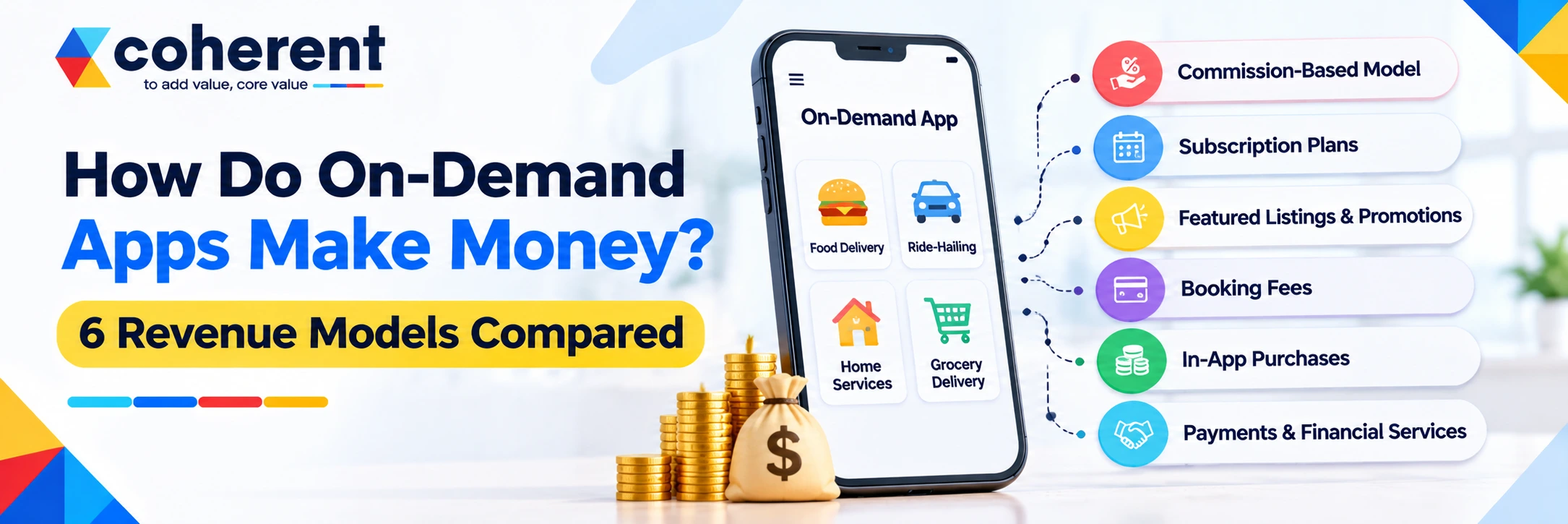
The on-demand economy has transformed how customers access transportation, food delivery, grocery shopping, healthcare, and home services. Businesses are increasingly investing in digital marketplaces to connect customers with service providers quickly and conveniently. However, one important question remains: How do on-demand apps make money?
Successful platforms such as Uber, DoorDash, Instacart, and Urban Company generate revenue through different monetization strategies, including commissions, subscriptions, delivery charges, advertising, and premium services. Choosing the right revenue model helps businesses maintain profitability while delivering value to customers and service providers.
Key Takeaways
- Commission-based monetization allows platforms to earn a percentage of completed transactions.
- Subscription models generate recurring revenue through monthly or annual membership plans.
- Delivery and service fees help cover operational expenses while creating additional revenue opportunities.
- Advertising and sponsored listings allow businesses to monetize marketplace visibility.
- Freemium models encourage adoption before introducing paid features.
- Dynamic pricing helps platforms respond to changing customer demand and service availability.
- Hybrid monetization strategies can diversify revenue and reduce dependence on one income source.
- Sustainable profitability requires balancing customer acquisition costs, operating expenses, and customer lifetime value.
What Is an On-Demand App Business Model?
An on-demand app business model connects customers with products or services through a digital platform.On-Demand Home Services Marketplace Like Urban Company These applications simplify booking, payments, service delivery, and communication between users and providers. Businesses generate revenue by facilitating transactions, charging platform fees, offering subscriptions, or selling premium services while maintaining a convenient customer experience.
How Does an On-Demand Business Model Work?
An on-demand application operates as a digital marketplace where customers request services and providers fulfill those requests.
The process generally involves customer registration, service selection, booking confirmation, payment processing, and service completion.
For example, a food delivery application connects customers with restaurants and delivery partners. The platform manages orders, processes payments, and earns revenue through applicable commissions and service charges.
Who Pays in an On-Demand Marketplace?
Different marketplace participants may contribute to platform revenue.
- Customers: Pay delivery charges, convenience fees, subscriptions, or service costs.
- Service providers: Pay commissions or platform access fees.
- Merchants: Pay advertising fees or commissions on completed orders.
- Advertisers: Purchase sponsored placements to reach relevant customers.
What Are the 6 Best Revenue Models for On-Demand Apps?
On-demand applications use several monetization strategies to generate income from customers, merchants, and service providers.On-Demand Laundry App Development Each revenue model offers different advantages depending on transaction frequency, market demand, and operational requirements. Understanding these six popular monetization approaches helps entrepreneurs select suitable strategies and develop sustainable, scalable on-demand marketplace businesses.
1. Commission-Based Revenue Model
The commission-based model is one of the most common monetization strategies for on-demand marketplaces. Platforms earn a percentage or fixed fee whenever customers complete transactions with service providers.
For example, if a customer books a service worth $100 and the platform charges a 15% commission, the application earns $15 before expenses.
Key Features:
- Revenue generated from completed transactions.
- Flexible commission percentages.
- Suitable for multi-vendor marketplaces.
- Earnings increase with transaction volume.
2. Subscription-Based Revenue Model
Subscription monetization allows customers or service providers to pay recurring fees for exclusive benefits, premium access, or additional services.Businesses can introduce monthly, quarterly, or annual membership plans.
For example, customers may subscribe to receive reduced delivery charges, exclusive offers, or priority services.
Key Features:
- Predictable recurring revenue.
- Monthly and annual membership options.
- Improved customer loyalty.
- Opportunities for premium service packages.
3. Delivery and Service Fee Revenue Model
Delivery and service fees allow on-demand applications to charge customers for completing orders or facilitating transactions.These charges may depend on delivery distance, order value, location, service complexity, or operational conditions.
For example, a grocery delivery application might charge a $4 delivery fee for an order, although the actual profit depends on fulfillment expenses.
Key Features:
- Fixed or variable delivery charges.
- Distance-based pricing options.
- Convenience and platform fees.
- Additional revenue from completed orders.
4. Advertising and Sponsored Listings Model
Advertising monetization allows businesses to earn revenue by promoting merchants, products, or service providers within their applications.Marketplace operators can offer sponsored search results, featured listings, promotional banners, and targeted advertising placements.
For example, restaurants may pay additional fees to appear prominently in food delivery search results.
Key Features:
- Sponsored merchant listings.
- In-app promotional banners.
- Featured service provider profiles.
- Targeted advertising opportunities.
5. Freemium and Premium Features Model
The freemium model provides basic application functionality without charging users while offering advanced features through paid upgrades.
This strategy helps attract users and encourages them to purchase additional services after experiencing the platform.
For example, a home services marketplace might offer free provider registration but charge for advanced business analytics or promotional tools.
Key Features:
- Free access to basic functionality.
- Paid premium features.
- Optional service upgrades.
- Monetization through user conversion.
6. Dynamic Pricing and Surge-Based Revenue Model
Dynamic pricing adjusts service prices based on demand, supply availability, location, and operational conditions.Ride-hailing platforms commonly use this strategy during busy periods when customer demand exceeds driver availability.
However, higher customer prices do not automatically mean higher platform profits because service providers may receive part of the additional amount.
Key Features:
- Demand-based pricing adjustments.
- Peak-hour pricing.
- Real-time supply and demand analysis.
- Flexible service charges.
Which On-Demand App Revenue Model Is Most Profitable?
The profitability of an on-demand app depends on its target market, transaction volume, pricing structure, and operating expenses.Coherent lab llp Commission models suit transaction-driven marketplaces, while subscriptions support recurring income. Advertising and premium services provide additional opportunities. Combining complementary revenue models can improve financial stability without relying entirely on individual transactions.
Comparison of 6 On-Demand App Revenue Models
|
Revenue Model |
Revenue Source |
Main Advantage |
Best For |
|---|---|---|---|
|
Commission-Based |
Percentage of each transaction |
Revenue scales with completed transactions |
Ride-hailing, home services |
|
Subscription-Based |
Monthly or annual membership fees |
Generates predictable recurring revenue |
Grocery and food delivery |
|
Delivery Fees |
Per-order delivery charges |
Helps cover logistics and fulfillment costs |
Food, grocery, and courier apps |
|
Advertising-Based |
Sponsored listings and paid promotions |
Creates additional revenue from merchants |
Large on-demand marketplaces |
|
Freemium Model |
Premium features and paid upgrades |
Encourages user adoption and upgrades |
Service provider platforms |
|
Dynamic Pricing |
Demand-based pricing adjustments |
Helps optimize revenue during peak demand |
Transportation and ride-hailing services |
Can On-Demand Apps Use Multiple Revenue Models?
Yes. Many successful applications use hybrid monetization strategies to diversify revenue.
For example, a food delivery marketplace can combine restaurant commissions, customer delivery fees, premium memberships, and sponsored restaurant listings.
However, businesses should evaluate the total cost charged to customers and merchants. Excessive combined fees can reduce demand, discourage service providers, and weaken customer retention.
How Much Money Can an On-Demand App Make?
On-demand app earnings vary significantly based on active customers, order frequency, average transaction value, and monetization strategy.On-Demand App Development A platform processing thousands of monthly transactions may generate substantial revenue, but operating costs determine profitability. Businesses should evaluate gross merchandise value, platform revenue, customer acquisition expenses, and contribution margins before forecasting financial performance.
Factors That Influence On-Demand App Revenue
Several factors determine the revenue potential of an on-demand marketplace.
- Active Users: More engaged customers can increase transaction opportunities.
- Average Order Value: Higher transaction values may generate greater commission revenue.
- Order Frequency: Repeat purchases improve revenue consistency.
- Commission Rate: Platform fees directly influence transaction earnings.
- Customer Retention: Returning customers can reduce reliance on expensive acquisition campaigns.
On-Demand App Revenue Calculation With Examples
Consider a hypothetical on-demand home services marketplace.
|
Revenue Metric |
Monthly Value |
|---|---|
|
Completed Orders |
5,000 |
|
Average Order Value (AOV) |
$40 |
|
Gross Merchandise Value (GMV) |
$200,000 |
|
Commission Rate |
15% |
|
Commission Revenue |
$30,000 |
|
Service Fee Revenue |
$5,000 |
|
Advertising Revenue |
$3,000 |
|
Total Platform Revenue |
$38,000 |
On-Demand App Market Statistics and Growth Insights for 2026–2027
The on-demand economy includes several expanding digital service categories, including food delivery, transportation, grocery delivery, and home services.
Important market indicators businesses should monitor include:
- Online food delivery revenue and order growth.
- Ride-hailing booking volume and customer adoption.
- Grocery delivery subscription participation.
- Customer retention and repeat purchase frequency.
- Advertising revenue generated by digital marketplaces.
The Right Revenue Model for Your On-Demand App
Selecting the right monetization strategy requires understanding customer behavior, market competition, service costs, and revenue expectations.On-Demand Logistics App Development Businesses should evaluate whether customers prefer transaction-based payments, subscriptions, or premium services. A structured approach helps startups minimize financial risks, validate pricing assumptions, and implement revenue models that support sustainable marketplace growth and profitability.
Step 1: Identify Your Target Audience and App Category
Start by understanding the customers and service providers your application will serve. Research their needs, purchasing behavior, preferred payment methods, and expectations to determine which monetization strategies fit the market.
- Define target customer segments.
- Identify primary service categories.
- Study customer spending patterns.
- Understand service provider expectations.
Step 2: Analyze Competitors and Their Monetization Strategies
Evaluate established applications operating within your industry. Study their pricing structures, subscription benefits, commission policies, and customer feedback to identify successful monetization approaches and opportunities for differentiation.
- Research competing applications.
- Compare service and commission fees.
- Evaluate membership programs.
- Identify gaps in competitor offerings.
Step 3: Understand Customer Willingness to Pay
Conduct customer interviews, surveys, and pricing experiments to understand acceptable service charges. This research helps businesses avoid pricing strategies that discourage adoption or reduce repeat transactions.
- Conduct customer surveys.
- Test different pricing options.
- Evaluate perceived service value.
- Analyze purchase behavior.
Step 4: Estimate Operating Costs and Profit Margins
Calculate expected infrastructure expenses, payment processing charges, marketing costs, customer support, and fulfillment requirements. Accurate financial estimates help determine whether the selected revenue model can generate sustainable margins.
- Calculate development expenses.
- Estimate customer acquisition costs.
- Forecast transaction revenue.
- Determine expected contribution margins.
Step 5: Select a Suitable Revenue Model
Choose a monetization strategy that matches the application category and customer expectations. Businesses may begin with one primary revenue stream before introducing subscriptions, advertising, or premium services.
- Compare available revenue models.
- Evaluate monetization feasibility.
- Consider hybrid revenue opportunities.
- Establish transparent pricing policies.
Step 6: Integrate Payment and Monetization Features
Implement secure payment processing, commission management, subscription billing, and transaction reporting. Reliable monetization infrastructure helps businesses manage revenue efficiently while providing customers with convenient payment experiences.
- Integrate payment gateways.
- Configure commission calculations.
- Implement subscription management.
- Enable transaction analytics.
Step 7: Test, Measure, and Optimize Revenue Performance
After launching the application, monitor revenue performance, customer retention, and operating expenses. Use real transaction data to improve pricing strategies and identify opportunities for increasing sustainable profitability.
- Track average revenue per user.
- Monitor customer lifetime value.
- Measure customer acquisition costs.
- Optimize pricing and monetization features.
Important KPIs to Measure Monetization Success
|
KPI |
Full Form |
What It Measures |
|---|---|---|
|
ARPU |
Average Revenue Per User |
Average revenue generated per user over a specific period. |
|
CAC |
Customer Acquisition Cost |
Total marketing and sales cost required to acquire a new customer. |
|
CLV |
Customer Lifetime Value |
Estimated total revenue a customer generates throughout their relationship with the platform. |
|
AOV |
Average Order Value |
Average transaction value per customer order or booking. |
|
Take Rate |
Platform Take Rate |
Percentage of total transaction value retained by the platform as revenue. |
|
Contribution Margin |
Contribution Margin |
Revenue remaining after deducting relevant variable costs. |
|
Retention Rate |
Customer Retention Rate |
Percentage of customers who continue using the app over a defined period. |
Conclusion
Understanding how on-demand apps make money is essential for building a sustainable digital marketplace. Commission fees, subscriptions, delivery charges, advertising, freemium features, and dynamic pricing each offer different revenue opportunities. The most suitable approach depends on your business category, customer expectations, operating costs, and long-term growth objectives.
Businesses should prioritize transparent pricing, strong customer retention, and measurable profitability rather than focusing only on transaction volume. A carefully planned hybrid monetization strategy can create additional income opportunities while maintaining marketplace value. Talk to our experts
Frequently Asked Questions
Q1. How do on-demand apps make money without charging users directly?
Ans. On-demand applications can generate revenue without directly charging customers by collecting commissions from merchants, offering sponsored listings, and selling premium tools to service providers. For example, a marketplace may allow customers to browse and book services without a separate platform fee while earning a commission from completed transactions. Advertising partnerships and merchant subscriptions provide additional income opportunities. However, businesses must ensure that these charges do not discourage service providers from participating or indirectly make services unaffordable for customers.
Q2. Which revenue model is best for an on-demand startup?
Ans. The best revenue model depends on the startup's industry, customer behavior, and operational requirements. Commission-based monetization is often suitable for marketplaces where customers frequently book services or purchase products. Subscription models work better when users receive consistent recurring value. Delivery fees can help recover fulfillment expenses, while advertising becomes more attractive as marketplace traffic increases. Startups should begin with a simple, measurable monetization strategy, validate customer willingness to pay, and introduce additional revenue streams when sufficient demand develops.
Q3. How much commission do on-demand service apps typically charge?
Ans. Commission rates vary significantly depending on the industry, market competition, service category, and agreement with providers. Some marketplaces use percentage-based commissions, while others charge fixed booking fees or customized merchant rates. There is no universal commission percentage suitable for every on-demand application. Businesses should calculate payment processing expenses, customer support costs, marketing investments, and expected margins before selecting a commission structure. Transparent and competitive pricing helps maintain positive relationships with service providers while supporting long-term platform profitability.
Q4. Can an on-demand app generate passive income through subscriptions?
Ans. Subscription-based on-demand applications can generate recurring revenue, but the income is not entirely passive. Businesses must continuously deliver valuable services, maintain application functionality, provide customer support, and manage subscription renewals. Membership programs may include discounted delivery charges, exclusive offers, priority bookings, or premium features. Recurring payments can improve revenue predictability when customers remain satisfied with the benefits. However, subscription cancellations, payment failures, promotional costs, and ongoing operational expenses must be considered when evaluating profitability.
Q5. How do food delivery apps like Uber Eats and DoorDash make money?
Ans. Food delivery applications such as Uber Eats and DoorDash use multiple revenue streams, including merchant commissions, customer service fees, delivery charges, advertising, and membership programs. Restaurants may pay fees for marketplace orders, while customers may pay additional charges depending on the order and service conditions. Sponsored placements allow merchants to improve visibility within the application. However, platform revenue must cover delivery-related expenses, payment processing, marketing, customer support, and other operational costs before contributing to profit.
Q6. How much does it cost to build a profitable on-demand app in 2027?
Ans. The cost of developing an on-demand application depends on its features, technical complexity, integrations, and development team. For initial planning, a basic MVP may cost approximately 15,000–35,000, while a more advanced marketplace may require 35,000–80,000 or more. Complex multi-service platforms can exceed $200,000. These are illustrative estimates rather than guaranteed quotations. Development investment alone does not determine profitability. Businesses must also account for marketing, maintenance, payment processing, service fulfillment, and customer acquisition costs.
Q7. What is the difference between commission-based and subscription-based app monetization?
Ans. Commission-based monetization generates revenue whenever a qualifying transaction occurs, while subscription-based monetization charges recurring fees for access or membership benefits. Commission earnings generally depend on transaction value and frequency, making them suitable for active marketplaces. Subscriptions can provide more predictable revenue but require ongoing customer value to prevent cancellations. Some on-demand applications combine both strategies by collecting commissions from merchants while offering premium memberships to customers. The right choice depends on service frequency, customer preferences, and operating economics.
Q8. How long does it take for an on-demand app to become profitable?
Ans. There is no fixed timeline for on-demand app profitability. The break-even period depends on development costs, transaction volume, customer acquisition expenses, operating margins, and customer retention. A marketplace with strong repeat purchases and controlled expenses may recover its investment faster than one requiring substantial promotional spending. Businesses should prepare financial forecasts, monitor monthly cash flow, and calculate contribution margins. Profitability should be evaluated using actual financial performance rather than assumptions based solely on app downloads or gross transaction value.

 +91 774-202-1725
 +1 (945) 3387904
 business@coherentlab.com
 +49 15223341304
 UK

