
Table of Contents
On-Demand Laundry App Development Guide for Pickup and Delivery
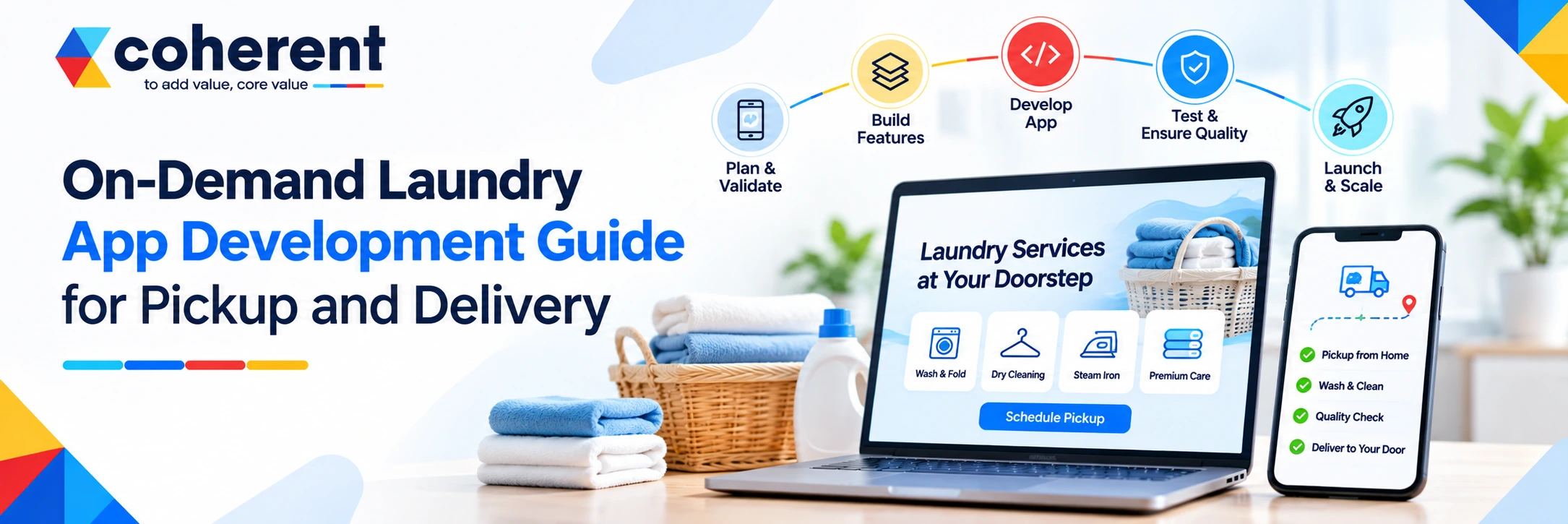
The demand for convenient, technology-driven laundry services is creating new opportunities for startups, dry cleaning businesses, and established laundry service providers. Customers increasingly prefer solutions that allow them to schedule laundry pickups, track orders, make secure payments, and receive freshly cleaned clothes at their doorsteps. On-demand laundry app development helps businesses meet these expectations through automated booking, delivery management, and improved customer communication.
Developing a successful laundry pickup and delivery application requires more than creating a mobile interface. Businesses must understand customer requirements, select suitable features, establish efficient delivery operations, and choose scalable technologies. With professional on-demand app development services from Coherent Lab, businesses can build customized laundry applications that support operational efficiency, customer satisfaction, and long-term growth. This guide explores essential features, development costs, business models, challenges, and emerging trends for 2026–2027.
Key Takeaways
- On-demand laundry apps simplify service booking, pickup scheduling, and doorstep delivery.
- Customer apps, provider dashboards, delivery apps, and admin panels support complete operations.
- Development costs depend on features, complexity, integrations, and platform selection.
- Real-time tracking and secure payments improve customer convenience.
- Subscription services and delivery fees create additional revenue opportunities.
- MVP development helps startups test demand before making larger investments.
- AI-powered scheduling and route optimization may improve future operational efficiency.
What Is On-Demand Laundry App Development?
On-demand laundry app development involves creating mobile applications that connect customers with professional laundry and dry cleaning services.On-Demand Home Services Marketplace Like Urban Company These platforms allow users to schedule pickups, select cleaning services, make payments, and track deliveries. Businesses use integrated dashboards to manage orders, coordinate delivery partners, monitor operations, and improve customer experiences efficiently.
How Does an On-Demand Laundry App Work?
A laundry pickup and delivery app simplifies the complete service process by connecting customers, laundry providers, and delivery partners through one digital platform.
- Registration: Customers create accounts and enter their pickup addresses.
- Service selection: Users choose washing, ironing, dry cleaning, or other services.
- Pickup scheduling: Customers select convenient pickup dates and times.
- Order processing: Laundry providers receive and process the assigned orders.
- Delivery tracking: Customers monitor their order status and expected delivery.
- Payment: Users complete payments through supported digital methods.
Types of Laundry Pickup and Delivery Apps
|
App Type |
Description |
Suitable For |
|---|---|---|
|
Single-Provider Laundry App |
Manages laundry bookings, payments, pickup, and delivery for a single laundry service provider. |
Local laundry shops and independent laundry businesses. |
|
Laundry Marketplace App |
Connects customers with multiple laundry service providers through a centralized booking platform. |
Startups, entrepreneurs, and laundry marketplace businesses. |
|
Laundry Aggregator App |
Coordinates customer orders, pickup schedules, and deliveries across partnered laundry businesses. |
Regional laundry service platforms and multi-location operators. |
|
Subscription-Based Laundry App |
Offers weekly or monthly laundry plans with recurring payments and scheduled pickup services. |
Residential customers, working professionals, hostels, and corporate clients. |
On-Demand Laundry App Market Size and Growth Trends
The laundry services industry is experiencing digital transformation as customers increasingly seek convenient pickup and delivery options.On-Demand App Development Mobile booking, digital payments, subscription services, and automated order management are creating opportunities for service providers. Understanding market trends helps businesses evaluate customer demand, identify competitive advantages, and develop sustainable laundry application business strategies.
Laundry Service Market Statistics and Insights
Laundry app development opportunities are influenced by urban lifestyles, smartphone adoption, and changing consumer expectations. However, businesses should distinguish between the overall laundry services market and the smaller technology-enabled laundry delivery segment when evaluating market size.
|
Market Trend |
Business Impact |
|---|---|
|
Mobile Service Booking |
Simplifies customer acquisition and enables convenient laundry scheduling through mobile apps. |
|
Doorstep Pickup and Delivery |
Improves customer convenience and increases accessibility to laundry services. |
|
Digital Payment Adoption |
Supports secure cashless transactions and streamlines payment processing. |
|
Subscription-Based Laundry Services |
Encourages recurring revenue and strengthens long-term customer retention. |
|
AI-Powered Delivery Route Optimization |
Helps reduce transportation costs, improve delivery efficiency, and optimize pickup schedules. |
|
Automated Order Management |
Reduces manual coordination, minimizes operational errors, and improves order tracking. |
Essential Features of an On-Demand Laundry Pickup and Delivery App
A successful laundry delivery application requires dedicated features for customers, laundry providers, delivery personnel, and administrators.On-Demand App Development Companies Each module should simplify daily operations while maintaining accurate order information. Businesses should prioritize booking management, payment processing, real-time updates, and reliable communication before introducing advanced automation or additional marketplace functionality.
Customer App Features
The customer application should provide a convenient and straightforward booking experience.
- User registration: Secure account creation and profile management.
- Service selection: Washing, ironing, dry cleaning, and specialized cleaning options.
- Pickup scheduling: Flexible pickup and delivery time slots.
- Order tracking: Real-time status updates and delivery notifications.
- Digital payments: Cards, wallets, UPI, and supported payment gateways.
- Ratings and reviews: Customer feedback and service evaluations.
Laundry Service Provider Dashboard
Laundry providers need a centralized dashboard to monitor orders, manage workflows, and communicate with customers.
- Order acceptance and scheduling
- Laundry status and inventory tracking
- Service pricing management
- Customer communication
- Revenue and performance reports
Delivery Partner App Features
Delivery applications help drivers coordinate pickup and drop-off activities while maintaining accurate delivery records.
- Pickup and delivery assignments
- GPS navigation and route planning
- Delivery status updates
- Proof of pickup and delivery
- Earnings and delivery history
Admin Panel Features
An administrative dashboard enables business owners to manage the entire laundry delivery platform.
- Customer and vendor management
- Order monitoring and dispute resolution
- Commission and payment management
- Discount and promotional campaigns
- Business analytics and performance reporting
How to Develop an On-Demand Laundry App: Step-by-Step Process
Developing a laundry pickup and delivery application requires a structured approach that combines business planning, user experience design, software engineering, and operational testing.Single-Service vs Multi-Service On-Demand Apps Following a defined development process helps businesses control costs, reduce technical risks, and deliver reliable services. Each stage should support customer convenience, operational efficiency, and future scalability requirements.
|
Step |
Development Stage |
Key Activities |
Expected Outcome |
|---|---|---|---|
|
Step 1 |
Market Research & Target Audience |
Analyze competitors, customer needs, laundry demand, and target locations. |
Clear business objectives and target market. |
|
Step 2 |
Choose a Business Model |
Select single-provider, marketplace, subscription, or hybrid laundry services. |
Profitable and scalable business strategy. |
|
Step 3 |
Define Features & MVP |
Prioritize booking, secure payments, order management, and delivery tracking. |
Cost-effective MVP development plan. |
|
Step 4 |
UI/UX Design |
Create wireframes, user journeys, intuitive navigation, and accessible interfaces. |
User-friendly laundry booking experience. |
|
Step 5 |
Technology Stack Selection |
Choose Android, iOS, Flutter, React Native, backend, and cloud technologies. |
Reliable and scalable app architecture. |
|
Step 6 |
App Development & Integration |
Develop customer, vendor, and delivery modules with payment and notification integrations. |
Fully functional laundry delivery platform. |
|
Step 7 |
Testing, Launch & Optimization |
Conduct security, performance, and usability testing; launch and collect feedback. |
Successful app launch and continuous improvement. |
Step 1: Research the Laundry Market and Target Customers
Analyze customer expectations, competitor services, local laundry demand, and delivery requirements. Identify target audiences such as working professionals, students, families, and commercial establishments before defining your application's business objectives and competitive positioning.
- Research local competitors.
- Identify customer challenges.
- Evaluate service demand.
- Define target locations.
Step 2: Choose the Right Laundry App Business Model
Select a business model based on available resources, target customers, and service capabilities. Businesses can operate their own laundry facilities, collaborate with third-party providers, or establish a marketplace connecting multiple vendors.
- Single-provider model
- Commission-based marketplace
- Subscription-based services
- Hybrid laundry delivery model
Step 3: Identify Essential Features and MVP Requirements
Prioritize features that directly support booking, payment, order processing, and delivery. Building a minimum viable product allows businesses to validate customer demand while avoiding unnecessary development expenses during the initial launch.
- Define customer features.
- Select provider dashboard functions.
- Include delivery tracking.
- Prioritize payment security.
Step 4: Design an Easy-to-Use Laundry App UI/UX
Create intuitive application interfaces that simplify service selection, pickup scheduling, and checkout. Consistent navigation, accessible layouts, and clear pricing information help customers complete bookings without confusion and improve overall usability.
- Develop user journey maps.
- Create wireframes and prototypes.
- Optimize booking navigation.
- Test interface accessibility.
Step 5: Select the Technology Stack and Development Team
Choose technologies based on performance requirements, development budgets, and expected user growth. An experienced development team can help evaluate cross-platform frameworks, backend infrastructure, database solutions, and third-party service integrations.
- Choose Android, iOS, or cross-platform development.
- Select backend technologies.
- Evaluate cloud infrastructure.
- Define integration requirements.
Step 6: Develop Customer, Vendor, and Delivery Applications
Build the required application modules and connect them through secure backend services. Integrate order management, notifications, payments, location tracking, and administrative controls while ensuring accurate communication between customers, laundry providers, and delivery partners.
- Develop booking functionality.
- Integrate payment gateways.
- Configure order notifications.
- Connect delivery management systems.
Step 7: Test, Launch, and Optimize Your Laundry Delivery App
Conduct functional, security, usability, and performance testing before releasing the application. Launch with a manageable service area, monitor customer feedback, evaluate delivery performance, and introduce improvements based on actual usage patterns.
- Test application functionality.
- Verify payment security.
- Monitor crashes and performance.
- Collect feedback after launch.
Conclusion
On-demand laundry app development offers businesses an opportunity to modernize laundry services, simplify customer bookings, and improve pickup and delivery operations. A successful platform should combine essential customer features, reliable order management, secure payments, and efficient logistics with a scalable technical foundation. Starting with an MVP and expanding based on customer feedback can help businesses manage development costs and reduce operational risks.
Whether you are launching a laundry startup or digitizing an existing service, selecting the right technology partner is an important decision. Coherent Lab can help you explore customized mobile app development solutions designed around your business requirements. Ready to build your laundry pickup and delivery platform? Contact us today to discuss your project, development requirements, and next steps.
Frequently Asked Questions
Q1. How much does it cost to develop an on-demand laundry app in 2027?
Ans. The estimated cost of developing an on-demand laundry app in 2027 may range from $10,000 to $120,000 or more, depending on application complexity and requirements. Basic laundry booking applications typically require smaller budgets, while advanced marketplaces need multiple dashboards, payment integrations, tracking systems, and administrative features. Development costs also depend on platform selection, UI/UX design, developer rates, and infrastructure. Businesses should request a detailed project estimate based on their specific features and operational needs.
Q2. How long does it take to build a laundry pickup and delivery app?
Ans. Developing a laundry pickup and delivery app may take approximately two to twelve months or longer, depending on project complexity. A basic application with booking and payment features can often be completed faster than a multi-vendor platform with real-time tracking and advanced administration. Development timelines depend on design requirements, third-party integrations, testing, and team availability. Businesses can accelerate initial launches by developing an MVP with essential functionality before introducing additional features.
Q3. What are the essential features of a laundry delivery app?
Ans. Essential laundry delivery app features include user registration, service selection, pickup scheduling, order tracking, secure payments, notifications, and customer support. Laundry providers need order management dashboards, while delivery partners require assignment details and navigation features. Administrators should have access to customer management, payment monitoring, and reporting tools. Additional features such as subscriptions, promotional offers, automated scheduling, and analytics can be introduced as the business expands and customer requirements evolve.
Q4. How does an on-demand laundry pickup and delivery app work?
Ans. An on-demand laundry pickup and delivery app connects customers with laundry service providers through a mobile platform. Customers register, choose cleaning services, select pickup times, and place orders. A delivery partner collects the clothes and transports them to the laundry facility. After washing, ironing, or dry cleaning, the completed order is delivered to the customer. The application manages scheduling, payments, notifications, and order updates, helping businesses coordinate the complete service process efficiently.
Q5. Which technology stack is best for laundry app development?
Ans. The best technology stack depends on application requirements, development budgets, and scalability goals. Flutter and React Native are popular options for cross-platform mobile development, while Kotlin and Swift support native Android and iOS applications. Backend technologies may include Node.js, Python, or Java, with PostgreSQL or other suitable databases for storing application data. Cloud infrastructure, mapping services, notification systems, and payment gateway integrations should be selected according to performance, security, and operational requirements.
Q6. How can I start an online laundry pickup and delivery business?
Ans. Starting an online laundry pickup and delivery business requires market research, operational planning, and a reliable service delivery model. Entrepreneurs should identify target customers, evaluate competitors, establish laundry processing capabilities, and determine pricing strategies. The next step involves developing a booking application, integrating payment systems, and organizing pickup and delivery operations. Launching in a limited service area can help validate demand, evaluate customer satisfaction, and improve business processes before expanding into additional locations.
Q7. How do on-demand laundry apps generate revenue?
Ans. On-demand laundry apps can generate revenue through several business models. Single-provider applications earn income directly from laundry and dry cleaning services, while marketplace platforms may charge commissions on partner transactions. Additional revenue opportunities include delivery fees, express service charges, subscription plans, and premium cleaning packages. Businesses may also introduce corporate laundry contracts and recurring household plans. Selecting an appropriate revenue model depends on customer demand, operational expenses, service coverage, and competitive pricing.
Q8. How do I choose the best on-demand laundry app development company?
Ans. Choosing the right laundry app development company involves evaluating technical expertise, relevant project experience, development processes, and communication practices. Businesses should review previous mobile application projects, assess UI/UX capabilities, and discuss payment, tracking, and backend integrations. Request a detailed proposal covering project scope, estimated costs, development milestones, testing, and post-launch support. A reliable development partner should understand operational requirements and recommend scalable solutions that align with business objectives and available budgets.

 +91 774-202-1725
 +1 (945) 3387904
 business@coherentlab.com
 +49 15223341304
 UK

