
Table of Contents
How to Build an On-Demand Home Services Marketplace Like Urban Company
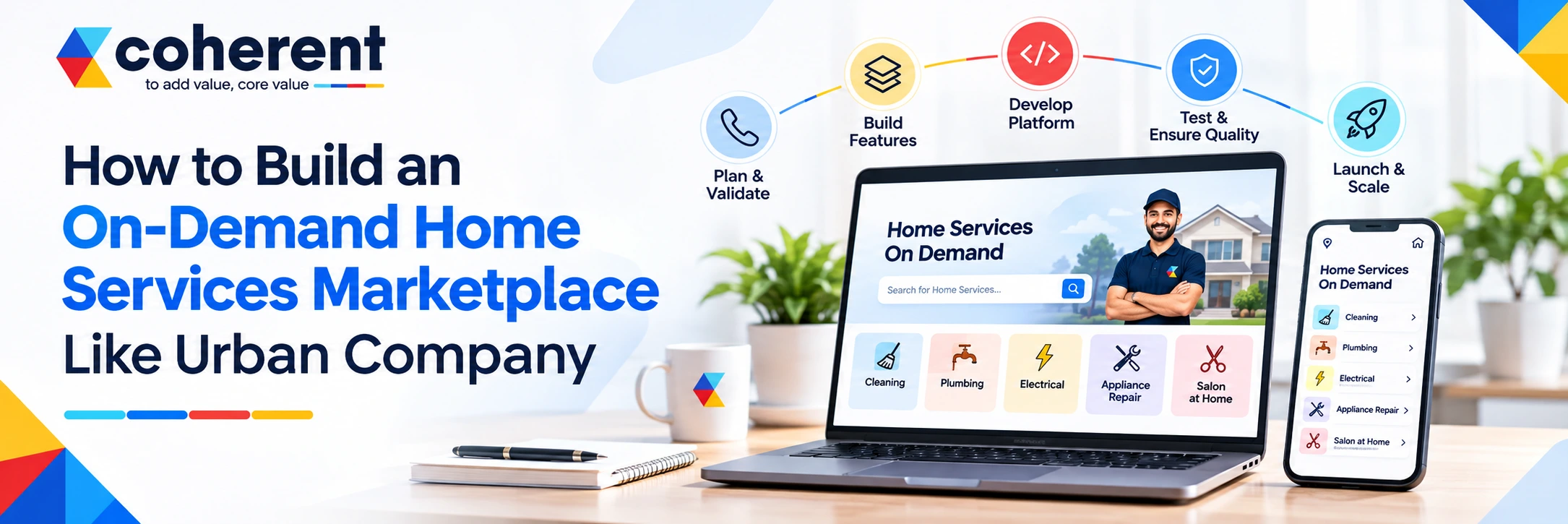
The on-demand home services industry is transforming how people book cleaning, plumbing, electrical repairs, beauty treatments, appliance maintenance, and other household services. Instead of searching for professionals through traditional methods, customers increasingly prefer digital platforms that offer convenient scheduling, transparent pricing, verified professionals, and secure payments.
Platforms like Urban Company demonstrate how technology can connect customers with skilled service providers through a centralized marketplace. For startups and entrepreneurs, developing a similar platform creates opportunities to serve local markets, generate recurring revenue, and build scalable digital businesses.However, creating a successful home services marketplace requires more than developing a mobile application. Businesses must understand customer expectations, select a suitable revenue model, recruit reliable professionals, and implement efficient booking systems.
Key Takeaways
- An on-demand home services marketplace connects customers with professionals through mobile applications or websites.
- Customer apps, service provider apps, and admin dashboards form the foundation of marketplace operations.
- Essential features include booking management, secure payments, provider verification, ratings, and notifications.
- A basic marketplace MVP may cost approximately 20,000–40,000, depending on development requirements.
- Commission fees, subscriptions, and premium listings provide potential revenue opportunities.
- AI-powered recommendations and automated scheduling can improve marketplace efficiency.
What Is an On-Demand Home Services Marketplace and How Does It Work?
An on-demand home services marketplace is a digital platform connecting customers with professionals offering household services.Apps Like Urban Company for Home Services Users can browse categories, compare providers, schedule appointments, and complete payments through one application. Marketplace operators manage service listings, bookings, commissions, and quality standards while professionals deliver services directly to customers at their preferred locations.
Understanding the Urban Company Business Model
Urban Company operates a technology-enabled home services marketplace that connects customers with trained service professionals. Its model emphasizes standardized service experiences, booking convenience, and quality management.Businesses developing similar platforms can adapt this approach to different cities, service categories, and customer segments.
How Customers, Service Providers, and Admins Interact
A home services marketplace generally involves three participants:
- Customers: Search for services, schedule appointments, make payments, and submit reviews.
- Service providers: Manage availability, accept assignments, deliver services, and monitor earnings.
- Administrators: Oversee operations, manage service categories, monitor transactions, and resolve complaints.
Popular Home Services Categories
|
Service Category |
Popular Services & Examples |
|---|---|
|
Home Cleaning |
Deep cleaning, kitchen cleaning, bathroom cleaning, sofa cleaning, floor cleaning |
|
Plumbing Services |
Pipe repairs, leakage fixing, bathroom fittings, drain cleaning, tap installation |
|
Electrical Services |
Wiring, switch repairs, lighting installation, fan installation, electrical maintenance |
|
Beauty & Wellness |
Salon services, personal grooming, massage therapy, skincare, hair styling |
|
Appliance Repair |
AC servicing, refrigerator repair, washing machine maintenance, microwave repair |
|
Handyman Services |
Carpentry, furniture assembly, painting, door repairs, general home maintenance |
Home Services Marketplace Statistics and Market Opportunities
The home services marketplace industry benefits from increasing smartphone adoption, digital payments, urbanization, and demand for convenient household maintenance.On-Demand App Development Businesses are exploring technology-driven booking systems to improve service accessibility and operational efficiency. Understanding regional market conditions, customer behavior, and competitive platforms helps entrepreneurs identify promising opportunities for marketplace development and expansion.
Global Home Services Market Size and Growth Trends
The home services market includes several segments, such as cleaning, repairs, maintenance, and personal care. Published market estimates differ significantly because research firms use different definitions and geographic coverage.
For reliable market analysis, businesses should evaluate current reports from organizations such as Grand View Research, Statista, and Research and Markets rather than relying on a single market-size estimate.
Why Online Home Service Booking Is Growing
Several factors are encouraging customers to use digital home services platforms:
- Convenient online appointment scheduling.
- Access to service reviews and professional profiles.
- Transparent service pricing.
- Digital payments and booking confirmations.
- Easier communication with service providers.
Business Opportunities for Home Services Startups
Entrepreneurs can explore opportunities in:
- Hyperlocal cleaning and maintenance services.
- Subscription-based household maintenance.
- Specialized appliance repair marketplaces.
- Senior-friendly home assistance platforms.
- Commercial property maintenance services.
What Are the Benefits of Building a Home Services Marketplace?
Developing a home services marketplace offers opportunities to connect local professionals with customers while generating revenue through multiple channels.On-Demand Logistics App Development However, marketplace success depends on balancing customer demand, provider availability, service quality, and operational expenses. Understanding both advantages and challenges helps businesses develop realistic strategies and establish sustainable marketplace operations over time.
Key Benefits for Marketplace Owners
- Multiple revenue streams: Earn through commissions, subscriptions, and promotional placements.
- Business scalability: Expand into additional locations and service categories.
- Customer convenience: Offer simple booking and payment experiences.
- Operational visibility: Monitor transactions, bookings, and service performance.
- Brand development: Build customer trust through consistent service experiences.
Essential Features of an On-Demand Home Services App Like Urban Company
A successful home services application requires features supporting customers, service professionals, and marketplace administrators.On-Demand App Development These capabilities simplify booking, improve communication, and streamline daily operations. Businesses should prioritize essential functionality during initial development and introduce advanced tools based on customer feedback, service demand, and operational requirements as the marketplace grows over time.
Must-Have Features for Customers
The customer application should provide a simple and convenient booking experience.
- Service search and category filters.
- Customer registration and profile management.
- Appointment scheduling and booking history.
- Secure online payment options.
- Service ratings and customer reviews.
Important Features for Service Providers
Service professionals need tools to manage assignments and daily operations efficiently.
- Professional registration and verification.
- Availability and appointment management.
- Booking notifications and job details.
- Earnings and transaction dashboards.
- Customer communication tools.
Admin Panel Features for Marketplace Management
The administrative dashboard helps businesses control marketplace operations.
- Customer and professional account management.
- Service category and pricing configuration.
- Commission and payment monitoring.
- Booking analytics and reporting.
- Complaint and dispute resolution.
Advanced Features for Competitive Advantage
Businesses can introduce advanced features as their marketplace expands.
- AI-powered service recommendations.
- Automated professional matching.
- Dynamic scheduling and route optimization.
- Subscription and loyalty programs.
- Personalized promotional offers.
also read :On-Demand Laundry App Development
How to Build an On-Demand Home Services Marketplace: Step-by-Step Guide
Building an on-demand home services marketplace involves multiple development stages, from validating business ideas to launching a functional platform.AI in on-demand app development A structured process helps businesses control costs, reduce technical risks, and prioritize customer requirements. The following steps explain how startups can develop a reliable marketplace while preparing their applications for future expansion and growth.
|
Step |
Development Stage |
Key Activities |
Expected Outcome |
|---|---|---|---|
|
Step 1 |
Research Target Market and Competitors |
Identify target customers, analyze Urban Company and competitors, research service demand, and evaluate customer pain points. |
Clear market opportunities and target audience. |
|
Step 2 |
Choose Your Marketplace Business Model |
Select commission or subscription models, define pricing policies, establish provider payments, and create refund rules. |
Sustainable revenue and operational strategy. |
|
Step 3 |
Define MVP Features and Requirements |
Prioritize customer features, provider dashboards, admin controls, and essential booking functionality. |
Cost-effective MVP development roadmap. |
|
Step 4 |
Design User-Friendly UI/UX |
Create customer journey maps, design responsive interfaces, simplify booking flows, and test prototypes. |
Seamless customer and service provider experience. |
|
Step 5 |
Select the Right Technology Stack |
Choose frontend and backend frameworks, databases, cloud infrastructure, and security solutions. |
Secure, scalable marketplace architecture. |
|
Step 6 |
Develop Apps and Admin Panel |
Build customer registration, service booking, provider scheduling, admin dashboards, and backend APIs. |
Fully functional home services marketplace platform. |
|
Step 7 |
Integrate Essential Third-Party APIs |
Integrate payment gateways, location services, maps, push notifications, and booking systems. |
Smooth transactions and real-time service management. |
|
Step 8 |
Test, Launch, and Scale |
Conduct quality testing, launch in selected markets, collect feedback, and optimize platform performance. |
Successful marketplace launch and scalable business growth. |
Step 1: Research Your Target Market and Competitors
Analyze customer demand, local service providers, competitor platforms, and pricing structures before development. Identify underserved locations and service categories where your marketplace can offer meaningful value. Understanding customer expectations helps establish a clear business direction and prevents unnecessary investment in features that may not attract sufficient demand.
- Identify target customers and locations.
- Analyze Urban Company and regional competitors.
- Research popular service categories.
- Evaluate customer pain points.
Step 2: Choose Your Home Services Marketplace Business Model
Select a marketplace business model that aligns with your revenue goals and operational capabilities. Decide whether professionals will pay commissions, subscriptions, or listing fees. Establish clear responsibilities for bookings, payments, cancellations, and service quality to support transparent relationships between customers, providers, and marketplace administrators.
- Choose a commission or subscription model.
- Define service pricing policies.
- Establish provider payment terms.
- Create cancellation and refund rules.
Step 3: Define Your MVP Features and User Requirements
Create a minimum viable product containing essential marketplace functionality. Focus on customer registration, service discovery, appointment booking, provider management, and payments. Avoid developing unnecessary advanced features during the initial stage. A focused MVP helps validate customer demand while reducing development time and financial investment.
- Prioritize essential customer features.
- Define provider dashboard requirements.
- Include basic administrative controls.
- Prepare a product development roadmap.
Step 4: Design User-Friendly UI/UX for Customers and Providers
Develop intuitive interfaces that make service discovery and booking straightforward. Customers should be able to find relevant professionals, understand pricing, and confirm appointments with minimal effort. Service providers need accessible dashboards for managing schedules and assignments. Consistent design improves usability across different devices.
- Create customer journey maps.
- Design responsive application interfaces.
- Simplify booking and payment flows.
- Test prototypes with potential users.
Step 5: Select the Right Technology Stack
Choose technologies based on platform requirements, scalability expectations, development budgets, and team expertise. Cross-platform frameworks can support Android and iOS development using shared codebases. Reliable backend technologies, databases, and cloud infrastructure help manage user accounts, booking transactions, and marketplace operations efficiently.
- Select frontend development frameworks.
- Choose backend technologies.
- Plan database and cloud infrastructure.
- Evaluate security and scalability requirements.
Step 6: Develop the Customer App, Provider App, and Admin Panel
Begin application development by implementing essential marketplace workflows. Build customer booking functionality, provider scheduling tools, and administrative management features. Ensure all components communicate through secure APIs. Modular development makes it easier to introduce additional services, improve existing functionality, and maintain the platform.
- Develop customer registration and booking.
- Build provider availability management.
- Create administrative dashboards.
- Connect applications through backend APIs.
Step 7: Integrate Payments, Maps, Notifications, and Booking APIs
Integrate third-party services to improve marketplace functionality and customer convenience. Payment gateways support secure transactions, mapping services assist with location-based discovery, and notifications provide booking updates. Proper integration testing helps prevent transaction failures, inaccurate scheduling, and communication problems during everyday marketplace operations.
- Integrate payment gateway services.
- Add location and mapping APIs.
- Configure push notifications.
- Test booking and payment workflows.
Step 8: Test, Launch, and Scale Your Marketplace
Conduct functional, security, performance, and usability testing before releasing the application. Launch initially in a limited service area to evaluate customer demand and provider performance. Monitor bookings, complaints, retention, and operational expenses. Use these insights to improve the platform before expanding into additional locations.
- Perform application quality testing.
- Launch in selected geographic markets.
- Monitor customer and provider feedback.
- Improve features based on performance data.
Conclusion
Building an on-demand home services marketplace like Urban Company offers entrepreneurs an opportunity to connect customers with skilled professionals through a convenient digital platform. However, success depends on more than application development. Businesses must establish reliable service networks, provide transparent pricing, deliver positive customer experiences, and implement sustainable monetization strategies.
Starting with an MVP allows businesses to validate demand, understand customer expectations, and improve operations before expanding into additional service categories or geographic markets. Advanced capabilities such as AI-powered recommendations, automated scheduling, and personalized services can support future growth when introduced strategically. Talk to our experts
Frequently Asked Questions
Q1. How much does it cost to build an on-demand home services app like Urban Company in 2027?
Ans. Developing an on-demand home services marketplace may cost approximately 20,000–40,000 for a basic MVP, while mid-level applications can range from 40,000–90,000. Advanced platforms with AI matching, multiple service categories, and extensive automation may exceed $200,000. These are illustrative planning estimates rather than fixed industry prices. Actual costs depend on application complexity, development team location, design requirements, integrations, and supported platforms. Businesses should request a detailed project estimate before finalizing their development budget.
Q2. How long does it take to develop a home services marketplace app?
Ans. A basic home services marketplace MVP typically requires approximately three to five months of development, depending on its features and technical requirements. A mid-level platform may take five to eight months, while complex enterprise applications can require eight to fourteen months or longer. The development process includes research, UI/UX design, application development, API integration, testing, and deployment. Businesses can shorten initial launch timelines by prioritizing essential functionality and introducing advanced features after validating customer demand.
Q3. What features are essential for an Urban Company-like home services app?
Ans. Essential features include customer registration, service category browsing, appointment scheduling, professional profiles, secure payments, booking notifications, and customer reviews. Service providers need availability management, booking details, earnings tracking, and customer communication tools. Administrators require dashboards for managing professionals, service categories, transactions, and complaints. Advanced features such as AI-powered recommendations, automated scheduling, subscriptions, and loyalty programs can be introduced later. Businesses should prioritize features that directly improve booking convenience, operational reliability, and customer satisfaction.
Q4. Which technology stack is best for on-demand home services marketplace development?
Ans. The ideal technology stack depends on application requirements, scalability expectations, budget, and development expertise. Flutter and React Native are popular options for cross-platform mobile applications, while Kotlin and Swift support native development. Backend technologies such as Node.js, Django, and Laravel can manage booking operations and user accounts. PostgreSQL and MongoDB are common database choices, while AWS and Google Cloud provide infrastructure services. Businesses should prioritize security, maintainability, performance, and integration compatibility rather than selecting technologies solely because they are popular.
Q5. How can startups build a home services marketplace with a limited budget?
Ans. Startups can reduce development expenses by launching a minimum viable product focused on essential booking functionality. Instead of supporting multiple cities and dozens of service categories, begin with one geographic market and a small group of high-demand services. Cross-platform development can also reduce duplicated engineering work. Use established payment and notification integrations rather than building every component from scratch. Collect customer feedback after launch and invest in advanced features only when there is evidence of demand and business value.
Q6. How do home services marketplace apps generate revenue?
Ans. Home services marketplace applications can generate revenue through commissions, subscriptions, booking fees, featured listings, and premium service packages. Commission-based models charge professionals a percentage or fixed amount for completed bookings. Subscription plans provide recurring revenue from professionals who pay for marketplace access or additional tools. Featured listings allow providers to purchase promotional visibility, while maintenance packages can encourage repeat customer bookings. Businesses should select monetization methods that balance platform profitability, professional earnings, and customer affordability.
Q7. What are the biggest challenges when launching an on-demand home services business?
Ans. Major challenges include recruiting reliable professionals, maintaining service quality, attracting customers, managing cancellations, and balancing provider availability with demand. Businesses must also establish transparent pricing, secure payment systems, and effective complaint resolution procedures. Customer acquisition expenses can become significant in competitive markets. Starting with a focused service area, verifying professionals, and monitoring booking performance can help reduce operational risks. Consistent customer experiences and strong professional relationships are important for building a sustainable marketplace.
Q8. Can AI improve booking, scheduling, and service provider matching in home services apps?
Ans. AI can improve home services marketplace operations by analyzing booking patterns, professional availability, customer preferences, and location information. Recommendation systems can suggest relevant service categories, while matching algorithms can help assign suitable professionals to appointments. AI-powered chatbots may answer common customer questions and assist with booking requests. Predictive analytics can support demand forecasting and resource planning. However, businesses should evaluate implementation costs, data quality, privacy requirements, and measurable operational benefits before introducing advanced AI capabilities.

 +91 774-202-1725
 +1 (945) 3387904
 business@coherentlab.com
 +49 15223341304
 UK

