Table of Contents
How to Develop a Ride-Hailing App in 2026
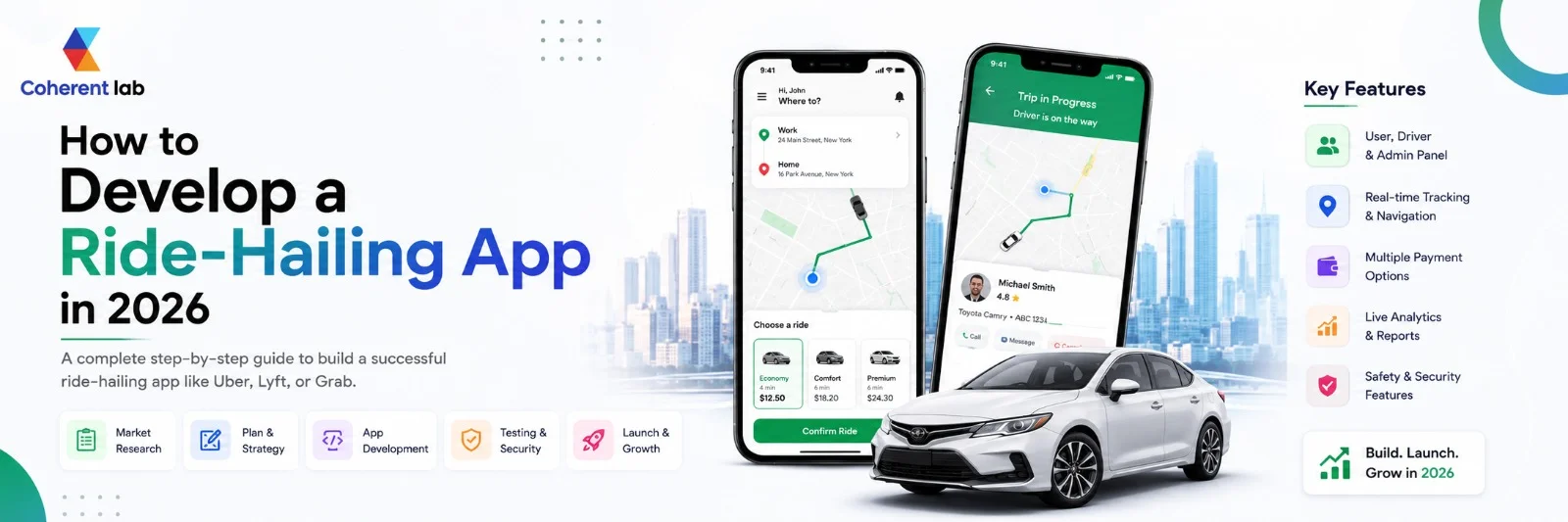
The ride-hailing industry has transformed the way people travel by making transportation faster, more convenient, and accessible through smartphones. From booking a taxi and tracking drivers to making cashless payments, modern ride-hailing apps provide a complete digital transportation experience. In 2026, businesses entering this market are going beyond basic booking functionality by integrating artificial intelligence, real-time analytics, smart route optimization, digital wallets, automated customer support, and advanced safety features.
If you are planning to develop a ride-hailing app like Uber, Lyft, Careem, or Bolt, understanding the development process is essential for building a scalable and profitable platform. This guide explains how to develop a ride-hailing app in 2026, including essential features, technology stack, development steps, monetization models, estimated costs, challenges, and AI-powered opportunities for launching a competitive transportation platform.
What Is a Ride-Hailing App and How Does It Work?
A ride-hailing app is a mobile platform that connects passengers with drivers through real-time technology. In Ride Sharing App Development, users can request rides, choose vehicle categories, view estimated fares, track drivers, make secure payments, and rate their experience. The backend manages driver matching, location tracking, pricing, payments, notifications, and trip data, while the rider app, driver app, and admin dashboard form the core platform.
How a Ride-Hailing App Works
- Ride booking: The passenger enters a pickup location, destination, and preferred ride category. The application calculates the estimated fare and displays available options.
- Driver matching: The backend identifies suitable nearby drivers based on location, availability, vehicle type, estimated arrival time, and other matching parameters.
- Real-time trip management: Once a driver accepts the request, both parties can view trip information, GPS location, route, and estimated arrival time.
- Payment and rating: After the trip ends, the customer pays through the selected payment method and can rate the driver while the platform records the transaction.
Why Develop a Ride-Hailing App in 2026?
Developing a ride-hailing app in 2026 offers businesses opportunities to enter the growing on-demand transportation market with differentiated services. Customers increasingly expect instant booking, transparent pricing, accurate tracking, multiple payment options, and personalized experiences. Meanwhile, AI and cloud technologies enable businesses to automate operations and improve efficiency. A well-designed ride-hailing platform can begin with one city and gradually expand into multiple locations, services, and transportation categories.
Key Opportunities in Ride-Hailing App Development
- Growing on-demand demand: Consumers increasingly prefer convenient transportation services that can be booked instantly from their smartphones.
- AI-driven operations: Artificial intelligence can help businesses predict demand, optimize routes, improve driver matching, detect fraud, and personalize customer experiences.
- Multiple revenue opportunities: Businesses can generate revenue through commissions, booking fees, subscriptions, premium rides, corporate transportation, and advertising.
- Scalable expansion: A cloud-based platform allows businesses to start with a specific city or niche and expand into additional regions as demand increases.
Also Read :- Top 10 Apps Like Grab in 2026
Essential Features of a Ride-Hailing App
The features of a ride-hailing app directly influence its usability, customer retention, operational efficiency, and competitive advantage. A complete platform normally requires separate functionality for passengers, drivers, and administrators. The MVP should focus on essential booking and transportation features, while advanced functionality can be introduced after launch. Features such as GPS tracking, fare estimation, secure payments, ratings, notifications, and driver verification are particularly important for creating customer trust.
Must-Have Ride-Hailing App Features
- Rider features: Registration, profile management, GPS location, destination search, fare estimation, ride booking, driver tracking, payment, ride history, ratings, promotions, and emergency assistance.
- Driver features: Driver registration, identity verification, document management, availability status, ride requests, navigation, trip management, earnings tracking, ratings, and incentives.
- Admin features: User management, driver management, ride monitoring, pricing controls, commission management, payment tracking, complaints, analytics, reports, and promotional management.
- Advanced features: Scheduled rides, multiple vehicle categories, digital wallets, corporate accounts, AI recommendations, loyalty programs, real-time demand analytics, voice assistance, and automated customer support.
How to Develop a Ride-Hailing App Step by Step
A successful ride-hailing application requires more than basic app development. Businesses need to combine market research, user experience design, backend architecture, real-time communication, location services, payment infrastructure, security, and continuous optimization. Experienced mobile app development services can help transform these requirements into a scalable platform. Starting with a focused MVP allows businesses to validate their model, understand user behavior, and improve the app before expanding.
Ride-Hailing App Development Process
- Define the business model and market: Identify the target customers, service area, competitors, ride categories, pricing strategy, commission structure, and regulatory requirements before development begins.
- Design the product: Create user flows and UI/UX designs for the rider app, driver app, and admin panel. The booking process should be simple, fast, and intuitive.
- Build and integrate the platform: Develop the mobile applications and backend while integrating maps, GPS, payment gateways, notifications, authentication, analytics, and other required APIs.
- Test, launch, and optimize: Perform functional, security, performance, location, payment, and load testing. Launch the MVP, collect feedback, monitor KPIs, and continuously improve the platform.
Best Technology Stack for Ride-Hailing App Development in 2026
Coherent Lab LLP helps businesses select and implement the right technology stack for ride-hailing applications, balancing performance, scalability, security, and development costs. The team can build solutions using native or cross-platform technologies based on project requirements. With expertise in real-time GPS, payment integration, notifications, and scalable backend systems, Coherent Lab LLP supports the development of reliable and user-friendly ride-hailing platforms.
Recommended Technology Stack
- Mobile development: Flutter or React Native can support cross-platform applications, while Swift and Kotlin are suitable choices for native iOS and Android development.
- Backend and database: Node.js, Python, Java, PostgreSQL, MongoDB, and Redis can support APIs, business logic, trip management, caching, and real-time application requirements.
- Cloud and real-time services: AWS, Google Cloud, or Microsoft Azure can provide scalable infrastructure, while WebSockets and cloud messaging can support real-time communication.
- Third-party integrations: Maps, navigation, payment gateways, SMS/OTP verification, push notifications, analytics, identity verification, and customer-support APIs can extend platform capabilities.
AI Features for a Ride-Hailing App in 2026
Artificial intelligence is becoming a key competitive advantage for modern mobility platforms. Businesses can integrate AI into pricing, matching, routing, customer service, fraud prevention, and demand forecasting. An experienced AI app development company can help build intelligent solutions that analyze real-time and historical transportation data, identify patterns, and support faster decisions. These capabilities improve operational efficiency while delivering a more personalized experience for both riders and drivers.
AI-Powered Ride-Hailing Features
- Intelligent driver-rider matching: AI can evaluate location, availability, estimated arrival time, trip history, and demand patterns to improve driver assignment and reduce passenger waiting times.
- Dynamic pricing and demand prediction: Machine-learning models can analyze demand, traffic, weather, events, and historical patterns to support more accurate pricing and driver allocation.
- Route and ETA optimization: AI can analyze traffic conditions and historical travel patterns to recommend efficient routes and improve estimated arrival times.
- AI customer support and fraud detection: AI assistants can handle common questions while intelligent systems can identify suspicious accounts, unusual transactions, fake bookings, and potentially fraudulent activity.
Also Read :- How to Develop a Taxi App Like Uber or Ola
How Much Does It Cost to Develop a Ride-Hailing App in 2026?
The cost of ride-hailing app development depends on application complexity, features, technology choices, development location, integrations, security requirements, and the size of the development team. A basic MVP with essential booking functionality generally costs less than a full-scale platform containing AI, multiple ride categories, corporate accounts, advanced analytics, and complex backend infrastructure. Businesses should also budget for cloud hosting, API charges, maintenance, security updates, and future improvements.
| App Type | Typical Features | Estimated Development Cost |
|---|---|---|
| Basic MVP | Booking, GPS, driver matching, payments, basic admin panel | $20,000–$40,000 |
| Medium-Level App | Advanced tracking, multiple payment options, promotions, analytics | $40,000–$80,000 |
| Advanced Platform | AI integration, advanced analytics, multiple ride types, automation | $80,000–$150,000+ |
Also Read : - How Much Does Taxi App Development Cost in 2026
How Long Does It Take to Build a Ride-Hailing App?
Development time depends on the scope and complexity of the platform. A basic MVP can generally be developed faster than a large-scale application requiring sophisticated AI, real-time analytics, multiple integrations, and complex administrative functionality. Businesses should prioritize core functionality first and add advanced capabilities through later development phases. A clear product roadmap can reduce unnecessary development time and help teams launch a functional product sooner.
Ride-Hailing App Development Timeline
- Planning and research: Business analysis, competitor research, technical planning, requirements gathering, and MVP definition may take several weeks.
- UI/UX design: User journeys, wireframes, prototypes, visual design, and usability improvements are developed for rider, driver, and admin interfaces.
- Development: Mobile applications, backend systems, APIs, databases, dashboards, GPS tracking, payment systems, and notifications are implemented.
- Testing and launch: QA testing, security testing, performance testing, bug fixing, deployment, monitoring, and post-launch optimization complete the initial development cycle.
Also Read :- Must-Have Features of a Top Taxi Booking App
How Does a Ride-Hailing App Make Money?
A ride-hailing business can use multiple monetization strategies rather than depending on a single revenue source. The most common model involves taking a commission from each completed ride. However, businesses can diversify revenue through booking fees, subscriptions, premium transportation services, corporate accounts, advertising, and partnerships. Selecting the right monetization model depends on the target market, customer behavior, competitive environment, and operating costs.
Ride-Hailing App Monetization Models
- Driver commission: The platform receives a percentage of the fare generated from every completed ride.
- Booking and service fees: Customers can pay additional platform or booking fees depending on the service and market.
- Subscriptions and memberships: Frequent riders can receive discounts or benefits through monthly or annual subscription plans.
- Premium and B2B services: Businesses can generate additional revenue through luxury rides, airport transfers, corporate transportation, advertising, and partnerships.
How to Make a Ride-Hailing App Successful?
Launching an application is only the beginning of building a successful ride-hailing business. With reliable Android app development company, businesses can create smooth experiences for riders and drivers while maintaining a balance between demand and supply. The platform should offer competitive driver earnings, transparent policies, real-time tools, and dependable performance. Starting in a focused geographic market helps businesses optimize operations, measure results, and expand confidently.
Strategies for Long-Term Growth
- Start with one market: Launching in a focused city or region allows businesses to understand local customer behavior and optimize operations before expanding.
- Build driver supply: Competitive commissions, incentives, flexible schedules, fast payments, and transparent policies can help attract and retain drivers.
- Improve customer experience: Fast booking, accurate ETAs, transparent fares, safety tools, responsive support, and reliable payments can increase customer retention.
- Use analytics for decisions: Monitor ride volume, cancellations, acquisition costs, retention, driver utilization, average booking value, and customer lifetime value.
Also Read :- How to Develop an App Like Porter: Cost, Features & Steps
Conclusion
Developing a ride-hailing app in 2026 requires a combination of strong technology, intuitive UX, reliable real-time infrastructure, secure payments, and a scalable business model. Businesses should begin with a focused MVP covering essential rider, driver, and admin features before adding advanced AI, automation, and analytics. Development cost and timelines depend on complexity, integrations, technology stack, and team expertise. By prioritizing customer experience, driver satisfaction, safety, and data-driven decisions, businesses can build a platform designed for sustainable growth.
If you are planning your ride-hailing app, Talk to Our Experts to discuss your idea, features, technology, and development roadmap.
Frequently Asked Questions
Q.1. How much does it cost to develop a ride-hailing app in 2026?
Ans. The cost depends on features, technology, development location, integrations, security requirements, and application complexity. A basic ride-hailing MVP may cost around $20,000–$40,000, while a medium-level application can range from $40,000–$80,000. Advanced platforms with AI, sophisticated analytics, multiple ride categories, and enterprise functionality can exceed $80,000. A detailed feature and technical specification is required for an accurate project estimate.
Q.2. How long does it take to develop a ride-hailing app?
Ans. A basic ride-hailing MVP can take several months, depending on the development team's size, technical complexity, design requirements, integrations, and testing scope. A larger platform with advanced AI, real-time analytics, multiple applications, and complex backend functionality can require significantly more time. A phased development strategy is generally recommended because businesses can launch core functionality first and introduce advanced features through subsequent development releases.
Q.3. What features should a ride-hailing app have?
Ans. A ride-hailing app should include essential features for riders, drivers, and administrators. Rider functionality should include registration, GPS, destination selection, fare estimation, booking, tracking, payments, ride history, ratings, and support. Drivers need onboarding, verification, availability, ride requests, navigation, earnings, and trip management. The admin panel should provide user management, driver management, ride monitoring, pricing, payments, analytics, reports, and customer support tools.
Q.4. How does a ride-hailing app make money?
Ans. Ride-hailing applications commonly generate revenue by charging a commission on completed rides. However, businesses can diversify their revenue through booking fees, service charges, subscriptions, premium transportation, corporate transportation, advertising, and strategic partnerships. The most suitable monetization strategy depends on the target market and business model. Combining multiple revenue streams can reduce dependence on ride commissions and create additional opportunities for long-term profitability.
Q.5. What technology is used to build a ride-hailing app?
Ans. A modern ride-hailing application can use Flutter or React Native for cross-platform mobile development, or Swift and Kotlin for native applications. Backend technologies may include Node.js, Python, or Java, with PostgreSQL, MongoDB, or Redis supporting data requirements. Cloud platforms such as AWS, Google Cloud, or Azure provide scalable infrastructure. Maps, payment, notification, authentication, analytics, and real-time communication APIs complete the technology ecosystem.
Q.6. How can AI improve a ride-hailing app?
Ans. AI can improve ride-hailing platforms by optimizing driver-rider matching, predicting transportation demand, supporting dynamic pricing, optimizing routes, improving estimated arrival times, detecting fraud, and automating customer service. Machine-learning models can analyze historical and real-time data to identify patterns and make operational recommendations. AI-powered support can also answer common customer questions quickly, reducing pressure on human support teams and improving overall service efficiency.
Q.7. How do I build an app like Uber?
Ans. To build an app like Uber, start by defining your target market, transportation category, business model, and MVP requirements. Develop three primary components: rider application, driver application, and admin dashboard. Integrate GPS, maps, navigation, payments, notifications, authentication, and real-time communication. After testing the MVP, launch in a focused market, measure user behavior, improve operations, and gradually introduce advanced capabilities such as AI, subscriptions, corporate accounts, and predictive analytics.
Q.8. What is the best way to reduce ride-hailing app development costs?
Ans. The most effective approach is to launch an MVP instead of developing every feature at once. Prioritize essential functions such as registration, booking, driver matching, GPS tracking, payments, notifications, and administration. Cross-platform development can also reduce the effort required to maintain separate mobile codebases. Using scalable cloud services and established APIs can reduce infrastructure complexity. After launch, businesses can invest in advanced features based on customer feedback and measurable demand.

 +91 774-202-1725
 +1 (945) 3387904
 business@coherentlab.com
 +49 15223341304
 UK
UK