
Table of Contents
Spec-Driven Development: Turning Business Requirements Into AI-Assisted Software
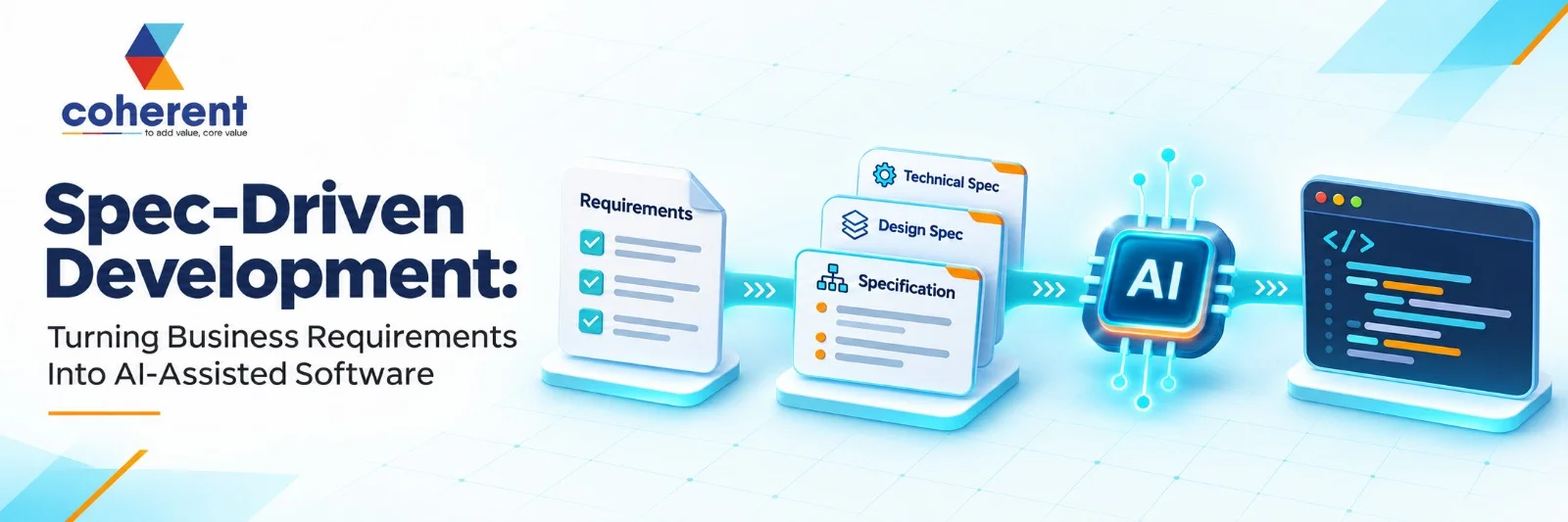
Software development is changing as artificial intelligence becomes an integral part of how applications are planned, built, and tested. However, generating code quickly does not always mean building the right product. Unclear requirements, changing expectations, and communication gaps can still create expensive development challenges.
Spec-Driven Development (SDD) addresses these problems by converting business requirements into structured specifications before implementation begins. These specifications guide developers and AI coding assistants through planning, code generation, testing, and validation. By combining clear business objectives with AI-assisted software development, organizations can build applications that better reflect their functional requirements and long-term goals.
Quick Answer
Spec-Driven Development is a software engineering approach in which structured specifications guide the entire development process. Business requirements are translated into functional and technical instructions that AI coding assistants and developers use to plan, generate, test, and validate software. This approach helps maintain alignment between business objectives and actual software behavior with Coherent Lab.
Key Takeaways
- SDD uses structured specifications as the foundation of software implementation.
- AI coding assistants help translate technical instructions into working code.
- Clear acceptance criteria improve alignment between business expectations and software functionality.
- Automated testing helps verify whether implementation matches documented requirements.
- Human supervision remains essential for security, architecture, and quality assurance.
- Version-controlled specifications support ongoing software maintenance.
- Businesses can use SDD for new applications, existing products, and software modernization.
What Is Spec-Driven Development and How Does It Work?
Spec-Driven Development is a methodology that makes software specifications central to the development lifecycle. It defines what an application should accomplish, how its functionality should behave, and how its success will be evaluated. Rather than treating documentation as a secondary activity, teams use specifications as a shared reference for developers, stakeholders, and AI coding tools. As AI Is Changing Software Development, this approach helps teams maintain clarity, consistency, and alignment throughout the development process.
Understanding the Meaning of Spec-Driven Development
In traditional workflows, developers may begin implementation using requirement documents, meetings, or informal instructions. In SDD, requirements are refined into structured specifications before coding. These specifications provide AI agents with context about expected functionality, constraints, workflows, and acceptance criteria, reducing ambiguity during implementation.
How Is Spec-Driven Development Different From Traditional Development?
Traditional software development often separates requirements documentation from implementation and testing. Spec-Driven Development connects these activities through a continuously maintained specification. AI-assisted implementation follows documented expectations, while testing checks whether the resulting software satisfies the original requirements.
What Are the Core Components of a Software Specification?
A comprehensive software specification describes the expected behavior, technical constraints, and measurable outcomes of an application. It gives development teams and AI systems sufficient context to make implementation decisions while maintaining consistency across different features and development stages.
- Business objectives and project scope.
- Functional and non-functional requirements.
- User stories and acceptance criteria.
- System architecture and API requirements.
- Security, performance, and scalability expectations.
Why Are Businesses Adopting AI-Assisted Spec-Driven Development?
Businesses increasingly use AI to accelerate software engineering, but productivity depends on more than code generation. Teams need reliable ways to communicate requirements and validate results. Spec-Driven Development introduces a structured process that combines business planning, technical documentation, AI assistance, and human expertise to support more predictable software delivery and build custom software aligned with business requirements.
How Does It Connect Business Requirements With Software Development?
Business stakeholders describe their goals, user expectations, and operational challenges. These details are translated into functional requirements and technical specifications. Developers then use this shared information to implement features that address actual business needs rather than relying on assumptions or incomplete instructions.
Why Are AI Coding Assistants Changing Development Workflows?
AI coding assistants can support developers with code generation, debugging, refactoring, documentation, and test creation. When provided with structured specifications, these tools receive clearer instructions and project context. Developers can therefore spend more time reviewing solutions, addressing complex problems, and making important architectural decisions.
Which Business Problems Can Spec-Driven Development Solve?
SDD helps address common challenges associated with complex software projects. It creates a consistent reference for stakeholders and development teams, making it easier to identify missing requirements and manage implementation decisions.
- Unclear or incomplete project requirements.
- Frequent changes in development scope.
- Communication gaps between business and technical teams.
- Repeated implementation and testing cycles.
- Inconsistent software functionality.
Statistics and Market Insights: How Is AI Changing Software Development?
AI adoption is influencing software engineering practices, but productivity gains depend on how organizations integrate these tools. Industry research highlights both the growing use of AI and the importance of effective development processes. These findings also relate to custom software vs off-the-shelf solutions, supporting the need for structured workflows that connect AI-generated output with business requirements, engineering standards, and measurable quality.
Important market areas to monitor include:
- AI adoption across software development teams.
- Growth of AI-assisted coding and testing.
- Enterprise investment in generative AI.
- Demand for secure and maintainable AI-generated software.
- Adoption of AI agents across engineering workflows.
What Are the Benefits of Spec-Driven Development?
Spec-Driven Development offers several benefits by establishing clear, structured requirements before implementation begins. It improves collaboration between business stakeholders, developers, and AI coding assistants while reducing misunderstandings during the development process. By connecting specifications with coding, testing, and documentation, teams can maintain better implementation consistency, identify gaps earlier, simplify future updates, and make AI custom software development more aligned with business objectives.
Key Benefits
- Helps developers understand project requirements before starting implementation.
- Reduces communication gaps between business stakeholders and technical teams.
- Enables AI coding assistants to generate code with better project context.
- Makes it easier to track requirements throughout the development lifecycle.
- Improves alignment between software functionality and business objectives.
- Simplifies testing by providing clear expectations and acceptance criteria.
- Supports future software updates through organized and reusable specifications.
How Does Spec-Driven Development Turn Business Requirements Into AI-Assisted Software?
The process begins with understanding business objectives and gradually transforms them into implementation-ready instructions. Each stage produces information that supports the next stage, helping AI tools work with relevant context. Software Development Companies can use this structured workflow to help developers review progress and verify whether the final application meets business expectations.
|
Step |
Short Description |
Key Activities |
|---|---|---|
|
1 |
Understand business objectives and project requirements before starting development. |
Define business goals, identify target users, establish project scope, and document essential features. |
|
2 |
Transform business requirements into clear and structured software specifications. |
Create requirement documents, define user stories, document functional requirements, and identify edge cases. |
|
3 |
Establish the technical architecture, technology stack, and measurable acceptance criteria. |
Design application architecture, plan databases and APIs, and define security and performance requirements. |
|
4 |
Use AI coding assistants to generate, implement, and refine software components. |
Select AI tools, provide structured instructions, generate code, and review AI-generated outputs. |
|
5 |
Test the developed software to ensure it meets documented specifications and quality standards. |
Perform unit and integration testing, validate features, check security, and resolve errors. |
|
6 |
Keep specifications updated and continuously improve software based on changing requirements. |
Update documentation, maintain version history, incorporate feedback, and revalidate software. |
Step 1: Identify Business Goals and Project Requirements
Begin by understanding the business problem, project objectives, and user expectations. Discuss requirements with stakeholders to establish a clear direction for software development. This ensures that AI-assisted development focuses on solving actual business needs.
- Define business goals and expected outcomes.
- Identify target users and their requirements.
- Establish project scope, priorities, and constraints.
- Document essential features and workflows.
Step 2: Convert Requirements Into Structured Specifications
Convert business requirements into detailed technical specifications that clearly describe how the software should function. Organize expectations into structured documentation so developers and AI coding assistants can understand implementation needs, workflows, and expected application behavior.
- Create detailed software requirement documents.
- Define user stories and business rules.
- Document functional and non-functional requirements.
- Identify edge cases and expected system behavior.
Step 3: Define Technical Architecture and Acceptance Criteria
Establish a technical roadmap that explains how the software will be designed and implemented. Define the architecture, technology stack, integrations, and measurable acceptance criteria to ensure development decisions align with business requirements and technical expectations.
- Define application architecture and technology stack.
- Plan database structures and API integrations.
- Establish security and performance requirements.
- Create measurable acceptance criteria for features.
Step 4: Use AI Tools to Generate and Implement Code
Use AI coding assistants such as GitHub Copilot, Cursor, and Claude Code to translate approved specifications into working software components. Provide clear instructions and review generated outputs to maintain code quality, consistency, and alignment with the technical architecture.
- Select suitable AI coding assistants.
- Provide structured specifications and implementation instructions.
- Generate code, APIs, and application components.
- Review and refine AI-generated code.
Step 5: Validate Software Against the Specifications
Evaluate the developed software against documented requirements and acceptance criteria. Combine automated testing with manual reviews to identify functional issues, integration errors, security vulnerabilities, and performance gaps before approving features for deployment.
- Perform unit and integration testing.
- Validate features against acceptance criteria.
- Check security, performance, and functionality.
- Identify and resolve implementation gaps.
Step 6: Update Specifications and Improve the Software
Keep technical specifications aligned with software updates, changing business requirements, and user feedback. Maintain documentation and version history to support continuous improvements, simplify future development, and ensure AI-assisted implementation remains consistent with evolving project needs.
- Update specifications whenever requirements change.
- Maintain documentation and version history.
- Incorporate user feedback and new features.
- Revalidate software after every major update.
Spec-Driven Development vs. Traditional and AI-Driven Development
Different software development approaches offer different levels of structure, automation, and human involvement. Understanding their differences helps organizations select a workflow that matches project complexity and business objectives. Software Development Predictions also highlight the growing importance of combining structured planning, AI-assisted implementation, and human expertise rather than depending entirely on manual coding or unstructured prompts.
|
Comparison Factor |
Traditional Development |
AI-Driven Development |
Spec-Driven Development |
|---|---|---|---|
|
Starting Point |
Requirements and planning |
Prompts and instructions |
Structured specifications |
|
Implementation |
Primarily manual |
AI-assisted |
Specification-guided AI assistance |
|
Documentation |
Maintained separately |
May depend on prompts |
Central to development |
|
Testing |
Developer-led |
AI-assisted or manual |
Specification-based validation |
|
Human Involvement |
High |
Essential |
Essential |
|
Requirement Tracking |
Project documentation |
May be inconsistent |
Structured and traceable |
Which Development Approach Should Businesses Choose?
Traditional development can suit projects requiring established manual workflows, while AI-driven development supports rapid experimentation. Spec-Driven Development is particularly useful when requirements are complex, multiple stakeholders are involved, and teams need consistent documentation and validation throughout implementation.
Conclusion
Spec-Driven Development is changing how businesses approach software engineering by connecting business requirements with structured technical specifications and AI-assisted implementation. It helps teams establish clearer expectations, improve collaboration, and validate application functionality throughout the development lifecycle.
As AI-assisted software engineering evolves through 2026 and 2027, specification-first workflows can provide a practical foundation for building maintainable, scalable, and business-focused applications. Businesses that combine clear specifications with AI capabilities and human expertise will be better positioned to manage software complexity and changing requirements. Talk to Our Experts
Frequently Asked Questions
Q1. What Is Spec-Driven Development in Software Engineering?
Spec-Driven Development is a software engineering methodology in which structured specifications guide the planning, implementation, and testing processes. It defines business objectives, functional requirements, technical constraints, expected application behavior, and acceptance criteria. These specifications provide developers and AI coding assistants with clear instructions, helping ensure that software implementation aligns with project expectations, technical standards, and business goals.
Q2. How Does Spec-Driven Development Work With AI Coding Assistants?
Spec-Driven Development provides AI coding assistants with structured information about business requirements, application architecture, workflows, and expected functionality. Tools such as GitHub Copilot, Cursor, and Claude Code use this context to support code generation, debugging, and testing. Developers review the generated output, validate its accuracy, and make necessary improvements to ensure alignment with technical standards and project requirements.
Q3. What Is the Difference Between Spec-Driven Development and Vibe Coding?
Vibe coding focuses on describing software ideas through conversational prompts and generating code through iterative interactions with AI tools. Spec-Driven Development follows a structured approach by documenting requirements, technical architecture, implementation plans, and acceptance criteria. While both approaches use AI assistance, spec-driven development provides greater documentation, consistency, traceability, and control, making it particularly useful for complex applications and collaborative projects.
Q4. How Do You Convert Business Requirements Into Technical Specifications?
Start by identifying business objectives, target users, operational challenges, and expected software outcomes. Translate these details into structured user stories, functional requirements, business rules, and non-functional requirements. Next, document application architecture, database requirements, integrations, and technical constraints. Establish measurable acceptance criteria to help developers and AI coding assistants implement and validate features accurately throughout the software development lifecycle.
Q5. Which AI Tools Are Best for Spec-Driven Software Development?
Several AI tools support spec-driven software development, depending on project requirements and development workflows. GitHub Copilot, Cursor, Claude Code, and OpenAI Codex assist with code generation, debugging, and implementation tasks. GitHub Spec Kit also supports structured specification workflows. Businesses should evaluate programming language compatibility, repository context, security capabilities, integrations, and developer preferences before selecting suitable tools.
Q6. Can Spec-Driven Development Reduce Software Development Costs?
Spec-Driven Development can help reduce avoidable development expenses by identifying unclear requirements, minimizing implementation errors, and improving communication between stakeholders and developers. Structured specifications also support more efficient testing and maintenance. However, actual cost savings depend on project complexity, documentation quality, team experience, and development practices. Businesses should balance initial planning investments against potential long-term efficiency improvements.
Q7. Is Spec-Driven Development Suitable for Startups and Enterprise Applications?
Yes, Spec-Driven Development is suitable for both startups and enterprise software projects. Startups can use structured specifications to clarify product requirements, prioritize essential features, and build minimum viable products. Enterprises can apply the methodology to manage complex architectures, integrations, security expectations, and compliance requirements. The documentation process should remain proportional to project complexity, available resources, and business objectives.
Q8. How Can Businesses Ensure the Quality and Security of AI-Generated Code?
Businesses can maintain AI-generated code quality through structured development standards, human code reviews, and continuous testing. Implement automated unit, integration, functional, and security tests to identify potential issues. Protect sensitive information, review third-party dependencies, and validate generated code against acceptance criteria. Additionally, use controlled deployment processes and ongoing monitoring to maintain application reliability, security, and performance.

 +91 774-202-1725
 +1 (945) 3387904
 business@coherentlab.com
 +49 15223341304
 UK

